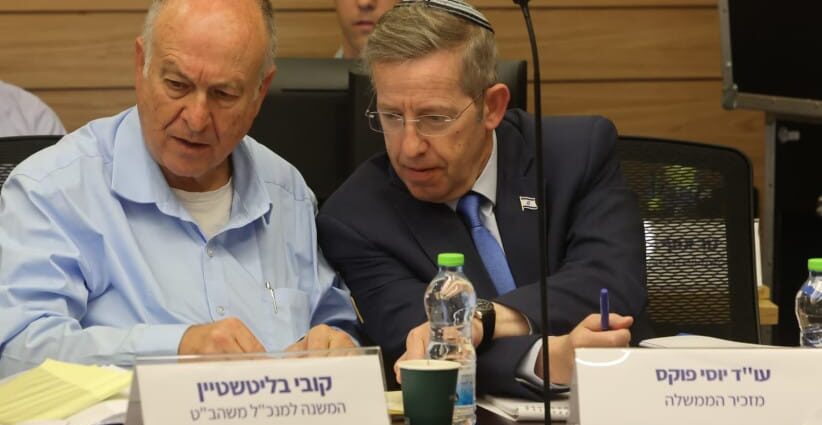
Head of the IDF’s personnel planning branch, Brig.-Gen. Shai Tayeb warned of severe manpower shortages in the IDF, and tens of thousands of draft evaders, as debates to advance the controversial haredi (ultra-Orthodox) draft bill resumed early Wednesday morning in the Knesset’s Foreign Affairs and Defense Committee.
The renewed dissensions came amid the crisis in Prime Minister Benjamin Netanyahu’s coalition with the ultra-Orthodox parties over the legislation.
Representing the IDF’s stance, Tayeb said there was a need for 12,000 soldiers to fill the manpower gap. He also said that ahead of January 2027, when the first soldiers who enlisted for only 30 months of service will be discharged, this gap is expected to widen to around 17,000 soldiers.
While he added that the number of recruits is also rising due to some sanctions placed on draft evaders, he said that there is a” serious” amount of the population avoiding service.
“We are soon expected to reach around 80, 000- 90,000 draft evaders,” Tayeb told the panel.
Tayeb also noted that no updated outline of the draft bill was published or given to lawmakers ahead of the committee meeting. The committee discussed two bills in preparation for their second and third readings: the haredi draft bill and a separate bill extending mandatory military service from about 30 months to 36 months.
Haredi draft bill debates resume ahead of Knesset dissolution vote amid coalition crisis
Advancement on the draft legislation had been halted for months, but resumed directly before the bill to dissolve the Knesset was scheduled to be brought forward for its preliminary reading in the plenum in the afternoon.
Pushing to move forward with the draft bill is seen as Netanyahu’s final effort to persuade the haredi parties not to vote in favor of dissolving the Knesset, which would begin the process of moving the election date up slightly from October 27.
The coalition tensions began on Tuesday last week after Netanyahu told the haredi parties that the draft legislation did not currently have enough support within the coalition to pass. This led the parties – Shas and United Torah Judaism – to push for the Knesset to be dissolved.
There are numerous reports that the haredi parties are seeking to set the election date in September, ahead of the High Holy Days, to increase haredi voter turnout.
Netanyahu reportedly opposed the move and instead sought to keep elections in late October, allowing the coalition more time to advance legislation during the Knesset’s final session and potentially achieve military goals.
Despite plans to resume advancing the draft bill, Degel Hatorah faction spiritual leader Rabbi Dov Lando and MK Moshe Gafni reconvened on Sunday evening and stated that their position in favor of dissolving the Knesset remained unchanged.
This means the election date could be moved up to either September or mid-October.
The coalition has fast-tracked several controversial bills this week, scheduling marathon committee meetings to advance as much legislation as possible ahead of a potential Knesset dissolution.
Deputy Foreign Minister Sharren Haskel (New Hope-United Right) told The Jerusalem Post on Sunday that coalition lawmakers were under “massive pressure” from Netanyahu’s coalition to support the haredi draft legislation. She added that one of the aspects of the pressure was the threat to “publicly shame Likud members who vote against the law.”
Deputy Foreign Minister Sharren Haskel (New Hope-United Right) told The Jerusalem Post on Sunday that coalition lawmakers were under “massive pressure” from Netanyahu’s coalition to support the haredi draft legislation. She added that one of the aspects of the pressure was the threat to “publicly shame Likud members who vote against the law.”
A separate Likud coalition source familiar with the matter also told the Post that throughout the weekend, the Prime Minister’s Office had been counting coalition lawmakers expected to support the conscription bill while holding talks aimed at securing a majority.
Opposition leader Yair Lapid vowed on Monday that any Likud MKs who support the haredi draft bill due to pressure from Netanyahu “will not fall under the radar.”
“We will buy billboards all across the State of Israel, and if you support this law, on every corner of the country there will be a sign with your face on it, and underneath it will be written: ‘Supported draft evasion from the IDF during wartime,’” Lapid said.
Highly controversial bill, which critics say is intended to appease ultra-Orthodox factions
The haredi draft bill being advanced in the Knesset’s Foreign Affairs and Defense Committee remains highly controversial. Critics argue that the legislation is primarily intended to appease the haredi parties in Netanyahu’s coalition and would do little to increase enlistment. A group of coalition MKs has vowed not to vote for it for that reason.
Haredi party leaders have pushed for legislation that would not increase ultra-Orthodox enlistment.
The committee is set to discuss two bills in preparation for their second and third readings: the haredi draft bill and a separate bill extending mandatory military service.
The IDF has repeatedly warned of an urgent manpower shortage, particularly after more than two years of war.
IDF Chief of Staff Lt.-Gen. Eyal Zamir warned in March that the military could soon collapse if there is no solution to the manpower shortage, saying in a cabinet meeting that he was raising “ten red flags” over the matter.