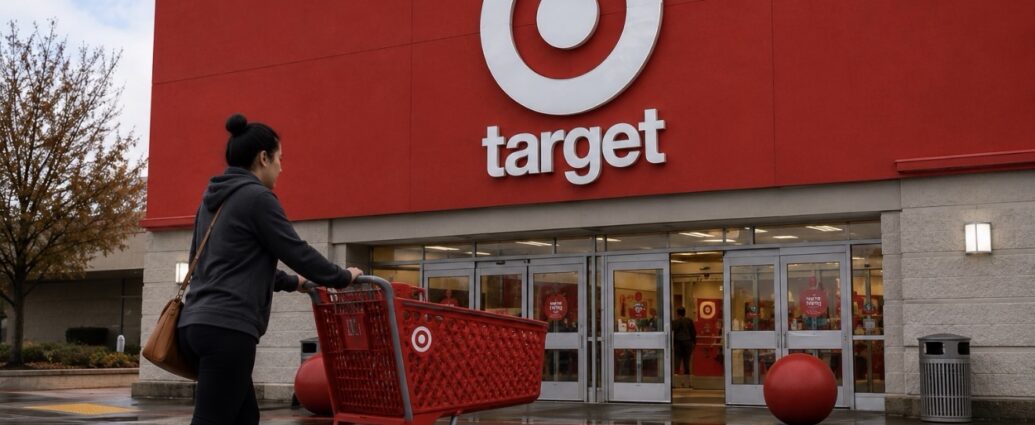
Target delivered a first-quarter result Wednesday that few on Wall Street expected, posting earnings per share of $1.71 against the $1.46 consensus estimate, revenue of $25.44 billion against expectations of $24.66 billion, and the company’s first positive comparable-sales quarter in more than a year.
Comparable sales rose 5.6%, store traffic increased 4.4%, and chief executive Michael Fiddelke raised the company’s full-year outlook for both revenue and earnings, signaling growing confidence that Target’s turnaround strategy is beginning to gain traction.
The surprise was not only the earnings beat but the breadth of the improvement. Target said sales increased across all six major merchandise categories, led by beauty, hardlines and food. Both digital and in-store traffic improved, and the gains were spread across geographic regions and demographic groups.
“First quarter financial results were stronger than expected, providing encouraging early signs that our clarified strategy is resonating with our guests and driving broad-based growth across our business,” Fiddelke said in the earnings release.
Speaking with analysts after the report, Fiddelke said the company is seeing consumers respond positively in categories where Target emphasizes “style, design, and value,” particularly across its private-label brands.
The company raised its full-year sales growth forecast to approximately 4%, double the roughly 2% growth guidance it issued earlier this year. Operating margin is now expected to exceed the 4.6% adjusted margin Target posted in 2025, while earnings per share are projected to land near the high end of the previously guided $7.50 to $8.50 range — above the $8.14 Wall Street consensus.
The results stand in sharp contrast to the broader narrative that the American consumer is slowing sharply. Lowe’s described the housing market this week as the weakest since the financial crisis, while home-improvement spending remains under pressure from elevated mortgage rates. Walmart has continued leaning aggressively on price competition. Home Depot has relied heavily on professional contractor demand.
Target, which had been viewed as the laggard among major big-box retailers for nearly two years, suddenly delivered numbers that looked far closer to Costco than to its own recent history.
Gross margin expanded to 29.0% from 28.2% a year earlier, helped by supply-chain efficiencies, higher advertising revenue from the company’s Roundel media business and lower markdown activity. Selling, general and administrative expenses also increased, which initially pressured the stock in premarket trading despite the earnings beat, though shares later stabilized.
Fiddelke’s strategy has focused heavily on repositioning Target around what management calls “busy families,” emphasizing private-label brands such as Cat & Jack, A New Day and Threshold while reducing less productive inventory categories.
The company has also continued prioritizing digital fulfillment, particularly same-day Drive Up services, which management sees as a major long-term growth driver.
The broader economic takeaway from the quarter is more nuanced than a simple retail rebound. Target’s customer base skews somewhat more affluent and suburban than the national average, and much of the strength came from discretionary categories such as beauty, apparel and home décor.
That reinforces the “split-economy” thesis that has increasingly defined corporate earnings over the last 18 months: higher-income consumers continue spending relatively freely, while lower-income households remain under pressure from inflation, housing costs and elevated borrowing rates.
For investors who had largely written off Target after five consecutive quarters of negative comparable sales, the earnings report marks the first meaningful evidence that Fiddelke’s turnaround strategy may be working.
The next challenge will come during the summer months, particularly if oil prices remain above $100 per barrel and rising gasoline costs begin to eat into discretionary household budgets.
Still, management’s decision to project sales growth in every quarter of 2026 suggests Target believes the momentum is durable rather than temporary.
JBizNews Desk
© 2026 JBizNews. All rights reserved.