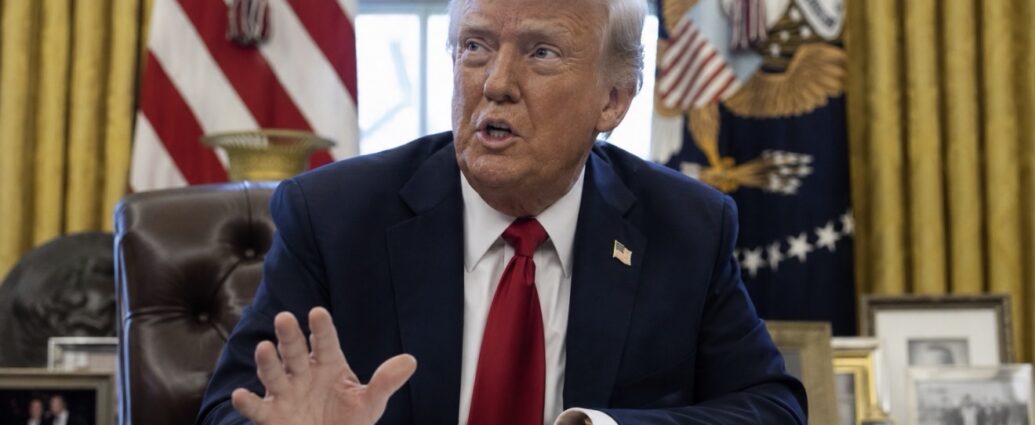
President Donald Trump abruptly postponed the signing of a long-anticipated executive order on artificial-intelligence oversight Thursday afternoon, telling reporters in the Oval Office that he yanked the order off his desk because he feared it could slow the United States in its race against China to dominate the technology.
“I didn’t like what I was seeing,” Trump told reporters during an unrelated event with Environmental Protection Agency Administrator Lee Zeldin, according to remarks confirmed by multiple outlets present in the room. “We’re leading China, we’re leading everybody, and I don’t want to do anything that’s going to get in the way of that lead. I really thought that could have been a blocker.”
The signing ceremony had been scheduled for later in the afternoon, and the White House had already sent invitations to executives from leading AI companies. Representatives from Anthropic, OpenAI, Google, xAI and major industry trade groups had been briefed earlier in the week on the contents of the order. Trump added that AI is “causing tremendous good” and reiterated that he did not want federal action to interfere with American competitiveness.
The shelved order would have established a voluntary government review process for so-called frontier AI models before public release, giving federal agencies a window of up to 90 days to evaluate the most powerful new systems for cybersecurity and national-security risks. The framework was reportedly modeled in part on the United Kingdom’s approach, which distributes safety responsibilities across multiple agencies, with the Treasury Department taking a lead role in a proposed clearinghouse for identifying and patching flaws in unreleased AI systems.
The trigger for the policy push, according to people briefed on the discussions, was the emergence of a new generation of cybersecurity-capable models — including Anthropic’s Mythos system, which the company has declined to release publicly because of its ability to identify and exploit software vulnerabilities at unprecedented speed. OpenAI has acknowledged that its newest system has similarly powerful capabilities. Both companies have been quietly partnering with banks, hospital systems and federal agencies to test defensive uses of the technology rather than open the models to the broader public.
The decision to pull the order marks a significant victory for the business-aligned wing of the Trump administration, led by White House AI and Crypto Czar David Sacks, the venture capitalist and Craft Ventures founder who has consistently pressed for a light federal touch on AI development. Sacks has argued publicly that heavy compliance regimes would crush smaller AI startups and that the United States needs a single national framework rather than a patchwork of rules. In December, Trump signed a separate executive order directing the Justice Department to challenge state-level AI laws deemed onerous to the industry — an order Sacks helped shape.
For the AI industry, the postponement removes — for now — what would have been the most significant federal oversight measure since the administration revoked former President Joe Biden’s 2023 AI executive order on its first day in office. That earlier Biden directive had required leading AI developers to share safety test results with the federal government. Since then, the Trump administration’s posture has been almost exclusively pro-deployment, including scrapping the so-called AI Diffusion framework on chip exports and announcing the Stargate infrastructure project alongside OpenAI and partners.
The reversal also lands in a sensitive market moment. Investors had been watching the planned order closely because of its potential impact on Nvidia, the dominant supplier of graphics processors used to train frontier models, as well as on Meta Platforms, Alphabet and Microsoft, all of which have heavy exposure to the pace of AI model releases. A mandated pre-release review window of up to 90 days would have lengthened product cycles across the ecosystem and complicated the open-weight release strategy that Meta has used for its Llama family of models.
Critics inside the administration’s own coalition had pushed back hard in recent days. Parts of the MAGA movement that distrust large technology companies argued that any voluntary federal framework, even one rooted in cybersecurity, would calcify into a regulatory regime that favors incumbents over smaller competitors. Sacks himself faced renewed scrutiny in December over ethics waivers tied to more than 400 investments his firm holds in technology companies with AI exposure, a controversy that has shadowed his role in shaping the now-delayed order.
A White House spokesperson, asked for further comment on the timing or substance of the postponement, referred reporters to Trump’s public remarks. The president did not give a new target date for the signing, and it remains unclear whether the order will be reworked, narrowed to focus strictly on cybersecurity, or shelved entirely. The order has already been pushed back several times since planning began earlier this spring.
For now, the message from the Oval Office is the one that Silicon Valley wanted to hear: federal Washington is once again standing aside while the largest AI labs continue to set the pace.
© 2026 JBizNews. All Rights Reserved. Reproduction or distribution without written permission is prohibited.