By JBizNews Desk
NEW YORK, May 24, 2026 — The man responsible for managing the retirement savings of millions of Canadians just delivered one of the clearest warnings yet about the artificial-intelligence stock boom driving global markets higher.
John Graham, chief executive of CPP Investments, said Thursday that he is increasingly concerned U.S. equity markets have become too concentrated around a small group of artificial-intelligence winners whose valuations may be running ahead of business fundamentals.
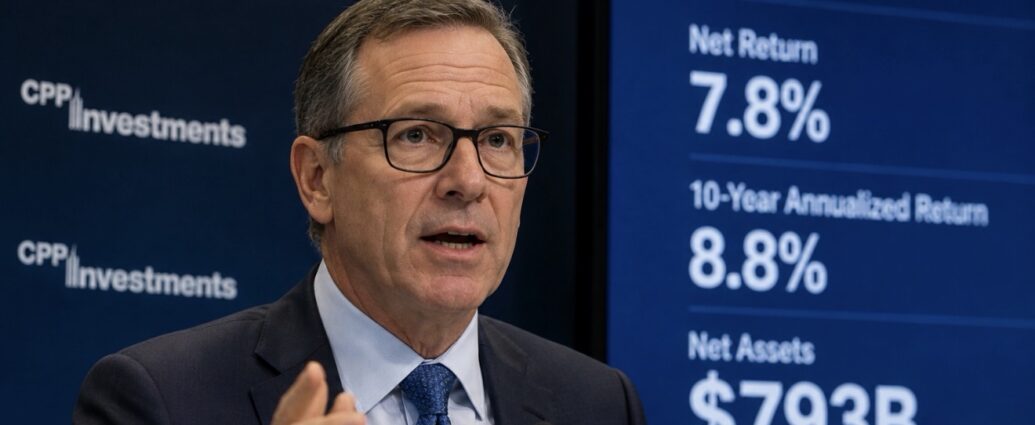
The comments came as CPP Investments reported strong annual results. The pension giant, one of the world’s largest institutional investors, said assets climbed to approximately $793 billion, generating a 7.8% net annual return and an 8.8% annualized return over the past decade.
Most pension executives would have used the moment to celebrate performance.
Graham instead used it to caution investors.
He said CPP Investments remains “knowingly underweight” artificial-intelligence exposure within its U.S. equity portfolio because of what he described as growing concentration risk surrounding the market’s largest technology companies.
That stance has carried a cost.
The so-called Magnificent Seven technology stocks — including Nvidia Corp., Microsoft Corp., Amazon.com Inc., Meta Platforms Inc., and other AI-linked megacaps — have continued powering indexes toward record highs throughout 2026, leaving more defensive institutional investors trailing benchmark performance.
Graham acknowledged the underweight position has been “super painful” while markets continue rallying.
But he also framed the AI debate in unusually direct terms for a pension-fund chief executive.
“Technology can change the world and be overvalued,” Graham said. “It can be both.”
The statement captures the increasingly uncomfortable tension sitting underneath the AI boom now dominating global markets. Many institutional investors believe artificial intelligence will fundamentally reshape industries, corporate productivity, and economic growth over the next decade. The question is whether current stock prices already assume too much future success too quickly.
Graham said the fund is not attempting to predict a market crash or call the top of the AI cycle. Instead, CPP is positioning itself around uncertainty.
“We actually don’t know” whether a bubble is forming, he said.
That uncertainty has shaped how the Canadian pension giant is allocating capital. Rather than aggressively chasing the highest-profile AI software and semiconductor names, CPP Investments has increasingly focused on what Graham described as the “picks and shovels” behind the AI buildout — infrastructure assets such as power systems, energy generation, data centers, land, cooling systems, and transmission capacity.
The strategy reflects a broader institutional shift now emerging among some of the world’s largest long-term investors.
Regardless of which AI platforms ultimately dominate, the underlying infrastructure powering artificial intelligence is expected to require enormous amounts of electricity, computing capacity, physical real estate, and network connectivity. Pension funds increasingly view those assets as more stable and less dependent on speculative equity valuations.
Several major global retirement systems are now signaling similar concerns.
Australia’s Aware Super, which manages roughly A$210 billion, recently warned about “orange lights” appearing inside portions of the AI financing ecosystem, particularly around circular funding arrangements in which companies indirectly finance demand for each other’s services.
AustralianSuper, one of the country’s largest pension managers, has also indicated plans to reduce portions of its global equity exposure heading into the second half of 2026.
The caution stands in sharp contrast to broader market momentum.
The Dow Jones Industrial Average closed at a record high Thursday above 50,000. The S&P 500 remains near historic highs, driven largely by continued investor enthusiasm surrounding AI-related spending and earnings growth.
At the same time, valuation measures are becoming increasingly stretched.
The S&P 500’s cyclically adjusted price-to-earnings ratio, one of Wall Street’s longest-running valuation gauges, has climbed toward levels historically associated with elevated future downside risk. Several prominent investors and policymakers have begun publicly discussing bubble conditions.
Federal Reserve Governor Lisa Cook recently warned she would not be surprised by “outsized asset price declines” if investor expectations eventually disconnect from economic fundamentals.
Bridgewater Associates founder Ray Dalio has similarly described artificial intelligence as being in the “early stages of a bubble,” comparing current investor enthusiasm to earlier periods of speculative excess.
Still, there remains a strong bullish argument supporting current valuations.
Artificial-intelligence spending has become one of the most powerful growth engines inside the U.S. economy. Analysts estimate AI-related capital expenditures contributed materially to U.S. GDP growth throughout 2025, while many of the companies leading the boom continue posting exceptionally strong revenue and profit expansion.
Unlike portions of the late-1990s dot-com bubble, today’s dominant AI companies are already highly profitable businesses generating enormous cash flow.
The debate, increasingly, is not whether AI changes the world.
It is whether the stock market has already priced in too much of that transformation too early.
That distinction explains why pension funds like CPP Investments are becoming more selective even while remaining invested overall. Graham and others are not abandoning markets. They are quietly shifting exposure toward assets they believe can survive multiple economic scenarios rather than relying entirely on continued multiple expansion in a handful of technology giants.
For long-duration investors managing retirement liabilities decades into the future, protecting against concentration risk matters more than outperforming over a single quarter or year.
And that may be the deeper message behind Graham’s warning.
The institutions with the longest investment horizons in the world are becoming more cautious precisely as public-market optimism reaches its highest levels.
That gap between rising market euphoria and increasingly defensive pension positioning is becoming one of the defining stories underneath the AI rally itself.
JBizNews Desk
© 2026 JBizNews. All Rights Reserved. Reproduction or distribution without written permission is prohibited.