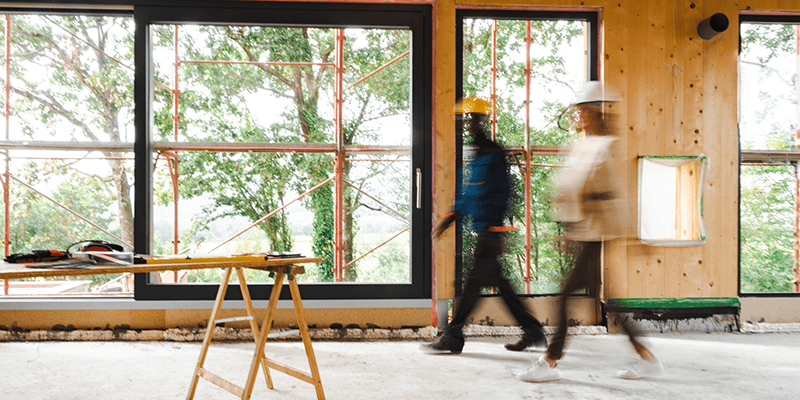
What does it take to deliver one of the largest cross-laminated timber (CLT) warehouses under construction in the U.S.? A powerhouse panel at I.CON East this week in Jersey City, New Jersey, broke down the strategy behind a 2.4 million-square-foot, robotics-ready distribution facility. The panelists shared how collaboration across the capital stack is redefining what’s possible in large-format industrial development.
Moderator Kelly Beaudreau-Hwang, RA, senior project manager/principal, BL Companies, led the discussion with panelists Clint Kehres, vice president of field operations, The Whiting-Turner Contracting Company, and Joseph Swain, AIA, LEED AP BD+C, associate principal, Mithun.
The trio worked together on the case study project in Texas, considered one of the largest mass timber warehouses in the U.S. It took the team a year from breaking ground to project delivery. Kehres and Swain both said they found the project to be a novel and rewarding experience.
“One of the biggest things that I took away from it was the amount of upfront coordination needed,” Kehres said. Whiting-Turner Contracting Company started holding mass timber coordination meetings with the mass timber contractor, the design team and the general contractor. The meetings quickly expanded to include contractors who worked on windows, structural steel, dock equipment and roofing.
“Pretty soon, every contractor on the project was in these mass timber coordination meetings; because the mass timber is part of the exterior wall and therefore part of the structure, everybody touches it,” Kehres said.
The warehouse itself consists of almost two miles of perimeter wall between 45 feet and 60 feet tall, Swain said. It has a cross-laminated timber skin that is three ply and four inches thick. “Everything is determined by the dock doors,” he said. “And you just have a ton of coordination between how those windows get inserted because the windows actually are part of also the cladding system, how the dock doors connect, how the wood connects to the steel.”
“I’ve worked in mass timber a lot, but I’m relatively new to using mass timber in an industrial application,” Swain said. He was able to apply his experience in managing coordination across mass timber project teams and his knowledge of industrial-specific components, such as dock doors.
“Every dock door represents money to the tenant of the building,” Beaudreau-Hwang said, making the amount of material between the doors a significant consideration in the design. “It’s crucial that we maintain a specific count of dock doors.”
“We did a lot of BIM modeling and clash detection right from the get-go because there were so many components that we had to think about in the exterior wall of this facility,” she said.
“All in all, everything came out and fit together well because we modeled everything so extensively at the front end,” Kehres added.
The 400-square-foot office block of the property is a fully mass timber structure that is integrated into the warehouse component, although it’s structurally separate. “That structure is fully mass timber post and beam CLT floors and roof,” Swain said, “and those solid walls are acting as shear for wind loads, so those are structurally integrated and anchored down into the foundation.”
The tenant’s corporate sustainability goals were the driving force behind using mass timber in this project, but the sustainability efforts did not stop there. The development team worked to minimize the carbon footprint of everything from the amount of concrete used for paving to the recycling of wood, steel, cardboard, concrete, asphalt and other materials diverted from a landfill.
A secondary driver for the client in using mass timber for this project was employee well-being and retention, with Beaudreau-Hwang noting the term “biophilia,” the innate desire for humans to be in touch with nature through our surroundings.
“The wood gives you a different kind of inner feeling versus the traditional warehouse where you’re just seeing steel, concrete and metal,” Beaudreau-Hwang said. Improving the employee experience in these buildings is a strong aspect of why this tenant considered going the CLT route, she said.
This facility operates around the clock with 1,000 employees in the building. Research shows that the use of these natural materials lowers stress levels of the people working inside, according to Beaudreau-Hwang. If that gives employees a little more satisfaction in their workplace and affects the retention rate year after year by a couple of percentage points, that would be considered a win for the tenant, she said.
“I’ve been working on industrial distribution facilities for the last 10 years now, and it was really fun to be on a project where we’re using some new materials and we’re exploring new ways to improve the look and feel of these buildings,” Beaudreau-Hwang said.
“That’s the feedback we get when we go into some towns where we’re trying to get approvals for warehouses where they don’t want just these big concrete boxes in their towns,” she said, “And finding new ways to put these buildings up and make them more interesting and more enjoyable to look at and to be inside is a very cool thing for us to start seeing more and more of in the industry.”

This post is brought to you by JLL, the social media and conference blog sponsor of NAIOP’s I.CON East 2026. Learn more about JLL at www.us.jll.com or www.jll.ca.