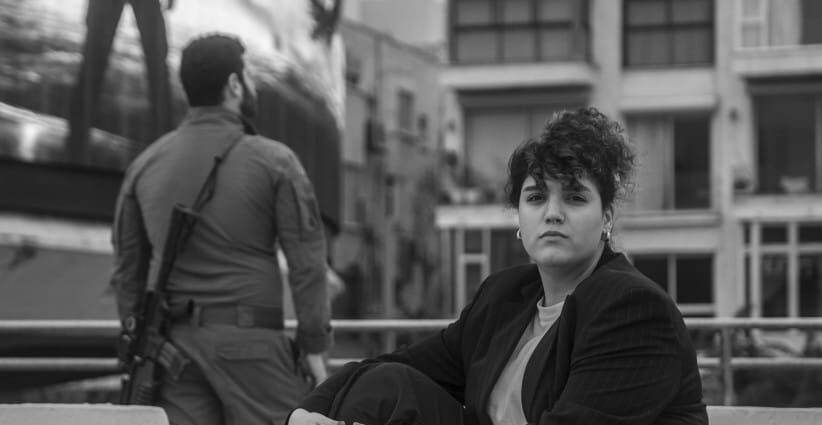
‘You wake up in the morning. You try to pass the day, and you wake up another day, and you try to make that day finish and last and be a bit better.”
These were the words of Neora, 32, as she reflected on how she has been coping during the two and a half years during which E., her partner (and now husband), has been fighting in active reserve duty.
Born in Afula, Neora met E., 29, while they were both studying at Ben-Gurion University of the Negev, five years ago. Neora was majoring in history and literature, while E. was getting a degree in math and computer science.
She said that from “almost the get-go,” she knew E. was very different from anyone she had ever met. And he felt the same way.
However, just two weeks into dating, Neora’s brother – her only sibling – died during active military service. Shocked by the sudden loss, Neora returned to her family’s home in Afula and stayed for three months. During that time, she and E. were in sporadic contact. While she says E. wanted to be there for her, on an emotional level, she was not able to think about dating.
“I did everything automatically,” she recalled. “Studying was suddenly very easy, because I didn’t have any anxiety. It disabled a lot of nerves that I had about everything else.”
Coping with a partner at battle
A week after she finally returned to Beersheba, E. sent her a text message, and they resumed dating.
While Neora said she knew she wanted to keep seeing him, she was still in mourning, and “everything felt very numb.”
“I think my spectrum of emotion was very limited. But at the same time, he was so understanding and so patient. I think if he weren’t that patient, I wouldn’t have been able to go through with it. He didn’t push anything. Everything was at my pace. Interaction was very slow. There was no pressure whatsoever.
“Because both of us was never in a serious relationships before this, the pace just gave us a lot of breathing room. And he was very mature and very understanding about the situation, which was very surprising to me.”
After she finished university, she remained in Beersheba another year with E., while he completed his studies.
It was during this period, on October 7, 2023, that the Hamas-led mass terrorist attacks occurred. “We were at home on Friday, the night before, hosting a Shabbat dinner for friends. I went to sleep, and then, at about 5 or 6 a.m., I kept hearing something that sounded like a whistle from the window.
“I told E., and he said it was just the wind coming from the window. Then I opened the window and could tell it wasn’t the wind. About 10 minutes later, we went outside to our hallway, and all our neighbors were on the stairway.”
Then came the alarms, and the videos of terrorists infiltrating the Gaza border communities. Neora especially remembers the recording of Ella Ben-Ami telling TV reporter Danny Kushmaro that her father [Ohad] had been kidnapped to Gaza.
“I just remember thinking: ‘This is not okay.’”
Just a few hours later, E., a paratrooper, left for reserve duty. The next day, he was in Be’eri, the kibbutz on the Gaza border that, at the time of his arrival, was still swarming with Hamas terrorists.
Since that day, E. has been in and out of reserve duty constantly. He has served on all fronts – Gaza, Lebanon, “everywhere there’s a war” – and just finished his fourth tour of duty a month ago. Neora hasn’t counted, but estimates that he has served 500 days, most likely more.
“For the first two years of the war, it was very intense. It was three months in, and he would come home for maybe 24 hours. I barely received calls from him. This last year, and this round specifically, was the easiest round we had. He left for eight days, then he came back for five days, which was amazing.”
How did she cope in the early days, with a partner at battle?
“You just do. You wake up in the morning. You try to pass the day, and you wake up another day, and you try to make that day finish and last and be a bit better, and you just move on. But the first week, I was very confused. I drove to Afula and back maybe five or six times, because I didn’t know what to do.”
Added to the already isolating experience of having a partner in the reserves was that she had already lost her brother in active service.
“I think it was 100% re-traumatizing. I kept imagining E.’s death. I kept reliving the military funeral and ceremonies, and everything that has to do with death when it comes to the army. I kept seeing people knock on my door, like they did with my brother.”
If she had to sum up her coping strategy in one word, it would be “function,” she said. “We tend to function really, really well when there are intense situations.”
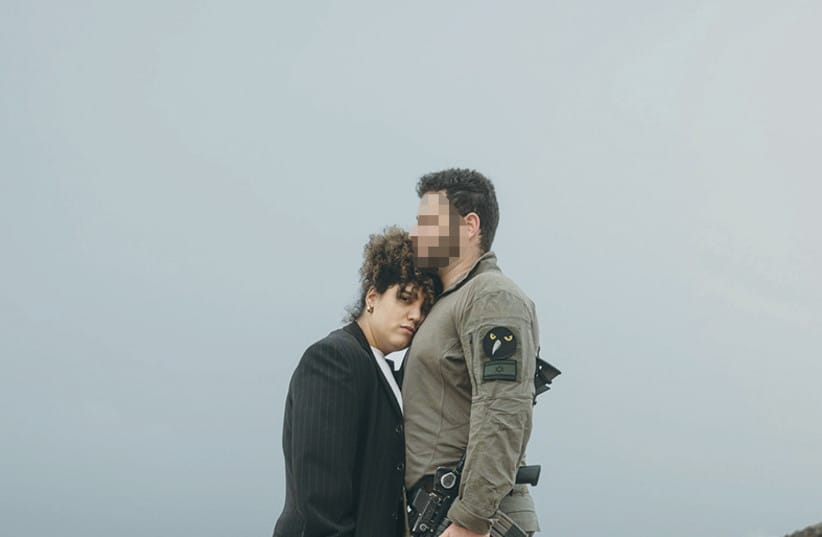
Coincidentally, for the last few years, E. was in reserves every time the couple moved, leaving her to tackle setting up the new nests.
“It was a good project. I built stuff, bought furniture, furnished the house, painted the walls, and did stuff around the house. I stopped thinking; just kept moving.
“Maybe for me and E., coping means just keeping busy. I don’t know if it’s the healthiest thing, but it is what it is.”
‘It’s really lonely. And you get angry, and you get frustrated’
Only during the last six months has the couple faced the cost of war on their partnership, Neora reflected.
“We realized what these long stints did to our relationship, to our intimacy, to everything that’s between us,” she said. “Now it’s sinking in. I think I understood how much E. has to give up, what I have to give up.
“And there is a price for all of that. Whether it’s trauma, whether it’s the relationship, whether it’s friend groups, whether it’s studying. I think it’s understanding that you have to function on 80% or 70% in almost every area in your life, if not less.”
Neora acknowledges that the war has put “a big strain” on their relationship. “It makes you feel distant,” she said, explaining that she has to make the “unnatural” switch between being detached – “because you’re not seeing that person because he’s in battle” – and then back to closeness when he comes home.
“I switch it really fast when he comes back, and then you have this big expectation of, oh my God, this is going to be the best week, we’re going to have so much fun, and we’re going to spend so much quality time together. But that person has just been with 30 other men; he didn’t have a minute of peace and quiet; he wants to be quiet, he wants to have a place to adjust.
“There’s this gap between what you need and what he needs. I want so much attention, I want to do all the stuff that we’ve been building up to, I want to do projects at home, I want to speak about finances, I want to catch up. For him, he’s just being in battle and reserve duty… I think the only thing he wants to do is relax.
“On top of that, he has to do work stuff, and he has to do school stuff, and he has to do friend stuff, and family stuff. It feels like you’re in a constant race, and it creates a distance.
“It’s really lonely. And you get angry, and you get frustrated.”
However, she said that they make sure to talk through the difficulties and process them together.
“Maybe it’s too cheesy, but I think we both understand that we really love each other, and that we really want to spend our life together. We can look at this time as the floor on which our relationship is based on,” she said, referring to the fact that the couple’s partnership grew out of a difficult, complex period, and that they are pros at navigating challenges together.
“There are a lot of people who tell their husbands not to go [to reserve duty]. I understand that, and I really want to tell E. not to go, but I feel like it’s not my place.
“I’m so proud of what he does, of the sacrifices that he’s willing to make. I feel it’s not even my place to touch that subject, because it’s a very sacred place for him.”
Five years into the relationship, what is her favorite thing about him?
“I like how steady he is, mentally. I think that he’s very much like a tree. He really knows how to face challenges. He’s very rooted in who he is. I really appreciate that about him.”
Neora also praised how intelligent E. is, both emotionally and cerebrally, and his compassion.
“And he’s really funny… really, really funny. Sometimes annoyingly so. I think, even when we argue, we usually end the argument in laughter.”
She also admires how hardworking E. is. He finished his first degree during his reserve duty, and found a job with a technology research company in Haifa, and started working during that time. Now, he has just started his second degree. And he’s done all of this while in active military service.
The couple became engaged in the spring of 2024 and married that December. E. was released from active duty just two weeks before the wedding.
While she hadn’t necessarily expected it, Neora said the wedding was “really happy.”
Neither of them enjoys being the center of attention, or have photos taken of them. Neora just wanted to get married in the offices of the rabbinate and “get it over with.” But they knew that for the sake of their parents, a wedding with family and friends was important.
“I was just so nervous. Because when you’re the only sibling, everything that’s happy is going to be sad as well. Like, it’s dipped in sadness… every aspect of your life.”
When they married, the tallit of Neora’s late brother was used as their huppah – a powerful statement of grief and life, love and loss.
“It was actually a really happy day,” she reminisced. “We had a lot of fun; we laughed, we danced. I felt completely free, which is unlike me.”
Two years ago, they moved to Ramat Gan and are now planning to start a family.
“I think we’re ready to do it. I really want to build a home based on what we believe in. I think that’s the most exciting part,” Neora said.
After years spent measuring time in reserve duty, funerals, sirens, and brief family visits, Neora and E. are finally beginning to imagine something gentler: a home, a family, maybe “land in the Golan, maybe some quiet.” Not an escape from what they have endured, but a life built despite it.