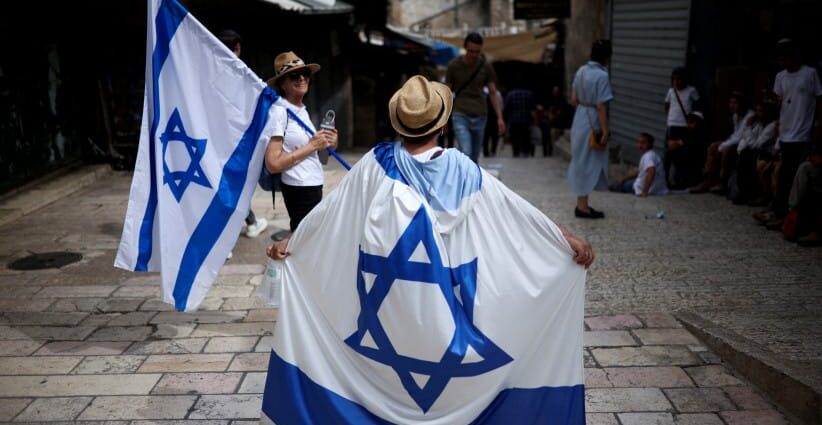
Now that Jerusalem Day has passed, once again, we have been made aware that there is a significant media theme surrounding the day, celebrating its unification, and it is mostly negative.
For a week or two prior to it happening, we are already informed of the violence of years past, and the expectation of more violence becomes the messaging.
The media crowd at Damascus Gate gathers, video cameras set up, and with crews to follow the masses of youth into the very narrow alleyway just inside. This year, some 300 peace and human rights activists stood alongside Arab residents “to provide a protective presence.”
This year, thankfully, even Nir Hasson’s Haaretz story last Friday informed that this year’s contretemps were noticeably less violent than previously. I think it was even less than at a few soccer matches this past year in Israel.
To be clear and firm: there is no need to be violent when marching through Jerusalem’s Old City. It is criminal and immoral.
Not only does it detract from the celebrations, but it also offers up to the detractors of a united Jerusalem a media victory. It stains our joy.
Still, there is context. The day recalls the years between 1948 and 1967, when Jerusalem, for the first time in some 3,000 years, was very briefly divided. In part, the celebration seeks to ensure that never happens again, as well as denying any “East” or, for that matter, “North” and “South” Jerusalem.
During those 19 years, Jews suffered Arab violence incessantly. For example, this newspaper, then called the Palestine Post, informed its readers on March 20, 1950, that Emil Taib, a 22-year-old immigrant, was shot and wounded while walking along the railway lines near Malha.
Another example was reported in Haaretz on Sunday, July 11, 1954. Readers were informed that all Shabbat long, sporadic shooting was heard in Jerusalem coming from the Jordanian side of the border. The neighborhoods affected were in the south of the city, near Mount Zion, and even in the center of town.
Throughout the 19 years of a divided city, following the Jordanian Arab Legion conquest on May 27, 1948, not only did the city’s residents need to fear for their lives, but even the agreements Jordan, the illegal occupier of the section of the pre-1948 city lost in the War of Independence, were ignored and violated.
Separating wall on Jaffa Road
I lived in Jerusalem for some six months during 1966-67 while attending the Machon LeMadrichim program for youth movement leaders, and I well remember the huge white wall at the beginning of Jaffa Road near the municipality that sought to protect vehicular traffic from snipings from the Old City walls.
On Friday night, October 8, 1966, an apartment block suffered an explosion in the neighbourhood of Romema. Five civilians were injured, and the building suffered damage. In reaction, prime minister Levy Eshkol, confronted by a journalist at the site and asked for a response, declared that he had a notebook and was recording all the incidents. Many dozens of murders, infiltrations, robberies, and sabotage occurred during 1948-1967.
The 1949 Jordan-Israel Armistice Agreement guaranteed, at least on paper, several important items that could have led, if not to peace, then to an atmosphere of coexistence. These included resumption of the normal functioning of the institutions on Mount Scopus, the Hebrew University, and the Hadassah Hospital; free access to the Western Wall and use of the cemetery on the Mount of Olives.
None of that was fulfilled.
Thirty-four of the 35 synagogues inside the Old City were destroyed. Those not completely broken down were used as chicken houses and stables and were found in 1967 filled with dung-heaps, carcasses, and garbage. Scores of Torah scrolls were burned or ripped along with holy books.
A large section of the 2,000-year old Jewish cemetery below the road to Jericho was destroyed. Tens of thousands of tombstones were broken, and grave stones were used by the Jordanian Army stationed nearby as paving for walkways, as well as latrine covers. Part of the upper cemetery was levelled for a shortcut to a new hotel.
Thousands of Jewish residents, those who had remained after successive Arab terror attacks during the Mandate period, especially during 1936-1939, when even the Friday night walk to the Western Wall became a death trip, were ethnically cleansed from the city. The neighborhoods of Nahalat Shimon, Kfar Shiloah, the moshavim of Neveh Yaakov and Atarot, and other pockets of Jewish residency were forcibly emptied of their Jews.
The Jewish Quarter was torched in parts, and synagogues throughout the walled Old City were desecrated. All that was left was a corridor to Mount Scopus for a small security unit that was changed every two weeks.
Jews would seek to view the Old City from Mount Zion. They would not yield up their holy city, their national capital. They would not surrender their national identity and its physical proof. They would not permit an erasing of the historical record along with Jerusalem’s illegal occupation.
We Jews refused and continue to refuse the idea that Jerusalem, a city of Temples, of pilgrimage festivities and gatherings, that for 3,000 years knew no division, no East and no West, should now forever seemingly consecrate a very short 19-year-long rupture and partition forced upon it by violent aggression.
Jerusalem has a heart, and Jews will not contribute to its submission to the fallacies of historical fiction. We raise Jerusalem above our greatest joy.
Again, Jews attacking Arabs is a stain on Jerusalem Day. It minimizes the history of a divided Jerusalem with its Arab murderous terror, its violations of international legal agreements, the destruction of Jewish property, desecration of Jewish graves and institutions, as if it never happened.
Arabs do not deserve for their crimes to be forgotten.
The writer is a researcher, analyst, and commentator on political, cultural, and media issues.