DEVELOPING — Saturday, May 23, 2026. Iran has agreed to relinquish its entire stockpile of highly enriched uranium as part of a framework agreement with the United States to end the months-long war, two senior U.S. officials told the New York Times on Saturday, marking a significant nonproliferation concession from Tehran and setting the stage for a meaningful repricing across global energy, equity, and shipping markets.
The breakthrough disclosure landed hours after President Donald Trump announced earlier Saturday that an agreement with Iran “has been largely negotiated,” telling reporters that calls he held overnight with Prime Minister Benjamin Netanyahu and a separate group of Middle Eastern leaders had gone well. Trump indicated the framework includes the reopening of the Strait of Hormuz — the critical maritime artery Tehran has largely blocked since the war’s outbreak roughly three months ago — and said a formal announcement could come “shortly.”
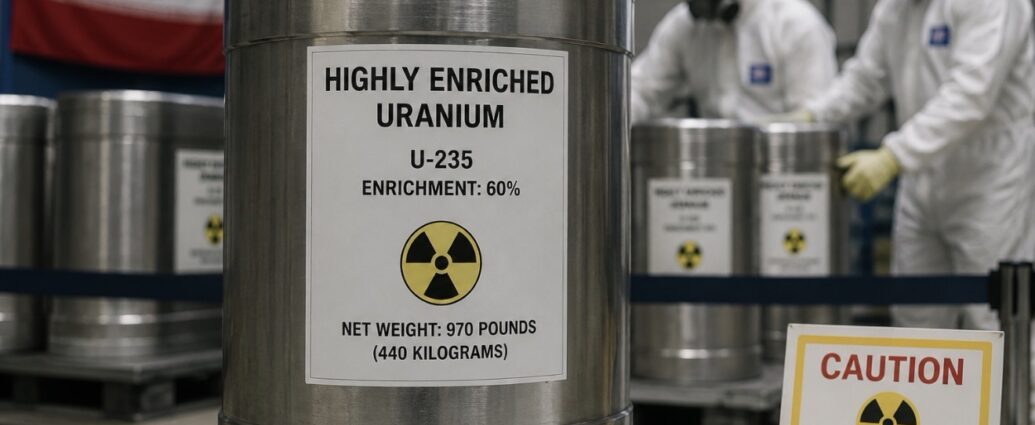
Trump had confirmed the contours of the uranium arrangement Thursday outside the White House, telling reporters, “We will get it. We don’t need it, we don’t want it. We’ll probably destroy it after we get it, but we’re not going to let them have it.” The 970-pound stockpile of uranium enriched to 60 percent purity — roughly 440 kilograms, just short of the 90 percent threshold required for weapons-grade material — has been the central sticking point in mediated negotiations conducted through Oman and Pakistan. Iran’s Parliament Speaker Mohammad Bagher Ghalibaf met with Pakistan Army Chief Syed Asim Munir in Tehran on Saturday, underscoring Islamabad’s role as a back-channel mediator.
According to the U.S. officials cited by the Times, Iran has committed only in a general statement to giving up the uranium, with the precise mechanism for transfer or downblending to be worked out in negotiations expected to follow a formal cessation of hostilities. The development comes despite a directive issued earlier in the week by Iran’s supreme leader, Ayatollah Ali Khamenei, that the near-weapons-grade material should not be sent abroad — a position that had whipsawed crude markets and rattled traders through Friday’s session. Iranian state media on Saturday also publicly contradicted Trump’s characterization of the Hormuz terms, insisting the waterway will remain under Iranian management, raising fresh questions about the durability of the framework.
Oil futures had already begun pricing the diplomatic thaw before Saturday’s reports. International benchmark Brent crude futures settled at $103.54 per barrel Friday, while U.S. West Texas Intermediate closed at $96.60, capping a week in which Brent lost more than 5 percent and WTI shed more than 8 percent. The declines followed Trump’s announcement Monday that he had called off imminent strikes on Iran at the request of U.S. Gulf Arab allies to give diplomacy additional runway.
U.S. Secretary of State Marco Rubio said Thursday there were “good signs” that an agreement to end the conflict is in sight, though he warned any deal would be “unfeasible” if Iran pursues measures to permanently control shipping through the Strait of Hormuz. The waterway, through which roughly a fifth of global crude transits, remains the second major sticking point. Tehran is reportedly working with Oman on a framework for a permanent toll system that would formalize Iranian control over maritime traffic — a proposal Trump has flatly rejected, insisting the strait remain open, free, and untolled.
The economic stakes of a final agreement are substantial. Analysts at SEB have estimated that sanctions relief tied to a nuclear accord could unlock an additional 800,000 barrels per day of Iranian crude for global markets, a development SEB analyst Ole Hvalbye called “undeniably bearish” for prices. Combined with the prospective reopening of the Strait of Hormuz to unimpeded traffic, a sustained agreement could pull Brent well below the $90 mark and ease the inflationary pressure that has dogged the Federal Reserve’s rate path through the spring.
Equity markets, particularly transportation, airline, refining, and consumer discretionary sectors hammered by elevated fuel costs since the war’s outbreak in February, stand to benefit from any durable de-escalation. Delta Air Lines, United Airlines, and American Airlines have all flagged jet fuel as a material drag on quarterly margins, while shipping giants A.P. Moller-Maersk and Hapag-Lloyd have absorbed surcharges and rerouting costs tied to Hormuz disruption. Conversely, U.S. shale producers including ExxonMobil, Chevron, ConocoPhillips, Pioneer Natural Resources, and Diamondback Energy, which have enjoyed a war-driven premium on every barrel, face compressed realized prices if Iranian supply returns at scale.
The proposed framework, according to multiple reports citing officials with knowledge of the talks, contemplates an immediate end to hostilities followed by a two-month negotiating window on the technical specifics of Iran’s nuclear program. The Financial Times reported that Trump is also demanding Iran dismantle its three principal nuclear sites — Natanz, Fordow, and Isfahan — all of which were struck by U.S. B-2 bombers in the opening phase of the war. CBS News reported that the proposal additionally includes the release of certain Iranian assets currently frozen in foreign banks, a concession likely to draw scrutiny from congressional hawks. Senior GOP senators on Saturday publicly criticized the reported terms as a “nightmare for Israel.”
For Iran, the economic case for capitulation is acute. The country’s oil exports, refining capacity, and banking sector have been crippled by both kinetic strikes and tightened secondary sanctions, and reopened access to international markets would deliver an immediate fiscal lifeline to a regime under sustained pressure. Oman Foreign Minister Badr al-Busaidi said earlier in the negotiations that Iran had effectively accepted the principle of “zero stockpiling” and that the existing material would be “downblended to the lowest level possible” and converted into irreversible reactor fuel.
Skeptics caution that prior Iranian commitments on enrichment have repeatedly unraveled and that the absence of detailed transfer protocols leaves room for backsliding. The Washington Post noted that Tehran’s pledge not to seek a nuclear weapon carries limited weight given its longstanding insistence that its program was never weapons-oriented to begin with. Israeli officials have warned that anything short of physical removal of the 440-kilogram stockpile would render the war, in the words of one senior Israeli military official, “one big failure.”
For markets, the asymmetry of outcomes is stark. A signed agreement removing both the nuclear overhang and the Hormuz chokepoint could trigger a sharp decline in crude prices, with knock-on relief for equities, bonds, and the dollar. A breakdown — particularly one driven by Khamenei’s reported intransigence on physical transfer, or Iranian state media’s Saturday repudiation of Trump’s Hormuz characterization — would send Brent sprinting back toward the highs above $115 per barrel that WTI touched in early April when Trump’s initial ultimatum expired.
Traders will return Tuesday from the U.S. holiday weekend to a market priced for cautious optimism but acutely sensitive to any signal — from Tehran, Washington, or the mediators in Muscat and Islamabad — that the framework is either firming or fraying. The next 72 hours of headlines will likely set the tone for crude, equities, and the inflation trajectory through the second half of the year.
— JBizNews Desk
© 2026 JBizNews. All Rights Reserved. Reproduction or distribution without written permission is prohibited.