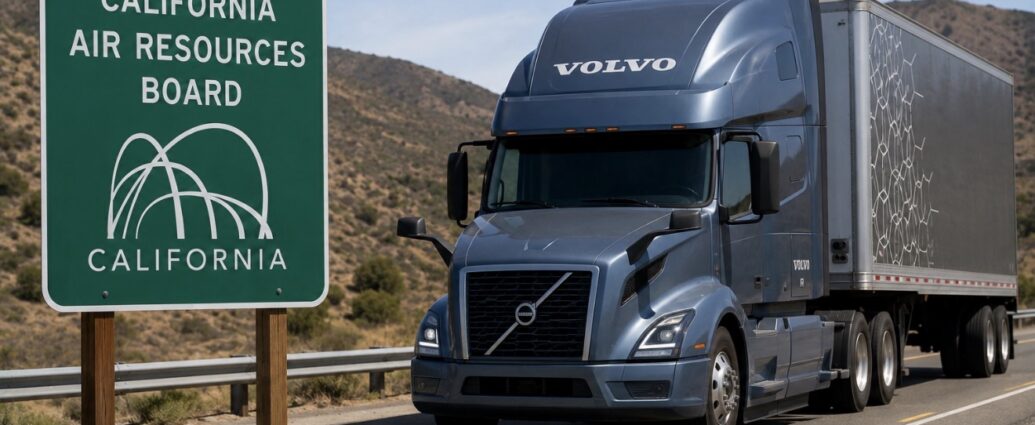
Volvo Group said that it will pay $197 million to settle a California investigation into heavy-duty diesel truck engines that regulators said emitted more pollution than allowed under state rules.
The settlement, announced jointly by the California Air Resources Board (CARB) and Volvo, covers more than 10,000 heavy-duty diesel engines sold in California between the 2010 and 2016 model years. Regulators said Volvo failed to properly disclose certain emissions-control software systems that affected how the engines handled pollution under different driving conditions.
California officials stressed that the case is not comparable to the intentional “cheat device” scandal that engulfed Volkswagen in 2015. Instead, the dispute centered on software disclosure and emissions calibration issues. CARB said Volvo cooperated fully with the investigation and acted “transparently and in good faith.”
Volvo said the settlement does not include any admission of wrongdoing.
The money will be split several ways. Volvo will pay $13 million in civil penalties, contribute $71 million to California’s Air Pollution Control Fund, spend $108 million on emissions-reduction projects across the state, and reimburse roughly $5 million in investigative costs. The company also agreed to provide software updates and extended warranty coverage for approximately 7,200 trucks still operating in California.
For Volvo, the financial hit is meaningful but manageable. The Sweden-based truckmaker said it will book the full amount as a second-quarter charge when it reports earnings on July 17. About $89 million of the impact will hit cash flow immediately, while the rest will be spread over the next five years.
The settlement involves Volvo Group, the commercial truck and equipment company that owns Volvo Trucks, Mack Trucks, Renault Trucks, and UD Trucks. It is separate from Volvo Cars, the passenger-car company owned by China’s Geely Holding Group.
The case highlights how powerful California has become in shaping the future of the trucking industry. The state has some of the strictest vehicle emissions rules in the world, and truckmakers that want access to California’s massive freight market must comply with CARB standards. The ports of Los Angeles and Long Beach together handle more than 40% of U.S. container imports, making California impossible for major truck manufacturers to ignore.
At the center of the dispute were “auxiliary emission control devices,” essentially software systems that adjust engine behavior depending on factors like temperature, altitude, and driving load. California rules require manufacturers to fully disclose how those systems work. Regulators said Volvo’s disclosures were incomplete and that some engine configurations exceeded permitted pollution limits.
The settlement lands as the trucking industry faces mounting pressure to move toward cleaner vehicles. California’s Advanced Clean Trucks rule requires manufacturers to steadily increase sales of zero-emission trucks through 2035, pushing companies including Volvo, Daimler Truck, Paccar, Navistar, and Tesla to accelerate electric and hydrogen-powered truck development.
For trucking companies, stricter emissions rules increasingly mean higher costs. Fleet operators including J.B. Hunt, Knight-Swift, Schneider National, Old Dominion, and XPO depend heavily on manufacturers like Volvo for their truck fleets. Software updates, warranty work, and compliance changes can affect maintenance schedules, fuel economy, and operating costs — especially for smaller trucking firms already dealing with tight profit margins.
Wall Street largely took the settlement in stride. Volvo Group generated roughly $48 billion in revenue and nearly $5 billion in net income last year, making the penalty financially absorbable. Analysts at Morgan Stanley, JPMorgan Chase, and UBS have repeatedly warned investors that emissions compliance costs are becoming a permanent expense across the global trucking sector.
The settlement also sends a message to the rest of the industry: California regulators are willing to negotiate with companies that cooperate, but enforcement pressure is only increasing. In recent years, Daimler Truck reached a separate emissions settlement with CARB, while diesel-engine giant Cummins agreed to pay roughly $2 billion in penalties tied to emissions violations involving Ram pickup trucks built by Stellantis.
For Volvo chief executive Martin Lundstedt, resolving the case removes a regulatory cloud hanging over the company ahead of a critical earnings cycle. For California regulators, the agreement adds another major enforcement victory as the state pushes aggressively toward a lower-emissions freight system.
For consumers, the bigger takeaway is simpler: the cost of meeting tougher environmental rules is increasingly becoming part of the price of moving goods across America.
— JBizNews Desk
© 2026 JBizNews. All Rights Reserved. Reproduction or distribution without written permission is prohibited.