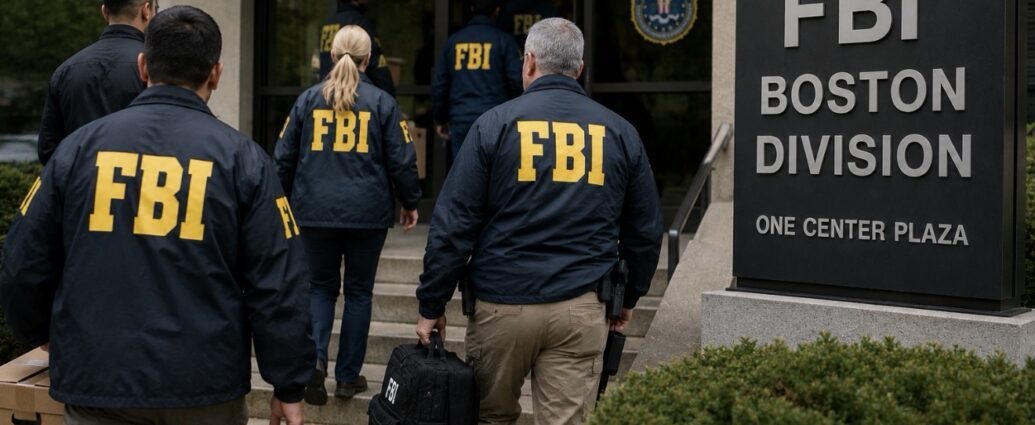
The Federal Bureau of Investigation’s Boston field office has just announced, that it has dismantled an India-based call center fraud operation that targeted elderly Americans through fake tech support scams, while two U.S. technology executives who helped route the scam calls have pleaded guilty to federal charges.
The case closes out a six-year investigation that has now produced convictions involving seven people across the United States and India — and highlights how a multibillion-dollar global scam industry continues draining retirement savings from older Americans.
The two U.S. executives identified by the FBI are Adam Young and Harrison Gevirtz, who served as chief executive officer and chief strategy officer of a call-tracking and analytics company that prosecutors say knowingly helped route scam calls from India to victims in the United States. According to federal prosecutors, the pair learned their customers were operating fraudulent tech support schemes but failed to report the activity between 2017 and April 2022.
Both men are scheduled to be sentenced on June 16, 2026.
“What the CEO and CSO of this well-known call tracking and analytics company did was downright despicable,” said Ted E. Docks, special agent in charge of the FBI’s Boston division. “By their own admission, they willfully profited from telemarketing and tech support scammers, here and abroad, who preyed on the elderly, exploited the vulnerable, and drained victims of their life savings and peace of mind.”
Federal authorities say the India-based scammers posed as representatives from companies such as Microsoft, Amazon, and government agencies, convincing victims their computers or bank accounts had been compromised. Victims were then pressured into sending money through gift cards, wire transfers, or cryptocurrency.
The five India-based defendants previously convicted in the case include Sahil Narang, Chirag Sachdeva, Abrar Anjum, and Manish Kumar, along with a former employee of the U.S. call-routing company. Prosecutors said the network defrauded Americans of millions of dollars, primarily targeting elderly victims.
The case reflects a much larger problem. According to the FBI’s Internet Crime Complaint Center (IC3), Americans lost roughly $2.1 billion to tech support scams in 2025 alone. Elderly Americans accounted for a disproportionate share of those losses.
Data from the Federal Trade Commission show Americans over age 60 lost $214 million in business and government impersonation scams involving losses between $10,000 and $100,000 during 2024. Victims reporting losses above $100,000 collectively lost another $445 million.
Older Americans are especially vulnerable because scammers often target retirees with savings accounts, home equity, or retirement funds. Fraud experts say many victims are manipulated through fear, confusion, and isolation.
The scams themselves have become highly organized businesses. Authorities earlier this year shut down three additional India-based call centers tied to nearly $49 million in losses involving more than 660 U.S. victims. Those operations were dismantled with assistance from India’s Central Bureau of Investigation after cooperation between U.S. and Indian law enforcement agencies intensified.
For the American technology industry, the case sends a warning well beyond one company.
Call-routing software, cloud phone systems, analytics tools, and customer-service platforms are legitimate multibillion-dollar businesses used daily by companies across the economy. Firms including Twilio, RingCentral, Five9, Cisco Systems, Microsoft, NICE Ltd., and Genesys provide communications infrastructure that powers customer support operations worldwide.
Federal prosecutors are now signaling that technology providers may face criminal exposure if they knowingly allow their systems to facilitate fraud.
That shift is drawing close attention from compliance officers and legal departments across the telecom and software industries, particularly companies involved in call routing, online advertising, customer analytics, and payment processing.
Banks and retailers are also deeply exposed. Fraud proceeds are often moved through Western Union, MoneyGram, gift cards sold at major retailers, and increasingly through cryptocurrency exchanges such as Coinbase, Kraken, and Binance.US.
Retailers including Walmart, Target, and Amazon have introduced warning signs and employee training programs aimed at helping consumers identify gift-card scams before money is lost. Financial institutions have also increased monitoring for suspicious transfers involving elderly customers.
The scams are creating broader economic consequences as well. AARP has repeatedly warned that elder fraud is becoming both a financial and public health issue. Victims often suffer depression, stress, and long-term financial insecurity after losing retirement savings.
For India, the reputational stakes are significant. The country’s business-process outsourcing industry generates more than $280 billion annually and employs millions of workers through legitimate companies such as Infosys, Tata Consultancy Services, Wipro, HCL Technologies, and Tech Mahindra.
Indian authorities have stepped up enforcement in recent years under pressure from Washington, but scam operations continue resurfacing because of low operating costs, high dollar-based profits, and historically inconsistent prosecutions.
The case also fits into the Trump administration’s broader focus on elder fraud enforcement and closer law-enforcement cooperation with the government of Prime Minister Narendra Modi. Attorney General Pam Bondi has made consumer fraud and elder exploitation a priority issue for the Department of Justice.
For ordinary Americans, investigators say the warning signs remain simple: unexpected calls claiming to be from tech support, the IRS, Social Security, Amazon, or a bank should immediately raise suspicion — especially if payment is requested through gift cards, wire transfers, or cryptocurrency.
The FBI urges victims to report scams through its IC3.gov reporting portal.
The broader reality is sobering. The money Americans lost to tech support scams last year alone exceeds the annual economic output of some small countries. And while this investigation shut down one network, authorities acknowledge that new scam operations continue appearing almost as quickly as old ones disappear.
— JBizNews Desk
© 2026 JBizNews. All Rights Reserved. Reproduction or distribution without written permission is prohibited.