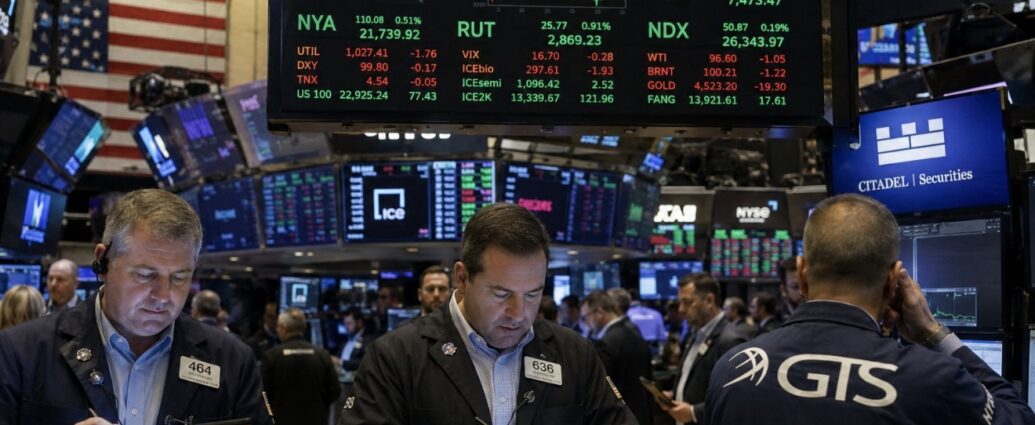
The Dow Jones Industrial Average climbed 294.04 points, or 0.58%, to a fresh all-time closing high of 50,579.70 on Friday, May 22, 2026, according to closing data from the New York Stock Exchange, capping the S&P 500’s eighth consecutive weekly gain — its longest winning streak since 2023. The S&P 500 rose 27.75 points, or 0.37%, to 7,473.47, inching closer to its all-time high set May 14. The Nasdaq Composite added 50.87 points, or 0.19%, to 26,343.97. The Russell 2000 gained 25.77 points, or 0.91%, to 2,869.23.
The rally extended into the Memorial Day weekend on twin tailwinds: easing oil prices and growing optimism that President Donald Trump’s mediated negotiations with Iran through Oman and Pakistan may yield a framework deal in the coming days. WTI crude settled at $96.60 per barrel and Brent crude at $100.21, both well off the recent highs that had spooked equity markets through the spring. The 10-year Treasury yield eased, the Cboe Volatility Index slipped to 16.70, and gold pulled back $19.30 to $4,523.20 per ounce as investors rotated out of safe havens.
The market gains came against a striking backdrop. The University of Michigan’s May Survey of Consumers showed household sentiment hitting a new low, with year-ahead inflation expectations climbing to 4.8% from 4.7% last month and long-run inflation expectations jumping to 3.9% in May from 3.5% in April. Both readings sit well above the 3.4% seen in February before the U.S.-Iran war began. The split between Wall Street optimism and Main Street pessimism is now as wide as it has been in years.
Earnings drove most of the day’s biggest movers. Ross Stores jumped 8.1% after the off-price retailer reported first-quarter profit and revenue that easily beat analyst expectations. The company raised its comparable sales forecast and full-year earnings guidance. Chief executive Jim Conroy said the retailer saw strong customer traffic during the quarter, with some boost likely tied to households spending tax refunds. Ross Stores has now decoupled from broader consumer concerns, with its value proposition resonating particularly well as inflation pressures intensify.
Workday surged 12.02% after the human-resources and finance software provider reported quarterly earnings of $2.66 per share, beating the $2.51 consensus by 5.98%, on revenue of $2.54 billion against an expected $2.52 billion. The company raised its full-year margin outlook. Co-founder Aneel Bhusri has returned as chief executive, a transition investors cheered for restoring founder-led strategic focus at a company facing intense competition from Microsoft and Oracle in enterprise software.
Zoom Communications jumped 9.2% after delivering a stronger-than-expected quarterly profit report, signaling that the video conferencing company is successfully pivoting from its pandemic-era growth model toward enterprise communications software and AI-powered productivity tools.
Qualcomm rallied more than 11% in midday trading on Friday and ended the week up 18%. The chipmaker has surged more than 50% since April 29 on the back of its fiscal second-quarter earnings beat and renewed investor enthusiasm for the artificial intelligence chip trade. SoftBank Group extended its scorching rally to a second day, rising more than 11% after closing up 20% Thursday on momentum from Nvidia’s blockbuster earnings, adding over $35 billion to its market capitalization in two sessions.
Estée Lauder jumped 11.9% after announcing it was no longer pursuing a possible merger with Puig, the Spanish fragrance and beauty products company. Puig shares plunged in Madrid trading on the news.
Take-Two Interactive rose 7% after a small revenue beat, with the company confirming Grand Theft Auto VI remains on track for a November launch — a release that Wall Street analysts have called the most important consumer technology launch of the year.
On the downside, Guzman y Gomez rose as much as 20.58% in Sydney trading after the Mexican-themed fast-food chain announced it would exit the U.S. market and refocus on Australia. Founder and co-chief executive Steven Marks said, “Having spent the last 3 months in the US, I realized this was going to take significantly more time and capital than we had expected,” adding that current U.S. performance “could not justify continued investment of shareholder capital.” The exit highlights how challenging the American restaurant market has become for international entrants competing against Chipotle Mexican Grill, Qdoba, and a fragmented field of regional Mexican-food chains.
The political and policy backdrop is reshaping itself in real time. President Donald Trump led a swearing-in ceremony Friday morning for Kevin Warsh as the new chair of the Federal Reserve, replacing Jerome Powell, whose term expired May 15. The ceremony took place in the East Room of the White House — the first time a Fed chair has been sworn in there since Alan Greenspan in 1987. “I want Kevin to be totally independent,” Trump said. “Don’t look at me, don’t look at anybody.” The president’s unprecedented public role in Warsh’s installation drew bipartisan concern about executive influence over the historically independent central bank.
Warsh inherits a central bank navigating an extraordinarily complex set of pressures: persistent inflation driven by the Iran war, elevated long-run inflation expectations, a rapidly rising private-credit default rate, the highest Memorial Day gas prices in four years, and a president with very specific expectations about interest rates. Goldman Sachs strategists this week warned of a growing risk that rising Treasury yields and inflation could trigger a stock market correction, even as the indexes sit at or near record highs.
For the week, the rally was broad. The S&P 500 rose 0.9% despite a rough Monday start, with concerns about persistent inflation and renewed Fed rate-hike risk giving way midweek to optimism on the Iran front. The index has now been above its 50-day moving average since April 8 and above its 200-day moving average for the same period. The 50-day moving average has been above the 200-day moving average since July 1, 2025 — a technical configuration known as a “golden cross” that historically supports continued upside.
For consumers, the disconnect between the stock market and household budgets continues to define the moment. 401(k) and IRA balances are at or near record highs for Americans with retirement accounts, providing a real boost to household wealth. At the same time, AAA reported the highest Memorial Day gas prices in four years at $4.56 a gallon, mortgage rates remain elevated, and grocery, restaurant, and service costs continue to climb. The Federal Reserve under new chair Warsh will be navigating between a stock market that does not appear to need help and a Main Street economy that may.
U.S. markets are closed Monday for Memorial Day. Traders return Tuesday to a calendar packed with macro data — including PCE inflation, durable goods orders, consumer confidence, and second-tier housing data — and continued attention to whether the Iran framework can be finalized into a signed agreement that reopens the Strait of Hormuz and pulls oil prices sharply lower.
For now, the trend is the bulls’ friend. Eight straight weekly gains is the longest streak in nearly three years. The Dow has crossed 50,000. The S&P 500 is within reach of fresh highs. But the cracks beneath the surface — consumer sentiment at record lows, private credit defaults at record highs, gas at a four-year peak, and inflation expectations climbing — remain.
— JBizNews Desk
© JBizNews.com. All rights reserved. This article is original reporting by JBizNews Desk. Unauthorized reproduction or redistribution is strictly prohibited.