Imagine for a moment that two countries are at war. One is firing missiles at the other. People are dying. Cities are being hit. And yet, in the middle of all of this, the country being attacked opens its doors to 30,000 citizens of the country attacking it — and welcomes them in to spend a week praying at its holiest religious site.
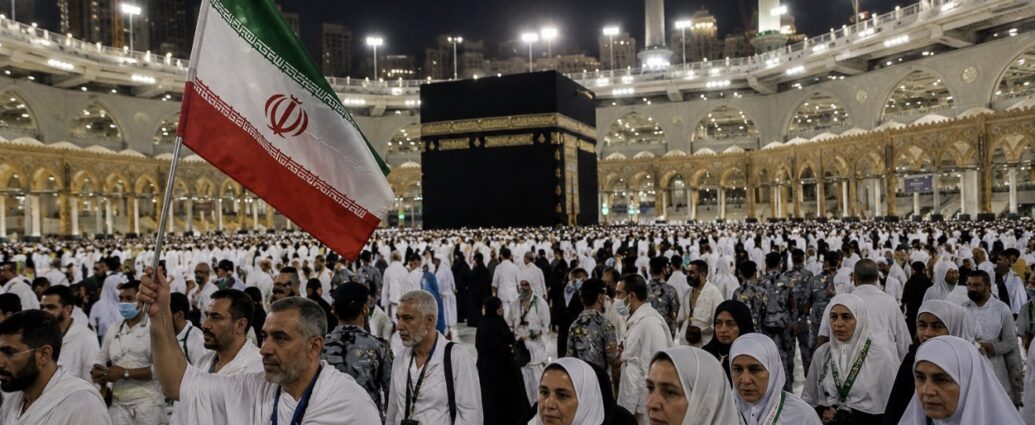
That is exactly what is happening right now in Saudi Arabia. The Iranian Hajj and Pilgrimage Organization confirmed through Iran’s state news agency IRNA on Friday, May 22, 2026, that roughly 30,000 Iranian pilgrims have safely arrived in Saudi Arabia for the annual Hajj — the once-in-a-lifetime religious journey that all Muslims with the means must make at least once in their lives. The Saudi Ministry of Hajj and Umrah, headed by Hajj Minister Tawfiq Al Rabiah, confirmed that more than 1.2 million total pilgrims from around the world have arrived in the kingdom, with 1.8 million expected by the time the rites begin Monday, May 26.
The natural question is the obvious one. Iran has been firing drones and missiles at Saudi Arabia for months. The Saudi air defense system, the PAC-3 interceptor network supplied by the United States, is down to about 14% of its pre-war stockpile because of how many incoming Iranian threats it has had to shoot out of the sky. The U.S. Embassy in Riyadh issued its first-ever Level 3 “Reconsider Travel” warning specifically targeting the Hajj.
So why on earth would Saudi Arabia open the gates to thousands of Iranian citizens right now?
The answer comes down to three things: money, religion, and a careful business decision both governments have quietly made.
The money is enormous.
The Hajj is not just a religious event. It is one of the largest annual businesses in the entire Arab world. According to Saudi General Authority for Statistics data, the Hajj and year-round religious tourism generate roughly $12 billion every year for the Saudi economy. That is more than the entire annual gross domestic product of dozens of countries.
That $12 billion supports more than 1 million jobs in Saudi Arabia. Hotels in Mecca and Medina. Restaurants. Taxi drivers. Bus operators. Airline workers at Saudia. Doctors and nurses staffing pilgrimage hospitals. Construction workers. Cleaners. Security guards. Telecommunications workers at STC, Mobily, and Zain Saudi Arabia. The Hajj is the lifeblood of an entire layer of the Saudi economy that has nothing to do with oil.
Crown Prince Mohammed bin Salman’s Vision 2030 plan is built on growing this number, not shrinking it. The kingdom wants to bring 30 million annual religious visitors to Saudi Arabia by 2030, generating an additional $13.32 billion in government revenue on top of what the Hajj already produces. Blocking Iranians from coming this year would mean publicly admitting that the religious tourism business can be turned off by war — which is the last message Mohammed bin Salman wants the world to hear.
The religion matters even more.
Saudi Arabia’s king holds a special title: Custodian of the Two Holy Mosques. That title gives the kingdom religious authority across the entire Muslim world — about 1.9 billion people. It is the foundation of Saudi Arabia’s soft power and a major reason the kingdom carries diplomatic weight far beyond what its size and population would normally justify.
If Saudi Arabia were to ban Iranian pilgrims because of the war, it would essentially be saying: we will deny Muslims their religious obligation because of politics. That is exactly the accusation Iran’s leadership has spent decades trying to make stick. Banning Iranians would hand Tehran a propaganda victory worth more than anything Iran could win on the battlefield. It would also alienate Shia Muslim populations across Iraq, Lebanon, Bahrain, Pakistan, and India — many of whom Saudi Arabia is actively trying to court diplomatically.
So Saudi Arabia does the opposite. It welcomes the Iranians in. It deploys security to protect them. It coordinates their entry with Iraqi authorities, who escort the pilgrims through border crossings in overland convoys. Crown Prince Mohammed bin Salman has personally ordered, according to Gulf News, the “full mobilization of operational, security, and preventive plans” to make sure the pilgrimage goes smoothly. Neither MBS nor Hajj Minister Al Rabiah mentioned Iran or the war by name in their public statements. The silence is the message: the Hajj is bigger than the war.
Iran needs this too.
For Iran, the calculation is just as cold and just as practical. Supreme Leader Ayatollah Mojtaba Khamenei could have ordered an Iranian boycott of the Hajj, as Iran did between 1988 and 1990 after a deadly clash in Mecca. Boycotting would have sent a powerful political message.
But it would have also denied tens of thousands of Iranian Muslims their religious obligation, particularly older pilgrims for whom the Hajj is the spiritual goal of a lifetime. It would have meant that Iran’s government was telling its own faithful: politics matters more than your Hajj. That is a message no leader of an officially Islamic republic wants to deliver to their population.
So instead, Iran quietly sent 30,000 pilgrims through Iraqi territory, coordinated with Saudi authorities through diplomatic back-channels, and called it a wartime compromise. The normal Iranian quota is 86,700. This year is about a third of that. Iran can claim it stayed religiously faithful. Saudi Arabia can claim it kept the holy sites open to all Muslims. Both governments get what they need.
How the system actually works.
The 2023 China-brokered deal that restored diplomatic relations between Saudi Arabia and Iran is the quiet machinery making all of this possible. That agreement, negotiated by Chinese President Xi Jinping’s team, reopened embassies in both capitals and established working channels between the two foreign ministries. The war has bent that relationship, but it has not broken it.
Iraq has taken a practical middleman role. Its Interior Minister, Lieutenant General Abdul Amir al-Shamari, announced Iraqi authorities are escorting Iranian pilgrim convoys through border crossings and coordinating directly with both Tehran and Riyadh. Ali Reza Rashidan, head of Iran’s Hajj Committee, confirmed direct discussions with the Saudi Ministry of Hajj and Umrah. Iranian Ambassador to Riyadh Ali Reza Enayati announced the safe arrival of the first pilgrim group on Saudi soil.
For pilgrims themselves, the experience is largely unchanged. “We know we are at the safest place in the world,” Fatima, a 36-year-old German housewife traveling with her family, told AFP reporters in Mecca. Mecca’s hotels are sold out. Jeddah’s restaurants are packed. Saudia is running additional flights. Pilgrimage infrastructure built over decades is operating at full capacity.
The lesson for the rest of the world.
The Hajj is teaching everyone a quiet lesson right now. Even in war, certain institutions are too valuable to break. Saudi Arabia earns $12 billion, preserves its religious authority over 1.9 billion Muslims, and maintains a diplomatic channel with its largest regional rival. Iran delivers its citizens’ religious obligation, preserves its own Islamic credentials, and keeps a working line of communication with Riyadh open.
Both countries are doing the math, and both are reaching the same conclusion. Block the pilgrimage and everyone loses. Allow it to happen and everyone wins something — including the pilgrims who just want to pray.
For everyday Americans, the takeaway is simple. The headlines about war suggest a region in chaos. The reality on the ground is more complicated. Countries that are firing missiles at each other can still find ways to keep oil flowing, ports running, planes in the air, and religious pilgrims moving across borders. The global economy holds together not because nations love each other, but because the cost of letting it fall apart is higher than anyone is willing to pay.
The pilgrimage runs through Friday, May 29. By then, several hundred thousand more Iranian and other pilgrims will have entered and exited the kingdom. If the rites pass without major incident — and Saudi Arabia is working overtime to make sure they do — both Riyadh and Tehran will quietly count it as a win. Neither will say so publicly. That, too, is part of how the system works.
— JBizNews Desk
© 2026 JBizNews. All Rights Reserved. Reproduction or distribution without written permission is prohibited.