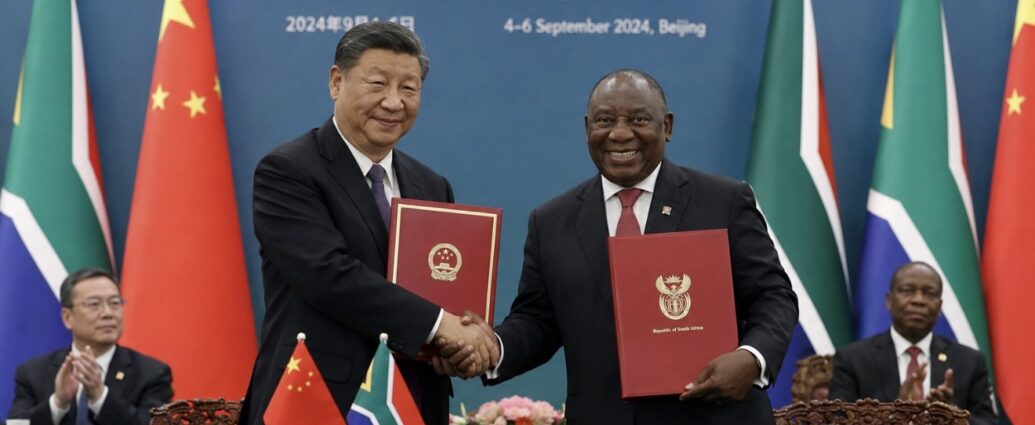
Chinese President Xi Jinping’s government implemented its zero-tariff policy for 53 African countries on May 1, 2026, formally opening China’s 1.4 billion-consumer market to duty-free imports from nearly the entire African continent — a sweeping trade move widely viewed by analysts as a direct geopolitical and economic counter to President Donald Trump’s tariff-heavy trade strategy.
The policy, first announced by Xi Jinping on February 14, was confirmed by China’s State Council and the Chinese Ministry of Commerce and has now been fully active for more than three weeks. Under the arrangement, all goods entering China from the 53 African nations that recognize Beijing instead of Taiwan now face zero customs duties.
The lone exception is Eswatini, the small Southern African kingdom that still maintains diplomatic ties with Taipei. Beijing excluded the country entirely, reinforcing China’s broader “One China” pressure campaign.
The scale of the move is historic.
The new tariff-free framework covers Africa’s largest economies, including South Africa, Nigeria, Egypt, Algeria, Kenya, Ethiopia, Ghana, Tanzania, Morocco, and Angola. It expands China’s earlier December 2024 decision that granted zero tariffs only to 33 least-developed African nations.
Now, virtually the entire continent has free access to the world’s second-largest economy.
For African exporters, the financial impact is immediate and massive.
A South African wine producer that previously paid a 14% import tariff to sell bottles in Shanghai now pays nothing. Nigerian cocoa exporters, Kenyan coffee growers, Egyptian cotton suppliers, Ethiopian sesame farmers, and Ghanaian cashew producers suddenly become significantly more competitive inside China’s enormous consumer market.
The timing is not accidental.
The policy arrives just as African exports to the United States are facing new tariffs under the Trump administration, while Washington’s long-standing Africa trade framework has weakened dramatically. The African Growth and Opportunity Act (AGOA) — the cornerstone of U.S.-Africa trade relations since 2000 — technically remains alive through December 31, 2026 after a temporary reauthorization, but confidence in Washington’s long-term commitment has sharply deteriorated.
At the same time, the Trump administration dismantled major portions of USAID, scaled back parts of the Export-Import Bank, and reduced development financing programs that historically helped anchor American influence across Africa.
China moved quickly to fill the vacuum.
According to official Chinese government data, China-Africa trade reached a record $295.6 billion in 2024, making China Africa’s largest trading partner by a wide margin. First-quarter 2025 trade totaled another $72.6 billion, up 2.7% year-over-year even before the full tariff elimination took effect.
Trade analysts now expect those numbers to accelerate sharply through the second half of 2026.
The bigger story is minerals.
Africa holds some of the world’s most important strategic resources: roughly 70% of global cobalt production, nearly half of known manganese reserves, major lithium deposits, rare earth elements, uranium, copper, platinum, graphite, and chromium — the raw materials powering the global race for artificial intelligence infrastructure, semiconductors, electric vehicles, defense systems, batteries, and renewable energy technology.
China’s new policy effectively gives African producers a stronger financial incentive to send those materials directly into Chinese supply chains rather than Western ones.
Companies positioned to benefit include CATL, BYD, CMOC Group, Zijin Mining, China Molybdenum, Ganfeng Lithium, Huayou Cobalt, and Tsingshan Holding Group, all of which already operate deep inside African mining and processing networks.
The move directly undercuts years of U.S. industrial strategy.
The Inflation Reduction Act, the CHIPS and Science Act, and U.S.-backed infrastructure projects like the Lobito Corridor rail network were all designed to reduce Western dependence on Chinese-controlled supply chains. China’s tariff elimination weakens the economics of those alternatives almost overnight.
For African governments, the appeal is simple: China is offering real market access with few political conditions attached.
There are no governance requirements, labor-rights benchmarks, or democratic reforms tied to the tariff removal. Leaders including South African President Cyril Ramaphosa, Nigerian President Bola Tinubu, Egyptian President Abdel Fattah el-Sisi, Kenyan President William Ruto, and Ethiopian Prime Minister Abiy Ahmed have publicly welcomed the deal.
China has also pledged financing support, exporter training, logistics coordination, and marketing assistance through what Beijing calls its “green channel” trade system.
The geopolitical signal is equally clear.
By excluding Eswatini, China demonstrated that diplomatic recognition of Taiwan now carries direct economic consequences. African nations considering closer relations with Taipei can now see exactly what they stand to lose.
For the United States, the policy represents a growing strategic problem.
American industrial giants including Caterpillar, John Deere, General Electric, Honeywell, Boeing, Cummins, and Bechtel now compete in African markets where Chinese companies can bundle infrastructure deals, financing, and guaranteed access to the world’s largest manufacturing ecosystem.
Meanwhile, cheaper African raw materials flowing into Chinese factories will help Beijing lower production costs for batteries, electronics, electric vehicles, magnets, and solar equipment — goods that still eventually reach global markets, including the United States.
Even Trump’s tariffs cannot fully block that dynamic.
Chinese goods can still enter global supply chains indirectly through countries like Mexico, Vietnam, Indonesia, and Malaysia, lowering the effectiveness of Washington’s tariff wall over time.
For everyday Africans, however, the benefits are immediate and tangible.
Workers in Lagos, Nairobi, Cairo, Addis Ababa, Johannesburg, Accra, and Lusaka stand to gain from rising exports, stronger currencies, higher commodity demand, and improved trade balances. Governments across the continent are expected to see increased foreign exchange reserves and stronger fiscal positions.
For Washington, the uncomfortable reality is becoming harder to ignore.
China spent two decades building the infrastructure, ports, rail systems, trade relationships, scholarships, diplomatic ties, and financing channels necessary to make a policy like this credible. The Belt and Road Initiative was not just about roads and bridges — it was about building long-term commercial dependence.
Now Beijing is cashing in on that investment.
The Trump administration has bet that tariffs and bilateral pressure can rebuild American industrial power. China has bet that opening its market to the developing world will buy lasting influence and strategic dominance.
Africa has become the first major battleground testing which model works better.
So far in 2026, the scoreboard favors Beijing.
— JBizNews Desk
© 2026 JBizNews. All Rights Reserved. Reproduction or distribution without written permission is prohibited.