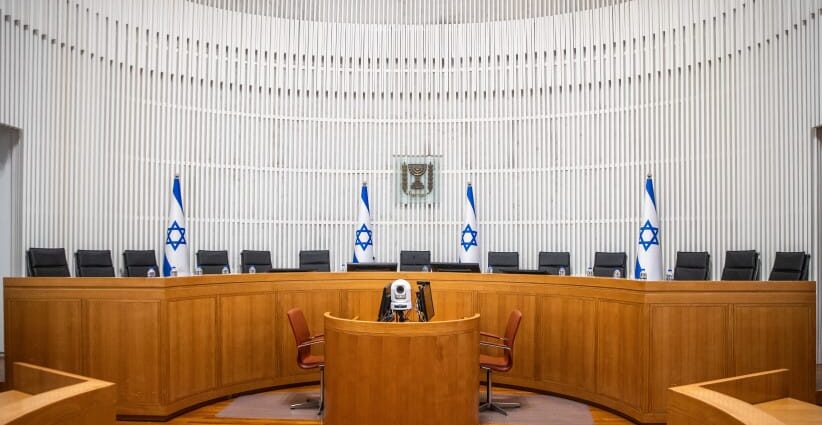
The High Court of Justice will convene at 4 p.m. Sunday for a follow-up hearing on Justice Minister Yariv Levin’s handling of the Judicial Selection Committee, as dozens of judicial posts remain empty and the election clock threatens to freeze the process altogether.
The hearing, before Justices Ofer Grosskopf, Alex Stein, and Gila Canfy-Steinitz, centers on whether Levin can continue advancing appointments in stages of his choosing, or whether the court should order him to bring vacancies across the judiciary to a vote.
The petition was filed by the Movement for Quality Government in July 2025. It asks the court to compel Levin, who chairs the committee, to convene it for appointments needed throughout the court system.
Levin says he has not neglected the issue. In an affidavit filed last week, he said he had already advanced nearly 200 appointments of judges and registrars through broad agreement, and was now moving “urgently, efficiently and decisively” to fill trial-court vacancies.
The petitioners say that is not enough. They argue that Levin has unlawfully tied further appointments to a broad consensus among committee members, even where the law does not require it, leaving large parts of the judiciary short-staffed.
Election timeline narrows window for judicial appointments
The case has become more urgent as elections approach. Candidates’ names must be published in the state gazette 45 days before the Judicial Selection Committee can vote on them. Once the election period begins, ordinary appointments are generally frozen, leaving only a narrow window to complete the process.
In February, the High Court issued a conditional order requiring Levin to explain why he would not convene the committee to fill vacant judicial posts across all levels of the judiciary. After a May 3 hearing, the justices ordered him to provide a timetable for appointments in the magistrates’ and district courts, rejecting his partial update as insufficient.
Levin’s latest affidavit lays out a limited plan. He said that after the war with Iran and the home-front emergency delayed the process, he asked committee members on April 17 to submit candidates for vacant posts and set June 7 as the first possible meeting, given the 45-day publication requirement.
He said he then decided to prioritize juvenile, traffic, and family courts, as well as magistrates’ court vacancies in the North and Haifa districts. Candidate lists for 36 positions were published on May 10, with committee meetings set for June 25 and June 30. Additional lists were published on May 17 for magistrates’ courts in the South and for senior registrar posts nationwide.
Levin said this amounted to a major response to the system’s needs. He blamed the earlier delay on a minority of committee members, saying efforts to reach an agreed list of appointments had been “torpedoed” by some Israel Bar Association representatives.
But Levin also acknowledged that the approaching election creates “real difficulty” in completing the work needed for district court and labor court appointments before the Knesset is dissolved. As an interim step, he said he was seeking temporary appointments to the Haifa and Beersheba district courts from a list supported by most committee members.
The affidavit also made clear that Levin does not intend to convene the committee to appoint Supreme Court justices “as long as the veto imposed by some committee members on his candidates is not removed.” Since Supreme Court appointments require seven of the committee’s nine members, Levin argued there is no point in convening the committee if the required majority cannot be reached.
Court shortages grow amid fight over appointments
The Movement for Quality Government, in its Wednesday response, said Levin’s position proves the problem rather than solves it. The group argued that the law does not give Levin, or any other committee member, a veto over appointments, and does not allow him to refuse to convene the committee until all members agree in advance.
MQG also argued that Levin’s plan ignores major shortages already known to him, including four vacancies in the Tel Aviv District Court, three in the Central and Jerusalem district courts, seven in the Central Magistrate’s Court, and five in the Tel Aviv Magistrate’s Court.
According to earlier state figures cited in the case, 51 judicial posts are currently vacant across the system, with another 15 expected to open by the end of 2026. The Courts Administration has warned that the shortage is delaying hearings, slowing urgent decisions, pushing back cases, and increasing the burden on sitting judges.
Levin warned the High Court against turning the conditional order into a final order, saying such a ruling would not only interfere with his authority to convene the committee but would also dictate the committee’s agenda, timetable, and method of selecting judges. In practice, he argued, it would turn the Supreme Court into the committee’s chair.
MQG rejected that framing, saying Levin’s staged approach would allow him to leave major vacancies unresolved until the next Knesset, when a controversial amendment changing the committee’s composition is set to take effect. The amendment, passed in March 2025, increases political influence over judicial appointments, but applies only from the next Knesset.
Sunday’s hearing is expected to turn on whether Levin’s publication of some candidate lists and scheduling of limited meetings is enough to satisfy his legal duty, or whether the court will impose a firm timetable before the election period closes the window for appointments.