By JBizNews Desk
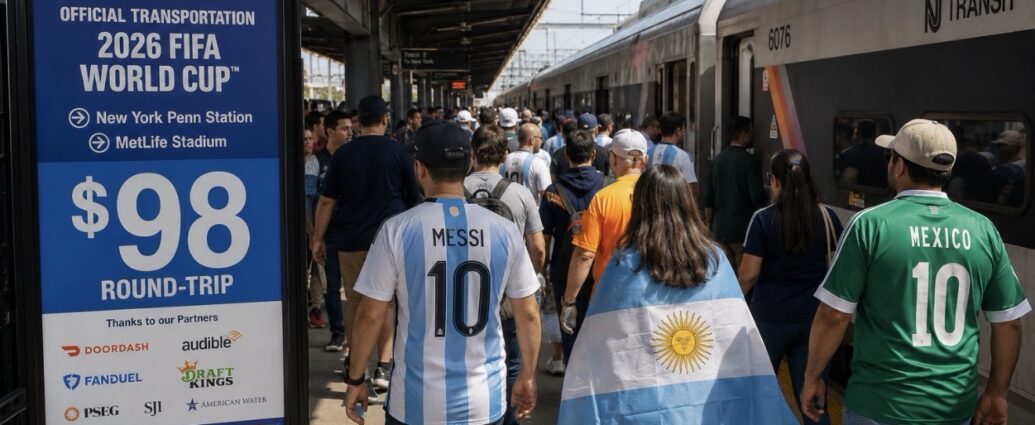
East Rutherford, N.J. — May 26, 2026 — New Jersey Governor Mikie Sherrill has secured another reduction in NJ Transit’s controversial 2026 FIFA World Cup fare pricing, cutting round-trip service from New York Penn Station to MetLife Stadium to $98 after the original $150 price triggered widespread backlash across the tri-state region.
The governor announced earlier this month that the latest reduction — down from an interim $105 fare — was achieved through a corporate sponsorship package funded by DoorDash, Audible, FanDuel, DraftKings, PSE&G, South Jersey Industries, and American Water, which she emphasized would come “without New Jersey taxpayer money.”
The pricing battle quickly became one of the most politically sensitive operational issues surrounding the 2026 World Cup buildup.
NJ Transit Chief Executive Officer Kris Kolluri had defended the original $150 round-trip fare as a necessary cost-recovery mechanism tied to roughly $48 million in tournament operating expenses and an estimated $6 million logistics bill per match day needed to move approximately 40,000 fans through the Meadowlands rail network during each of the tournament’s eight matches at MetLife Stadium.
The comparison to ordinary commuter pricing fueled the outrage.
A standard round-trip fare between New York Penn Station and MetLife Stadium currently costs approximately $12.90, meaning the original World Cup pricing represented an effective 11-times premium over normal transit service.
Criticism escalated rapidly after the April announcement, with local officials, transit advocates and commuters accusing NJ Transit and state officials of turning public infrastructure into a FIFA profit center at the expense of residents.
The sponsorship model ultimately became the political solution.
By replacing taxpayer subsidy with private corporate underwriting, Sherrill effectively repositioned the fare reduction from a government bailout into a high-profile public-private partnership tied to what is expected to become the largest sporting event ever hosted in North America.
For the sponsors, the economics are equally clear.
DoorDash, Audible, FanDuel and DraftKings gain massive global brand exposure tied to World Cup transportation and fan mobility infrastructure, while regulated utilities including PSE&G, South Jersey Industries and American Water strengthen goodwill with Trenton policymakers at a time when infrastructure approvals, energy-transition investments and future rate cases remain front and center across New Jersey politics.
The fare rollback also reflects growing coordination between New Jersey and New York officials seeking to maximize the economic impact of the World Cup across the broader metropolitan region.
New York Governor Kathy Hochul separately reduced MTA special-event bus pricing to $20 from $80 for New York City fans traveling to MetLife Stadium, reinforcing a broader tri-state strategy focused on visitor spending, tourism capture and regional transportation capacity.
Tourism officials across New York and New Jersey estimate the tournament could generate several billion dollars in combined economic activity across hospitality, retail, transportation and entertainment sectors during the June-through-July tournament window.
Operationally, however, the transportation challenge remains enormous.
NJ Transit’s board has already approved a contract worth up to $3.4 million with A Yankee Line, Inc. to provide emergency backup bus capacity, with 100 buses on standby during standard match days and 125 buses reserved for the July 19 World Cup final.
The pressure on the rail and bus system will intensify further because private parking at MetLife Stadium will largely be prohibited during match days, while ride-share access will also face significant restrictions designed to reduce roadway congestion and security risks.
That effectively forces tens of thousands of spectators directly onto the public transportation network.
The first World Cup match at MetLife Stadium is scheduled for June 13, with the venue hosting eight total matches, including the tournament final.
Ticket pricing itself has already underscored the event’s massive economic scale.
Early group-stage seats have started around $60, while premium Category 1 tickets for the final have exceeded $10,000 before resale markups, with secondary-market pricing in some cases already climbing far higher.
For Governor Sherrill, the fare reduction represents more than a transportation adjustment.
It converts what had become a politically damaging narrative around transit price gouging into a corporate-sponsored affordability initiative she can carry into the broader fiscal and infrastructure debates ahead of the 2026 election cycle.
The operational test, however, still lies ahead.
Once the crowds arrive next summer, the success or failure of the entire strategy may ultimately depend less on the ticket price — and more on whether the trains actually move.
JBizNews Desk
© 2026 JBizNews. All Rights Reserved. Reproduction or distribution without written permission is prohibited.