By JBizNews Desk
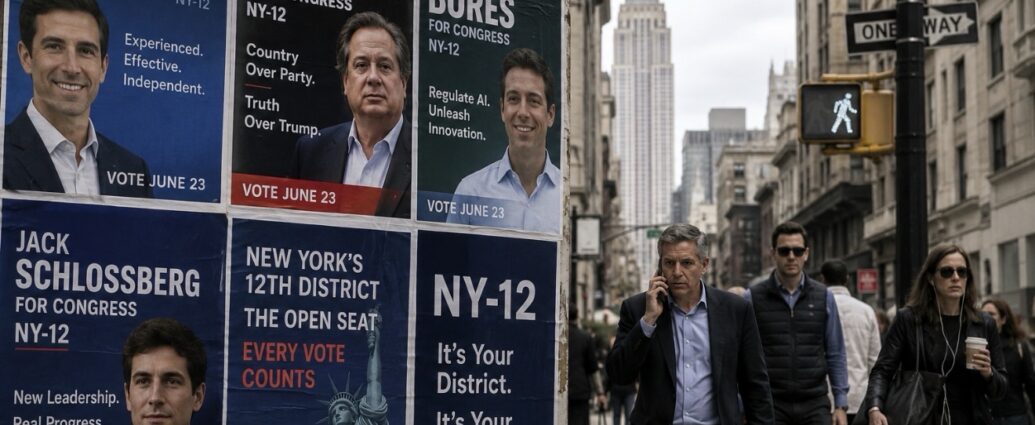
NEW YORK, May 26, 2026 — Retiring Representative Jerry Nadler announced in September 2025 that he would not seek a 17th term, opening New York’s 12th Congressional District for the first time in more than three decades and triggering what has quickly become the most expensive open-seat House race in the country.
The district — covering Manhattan’s Upper East Side, Upper West Side, Midtown, Hell’s Kitchen, Chelsea and Stuyvesant Town — is the wealthiest congressional district in New York State, one of the wealthiest in America, and among the most politically influential donor bases in the country. The June 23 Democratic primary is widely viewed as the real election in the heavily Democratic seat.
What makes the race extraordinary is not just the candidates. It is the money, the industries and the power centers lining up behind them.
Former New York Mayor Michael Bloomberg is preparing to spend roughly $5 million through allied outside groups backing Assemblyman Micah Lasher, according to NY1, marking one of the largest single-donor interventions in a House primary this cycle. Lasher previously worked for both Nadler and Bloomberg and is widely viewed inside Manhattan political circles as the establishment favorite.
For the business community, the race carries weight far beyond Manhattan politics.
Wall Street spent much of the past year reacting nervously to Mayor Zohran Mamdani’s political rise, with several finance executives warning publicly that New York’s competitiveness was under pressure. Pershing Square founder Bill Ackman became one of the most outspoken voices arguing that the city’s business climate was deteriorating. Inside finance circles, the NY-12 race is increasingly viewed as the next test of how Manhattan’s economic leadership wants to be represented in Washington.
Nadler himself endorsed Lasher in February, calling him the candidate best positioned to carry forward the district’s long-established political tradition. Lasher has raised roughly $2 million directly through the latest Federal Election Commission filing period, with his campaign emphasizing that most of his donations come from Manhattan itself.
But Lasher is far from alone.
Attorney and political commentator George Conway has turned the race into a nationalized anti-Trump fundraising machine, raising more than $3 million in the first quarter of 2026 alone, fueled heavily by national Democratic donors familiar with his television appearances and public criticism of President Donald Trump.
Then there is Alex Bores, the East Side assemblyman and former Palantir Technologies employee who has emerged as the race’s most important technology and artificial intelligence candidate.
Bores has centered much of his campaign around AI regulation and tech policy, triggering an unusual Silicon Valley proxy battle inside a New York congressional race. Pro-Bores outside groups funded by AI-industry executives are spending heavily to support him, while separate AI-aligned super PACs are simultaneously funding opposition efforts against him, according to campaign-finance filings reviewed by City & State New York.
The fight reflects growing tension inside the technology industry itself over how aggressively artificial intelligence should be regulated as AI becomes one of the largest investment themes in modern economic history.
Bores has raised nearly $2.9 million according to some campaign tallies, though critics note that much of his donor support comes from outside New York City, including substantial fundraising from California technology circles.
The race also includes one of America’s most recognizable political names.
Jack Schlossberg, the grandson of President John F. Kennedy, entered the race in November and quickly converted his social-media following into roughly $2 million in campaign fundraising. Schlossberg has leaned heavily into younger, digital-first campaigning styles and positioned himself as a generational-change candidate for Manhattan Democrats.
The broader stakes are enormous because NY-12 is not simply another congressional district.
The district’s donor ecosystem includes hedge fund managers, private-equity executives, major law-firm partners, real-estate developers, investment bankers and corporate executives who routinely finance national Democratic campaigns across the country. Whoever wins the seat inherits not only Nadler’s congressional position, but one of the most powerful fundraising networks in American politics.
Political observers increasingly see the race as a live proxy battle between several competing visions of elite Democratic power.
A Lasher victory would reinforce the Bloomberg-Nadler institutional establishment backed by Wall Street and traditional Manhattan political networks.
A Conway win would elevate a nationally known anti-Trump voice with crossover centrist appeal.
A Bores victory would hand Silicon Valley-aligned AI policy advocates a major platform inside Congress at the exact moment Washington is beginning to wrestle seriously with artificial intelligence regulation.
And a Schlossberg upset would instantly reshape the role celebrity, dynasty and social-media politics play inside modern House campaigns.
The filing deadline closed in April. Ten Democrats remain on the ballot. Early voting begins June 13.
For Wall Street, Silicon Valley and New York’s political establishment, the race is no longer just about replacing Jerry Nadler.
It is becoming a fight over who represents the future power structure of Manhattan itself.
JBizNews Desk
© 2026 JBizNews. All Rights Reserved. Reproduction or distribution without written permission is prohibited.