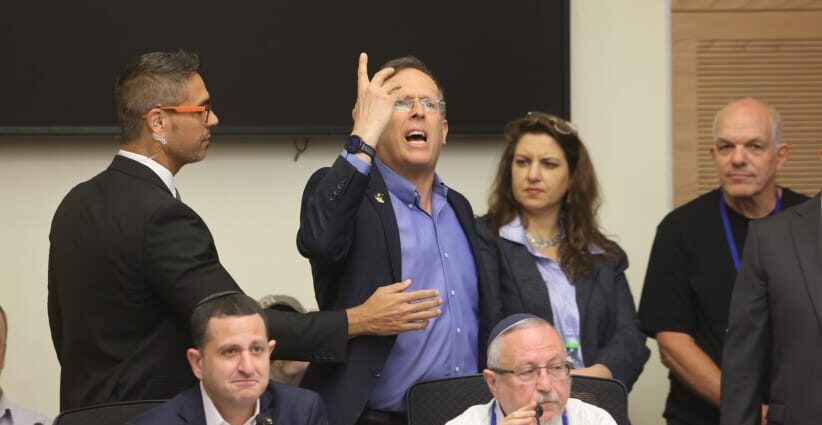
Lawmakers from the haredi (ultra-Orthodox) party United Torah Judaism were instructed by spiritual leader Rabbi Dov Lando on Sunday evening to stop cooperating with the coalition’s efforts to advance the controversial haredi draft bill, once again setting back progress on the legislation.
The progress on the contentious haredi draft legislation has become intertwined with the push for the haredi parties – Shas and United Torah Judaism – to dissolve the Knesset and move up the election date slightly from October 27 to September to better fit scheduling amid the High Holy Days.
Lawmakers in the Degel Hatorah faction within United Torah Judaism were told not to push for the coalition’s haredi draft legislation, Lando’s spokesperson told The Jerusalem Post on Monday.
Lando’s decision came amid doubts about whether the bill can pass, as multiple coalition lawmakers have spoken out against the legislation and vowed not to vote for it. They have warned that it would not solve the IDF’s manpower crisis and could severely harm Israel’s security.
Lawmakers against the legislation had been under pressure from Prime Minister Benjamin Netanyahu‘s coalition to support the bill.
Lando’s spokesperson criticized Netanyahu on Monday, saying it was no longer possible to rely on the legislation’s passage.
“If Netanyahu really wanted to pass this law, it already would have happened. We know that party leaders tend to break promises and not stick to what they said before elections,” Lando’s spokesperson said in a Monday Army Radio interview.
The renewed outline of the haredi draft bill was reportedly expected to be published on Sunday evening, after the coalition had resumed progress on it last week.
Netanyahu moving forward with draft bill in final bid against Knesset dissolution
Pushing to move forward with the draft bill, after progress on it was halted, was seen as Netanyahu’s final effort to persuade the haredi parties not to vote in favor of dissolving the Knesset, which would allow the coalition more time to pass legislation in its final Knesset summer session before the elections.
After the haredi parties’ stance on the bill shifted on Sunday evening, the coalition is now reconsidering whether to advance the haredi draft bill, which had been planned to advance rapidly, according to a Monday Kan News report.
The possibility that the coalition will no longer advance the bill comes after Government Secretary Yossi Fuchs had expressed his firm belief that it would be possible to secure a majority to pass the haredi draft bill in remarks made on Thursday.
Meanwhile, there have still been no committee meetings set to advance the Knesset dissolution bill.
If the coalition intended for the Knesset dissolution bill to pass quickly in three readings, it could expedite its passage.
The coalition had submitted its own bill to dissolve the Knesset, which passed its preliminary reading last week and still must undergo three more readings to become law.
The coalition’s submission of its own dissolution bill has been viewed as a way for Netanyahu to control the pace and timing of the elections, as it grants the government greater control over the process.
The bill proposes determining the election date in committee debates.
Even if elections are moved forward from the current scheduled date of October 27, they cannot take place in August because at least 90 days must pass after a Knesset dissolution bill is approved before elections can be held.
Directly ahead of the preliminary reading vote on the dissolution, the haredi draft bill had returned to the Knesset’s Foreign Affairs and Defense Committee for debate.
Draft legislation lacks coalition support
The coalition tensions began after Netanyahu told the haredi parties that the draft legislation did not currently have enough support within the coalition to pass. This led the parties to push for the Knesset’s dissolution.
Degel Hatorah’s spiritual leader wrote in a letter to the faction’s Knesset members that, “We no longer have trust in Netanyahu.”
Critics of the haredi draft bill say it is primarily intended to appease the haredi parties in the coalition and would do little to increase enlistment.
Haredi party leaders have pushed for legislation that would not significantly increase enlistment from the ultra-Orthodox population to the IDF.
The IDF has repeatedly warned of an urgent manpower shortage, especially after more than two years of war.
In March, IDF Chief of Staff Lt.-Gen. Eyal Zamir said the IDF could soon collapse if there is no solution to the manpower shortage.