By JBizNews Desk
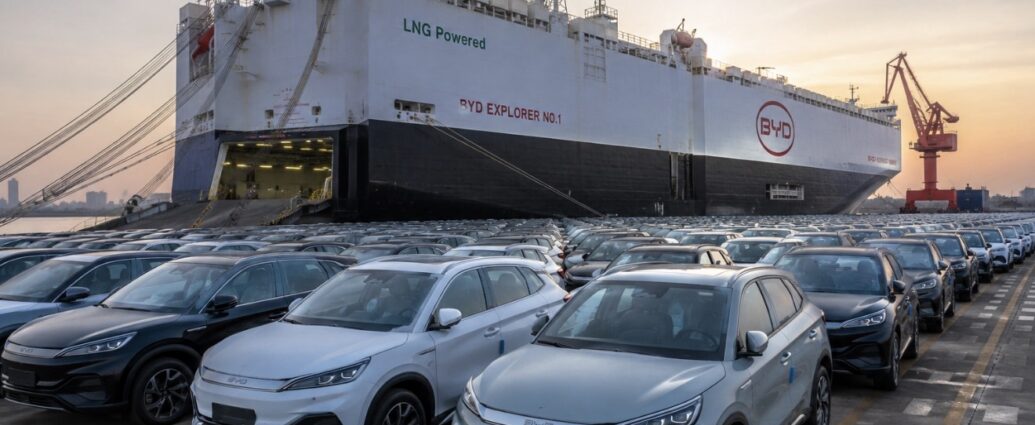
BEIJING — China Customs data released Tuesday, May 26, 2026, showed that the country’s electric vehicle exports jumped 40% year-on-year in April to 278,081 units, with Brazil emerging as the single largest destination after shipments to the South American economy soared 221% from a year earlier, underscoring how Chinese automakers are pivoting aggressively away from saturated Western markets toward Latin America, the Middle East, and emerging Asia to absorb mounting overcapacity at home.
The General Administration of Customs of the People’s Republic of China reported that Brazil alone took 38,144 EVs in April, the highest volume of any single nation or territory and a dramatic acceleration from a market that ranked outside the top ten as recently as 2024. The shift reflects both Brazil’s rapid embrace of affordable Chinese-built electric vehicles and a coordinated push by mainland automakers to plant manufacturing roots in the country before tariff increases scheduled for later this year fully take hold.
The April figures from China Customs confirm a structural rebalancing of Chinese EV exports that has accelerated throughout the first four months of 2026. Total EV shipments from China over the January–April period have approached 1.4 million units, more than double the same stretch of 2025, according to industry data tracked by the China Passenger Car Association and corroborated by analysts at Benchmark Mineral Intelligence.
The export boom is unfolding against a sharply weakening domestic Chinese EV market. Wholesale data published earlier this month by the China Association of Automobile Manufacturers showed domestic new energy vehicle sales in April fell 10.8% year-on-year to 914,000 units, the fourth consecutive month of double-digit declines tied largely to the expiry of consumer subsidies at the end of 2025. Manufacturers are increasingly redirecting unsold inventory and incremental production toward overseas buyers, transforming exports into the single most important growth lever for the sector.
BYD, now the world’s largest electric vehicle manufacturer by volume, has publicly committed to exporting 1.3 million vehicles in 2026, a 25% increase over last year. The Shenzhen-based automaker has become the dominant force behind the Brazil expansion, building a manufacturing complex in Bahia state and steadily expanding local capacity to absorb anticipated tariff pressure.
Rivals including Geely Holding Group, Chery Automobile, Great Wall Motor, and SAIC Motor are pursuing parallel strategies across Mexico, Thailand, Indonesia, the United Arab Emirates, and increasingly across Europe through local assembly arrangements designed to avoid direct tariff exposure.
Europe remains one of the largest targets for Chinese EV manufacturers, but the strategy there is rapidly evolving. According to Benchmark Mineral Intelligence, roughly 22% of all EVs sold in Europe so far in 2026 were built in China, up from 19% in 2025. But rather than exporting finished vehicles directly into the European Union, automakers are increasingly shifting toward European assembly operations to bypass anti-subsidy tariffs imposed by Brussels.
Stellantis and Leapmotor announced in April plans to produce the B10 electric SUV at Stellantis’s Zaragoza facility in Spain, while XPeng has begun local production of its P7+ model through Magna Steyr’s plant in Graz, Austria. BYD continues to ramp manufacturing operations at its new facility in Szeged, Hungary, positioning itself to deepen European penetration while reducing tariff exposure.
The picture in North America is far more restrictive. United States imports of Chinese EVs remain effectively blocked by tariffs and proposed federal legislation targeting connected Chinese automotive technology. Senator Bernie Moreno, an Ohio Republican, and Senator Elissa Slotkin, a Michigan Democrat, introduced the bipartisan Connected Vehicle Security Act of 2026, legislation that would prohibit Chinese-connected vehicles and software systems from operating on American roads over national security concerns.
The measure has drawn broad support from U.S. automakers and industry trade associations worried about both cybersecurity vulnerabilities and the competitive pressure posed by heavily subsidized Chinese manufacturers.
Analysts at AlixPartners project Chinese passenger-car exports overall will rise another 20% in 2026, with electric vehicles accounting for the overwhelming majority of that growth. The consultancy argues that China’s scale advantage in batteries, lower manufacturing costs, and increasingly sophisticated supply-chain control are creating structural advantages that Western competitors may struggle to reverse this decade.
Geopolitics is adding further momentum. The ongoing disruption tied to the Iran conflict and elevated global oil prices has intensified concerns about long-term fuel costs across emerging economies including Brazil, India, Mexico, and Southeast Asia. Analysts at the Atlantic Council recently argued that sustained volatility in global crude markets could provide a major structural tailwind for Chinese EV exports through the second half of 2026 and beyond.
For Beijing, the export surge serves multiple strategic goals simultaneously. It absorbs excess industrial capacity, supports manufacturing employment during a period of weak domestic demand, and entrenches Chinese technology standards across global EV infrastructure — from charging systems and battery chemistry to connected-vehicle software ecosystems.
For policymakers and legacy automakers in Detroit, Wolfsburg, Tokyo, and Seoul, the April China Customs figures reinforce a competitive challenge that appears to be widening rather than narrowing.
The 278,081-unit April figure is unlikely to mark a peak. With BYD, Geely, Chery, and a growing list of Chinese EV startups all ramping export programs simultaneously, analysts expect monthly shipment volumes to climb above 400,000 vehicles before the end of the summer.
© 2026 JBizNews. All Rights Reserved. Reproduction or distribution without written permission is prohibited.