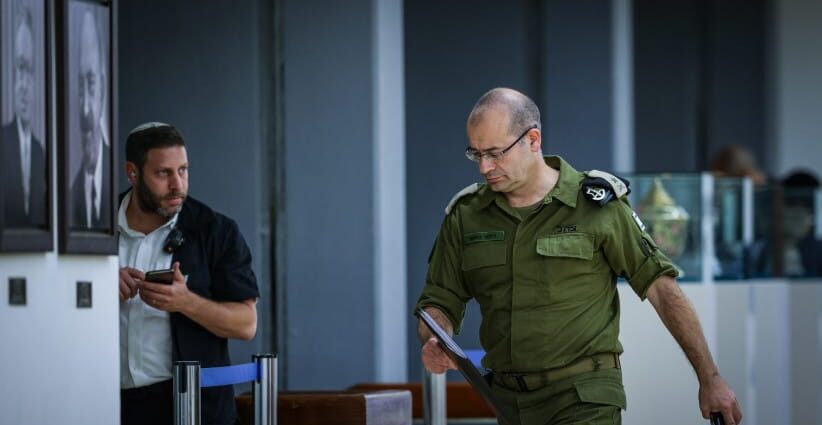
The High Court of Justice gave all parties until Wednesday evening to respond to a supplementary opinion by the Senior Appointments Advisory Committee, after a majority of the panel again cleared IDF Maj.-Gen. Roman Gofman’s appointment as the next Mossad chief and said new material had only strengthened its position.
The decision by Justices Dafna Barak-Erez, Ofer Grosskopf and Alex Stein came shortly after the committee submitted its updated opinion, along with the protocols of its additional hearings and reviewed materials in a sealed envelope. The justices ordered all sides to submit responses by 6 p.m. Wednesday, keeping the petitions alive days before outgoing Mossad chief David Barnea is set to leave office and Gofman is slated to take over on June 2.
The opinion followed a previous High Court order requiring the committee to complete its review by hearing from petitioner Ori Elmakayes, Brig.-Gen. G., Gofman, and any other relevant figures. The petitions challenge Netanyahu’s decision to appoint Gofman, currently Netanyahu’s military secretary, over questions tied to the Elmakayes affair, in which Elmakayes, then a minor, was allegedly operated through an IDF-linked influence effort connected to the 210th Division when Gofman commanded it.
The committee held two additional meetings, on May 21 and May 24, hearing from Elmakayes; Brig.-Gen. G., then head of the IDF Intelligence Directorate’s Operations Division; Tzur Wexler, an intelligence officer in the 210th Division who was in direct contact with Elmakayes; Maj. Z., who appeared by Zoom; and Gofman himself.
The new material included G.’s affidavit about a May 2022 phone call with Gofman, classified investigative material, Elmakayes’s indictment and the later notice withdrawing it, a May 7 letter by Barnea, and a 511-page WhatsApp file containing their correspondence.
Majority of commitee unanimous on Gofman as new Mossad chief
A majority of the committee – former Mossad official Shula Eytan, former civil service commissioner Moshe Dayan, and attorney Talia Einhorn – said they were “unanimous” that no flaw had been found in Gofman’s integrity, and that the additional materials had “substantially and meaningfully” strengthened their view.
Committee chairman and former Supreme Court president Asher Grunis remained in the minority. In his separate opinion, Grunis said he saw no reason to change his earlier position that Gofman should not be appointed, writing that, from the perspective of integrity, Gofman was “tainted” by his role as commander of the 210th Division in 2022.
Grunis said the central question was whether the communications between the division and Elmakayes dealt only with non-classified information or also with classified material. That question, he wrote, was not for Elmakayes or the committee itself to decide, since the committee lacked the expertise to determine what was classified. He said a military official, under the committee’s direction and supervision, should review the WhatsApp correspondence, and that additional matters still required examination.
Grunis also noted that Barnea was set to finish his term within days, but wrote that there were “different ways” to have another person serve in the role for a short interim period while the matter was further examined.
The majority sharply rejected that approach, saying the committee’s mandate was limited to assessing the candidate’s integrity, not recommending interim arrangements or sending the matter to an outside body.
The majority also took direct aim at Grunis’s handling of the WhatsApp material. The three members said they had read the 511 pages carefully and wrote that the messages were the “best evidence” for assessing the contact between Elmakayes and Wexler. They noted that Grunis had told them in the May 24 meeting that he had not read the messages, adding: “This is regrettable.”
WhatsApp correspondence did not support presented claims
According to the majority, the WhatsApp correspondence did not support Elmakayes’s claims that Wexler told him “everything was approved from above,” that he was gradually given classified material, or that Gofman’s name was mentioned to him. Elmakayes himself, the majority wrote, confirmed before the committee that he had never had any contact with Gofman, that “the name Roman [Gofman] was not mentioned,” and that Wexler “never mentioned the name.”
The majority concluded that Elmakayes had not brought “a shred of evidence” that Gofman knew his identity before the matter reached the media roughly two years later. It said Gofman had given only general approval to transfer to an anonymous “blogger” information that had already been lawfully published elsewhere, and that even this required approval in hindsight, leading to a command comment that was not placed in his personal file.
The majority further found that Gofman’s answer to Brig.-Gen. G. in May 2022 – that he did not know of such an operation or classified leak from his division – was true. It said Gofman believed no classified material had been handed over by the division, sought to check the matter with subordinates, but was prevented from doing so because an investigation was underway.
Gofman, according to the opinion, told the committee that what was at stake for him was his integrity. The claim that he knew Elmakayes had been operated and then abandoned him, the committee recounted, “seriously hurt him.” He also said he learned Elmakayes’s identity only when the affair broke in the media, after receiving a journalist’s query.
In another unusual passage, the majority criticized the handling of a classified legal opinion by Attorney-General Gali Baharav-Miara, saying they were surprised to learn it had been sent personally to Grunis as “secret” and “for the addressee only,” rather than to the committee’s secretariat. The other members, they said, did not receive it until May 20.
Netanyahu rejected Grunis’s minority opinion after the committee submitted its findings, saying Gofman had been put through unnecessary hardship and that the further review had turned up nothing. He said he expected the High Court to reject the petitions and not delay Gofman’s entry into office “in the midst of a war on seven fronts.”