Facing persistent food inflation and increasingly cost-conscious consumers, a growing number of U.S. restaurants are experimenting with pay-what-you-want pricing models as operators search for ways to keep dining rooms full without driving customers away with higher menu prices.
One of the most visible experiments is unfolding in New York City at HAGS, the acclaimed Lower East Side restaurant run by James Beard-nominated chef Telly Justice and wine director Camille Lindsley.
The restaurant has spent several years operating pay-what-you-can weekend brunches and is now expanding the concept nationally through a new dinner series launching with partner restaurants in Philadelphia, New Orleans, and Charlotte.
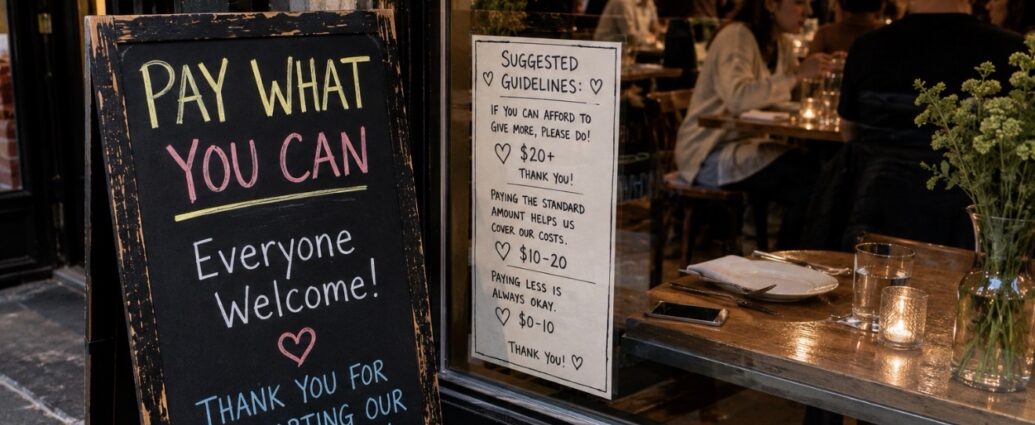
The structure is simple but unusual for modern American dining: guests pay whatever they can afford rather than a fixed menu price.
At a time when tasting menus in major cities routinely exceed $200 per person, the model is gaining attention as independent restaurants struggle to navigate rising costs and weakening consumer demand.
Justice said the concept reflects growing pressure on diners who increasingly feel priced out of full-service restaurants altogether.
The model depends heavily on a mix of loyal regular customers, diners willing to pay above-average amounts, and enough overall traffic to offset lower individual payments from guests with tighter budgets.
Several restaurants testing the approach have adopted suggested pricing tiers tied loosely to income levels or financial flexibility. Diners are encouraged to pay more if they can afford it, pay approximately the actual cost if comfortable, or contribute a reduced amount if they otherwise would not dine out at all.
Restaurant owners say the structure helps remove some of the social awkwardness around deciding what feels “fair” while preserving accessibility.
The economic pressure driving these experiments is significant.
A nationwide consumer survey released earlier this year by restaurant technology firm Popmenu found roughly 68% of Americans are reducing restaurant spending in 2026 and prioritizing affordability and convenience more heavily than in prior years.
Average weekly restaurant spending declined to approximately $90 earlier this year from roughly $115 during mid-2025, according to the survey.
At the same time, 71% of restaurant operators said they planned additional menu-price increases this year as labor, rent, insurance, and food costs continue climbing.
Independent restaurants in cities like New York are facing especially intense pressure.
Operators are dealing with rising commercial rents, elevated wage costs, congestion pricing impacts, and ingredient inflation that the National Restaurant Association says remains roughly 30% above pre-pandemic levels.
At the same time, the financial gap between cooking at home and dining out has narrowed substantially as grocery inflation remains elevated.
The pay-what-you-want trend is also spreading beyond New York.
In Austin, Texas, Italian restaurant L’Oca d’Oro has drawn national attention for its “Pay What You Will Tuesdays,” which ownership says are generating stronger midweek traffic and higher overall revenue than traditional pricing previously produced on slower nights.
According to interviews with NPR, most diners still pay a substantial portion of the standard bill, while beverage sales and service charges continue generating stable revenue streams for the business.
Restaurant owners experimenting with the model say the goal is not charity but traffic preservation and customer retention during a period when consumers increasingly hesitate before spending on discretionary dining.
Large chains, however, remain skeptical.
Panera Bread famously experimented with a pay-what-you-want concept through its “Panera Cares” cafes beginning in 2010 before ultimately shutting the initiative down after years of financial losses.
That experience continues serving as a cautionary example throughout the industry and helps explain why most current experiments are concentrated among smaller independent operators rather than national chains.
The broader economics of the restaurant business remain difficult.
Industry analysts estimate operating costs across the U.S. restaurant sector remain roughly 30% above 2019 levels, while margins for many full-service restaurants continue hovering in the low single digits.
Food and beverage inflation is expected to continue rising through the remainder of 2026, while labor expenses remain elevated following years of wage increases across hospitality industries.
Consumer behavior is also shifting in ways that complicate traditional restaurant pricing strategies.
Cristin O’Hara, head of Bank of America Global Commercial Banking’s Restaurant Group, recently noted that many consumers who previously traded down toward fast-food chains for value are now reducing restaurant visits altogether or seeking visible affordability even at casual dining establishments.
Industry consultants say price sensitivity now cuts across nearly every income level.
For restaurants, that creates a difficult balancing act: raise prices too aggressively and traffic falls, but absorb inflation entirely and already-thin margins disappear.
The Trump administration’s tariffs on imported food products and packaging materials have added additional pressure across parts of the industry, particularly for restaurants dependent on imported seafood, produce, coffee, and specialty ingredients.
Few analysts believe pay-what-you-want pricing will become a mainstream national model.
But the fact that respected independent restaurants are experimenting with it — and in some cases generating stronger traffic and customer loyalty — highlights how dramatically consumer dining habits are changing under prolonged inflation pressure.
For restaurant owners across the country, the message is becoming increasingly clear: affordability is no longer just a marketing strategy. It is becoming central to survival.
JBizNews Desk — New York
© 2026 JBizNews. All Rights Reserved. Reproduction or distribution without written permission is prohibited.