
The Jewish community remained the most common target of extremist or terrorist threats in Belgium in 2025, the Coordination Unit for Threat Analysis (OCAD) revealed in its annual report, released on Tuesday. Political authorities were the second most common target.
OCAD said the number of physical incidents in Belgium has remained limited, although Jewish organizations indicated that not all incidents were actually reported to the police. The total number of extremist or terrorist threat reports received by OCAD in 2025 decreased significantly compared to the previous year (213 threat reports in 2024 compared to 157 in 2025).
Despite this notable decline compared to previous years, Islamist extremism remained the largest threat category in 2025, accounting for 39% of all reports. These threats mainly stemmed from Islamist and jihadist ideologies. As many as 86% of the persons in the ‘Joint Database on Terrorism, Extremism, Radicalization Process’ are Muslims or are linked to Islamist ideology.
Approximately one quarter of the reports (24%) concerned a context linked to foreign affairs. These included cases related to tensions between Diaspora communities in Belgium, threats against embassies or Belgian interests abroad, or threats against foreign embassies in Belgium.
Thirteen percent of the threat reports involved a right-wing extremist motive, while 8% involved an anti-government or anti-establishment motive.
Right-wing extremist threat reports doubled in 2025
The number of threat reports originating from left-wing extremist circles remained relatively low, accounting for 4% of the total number in 2025.
Finally, 2% of such reports concerned state-related threats, meaning they were linked to activities carried out by or on behalf of foreign states.
OCAD said that right-wing extremist ideology is well-established within Belgium’s threat landscape and that the number of threat reports doubled in 2025, rising from around 10 to about 20.
However, this increase in activity does not mean that the intent to commit violence increased proportionally. OCAD found that the right-wing extremist threat in Belgium mainly manifested itself through what could be described as “low-intensity violence” and that there is an increasing trend towards blending traditional nationalist, identitarian, and racist views with modern conspiracy theories, such as the “Great Replacement” theory.
Anti-Islam and anti-immigration positions formed important ideological driving forces, as did antisemitism.
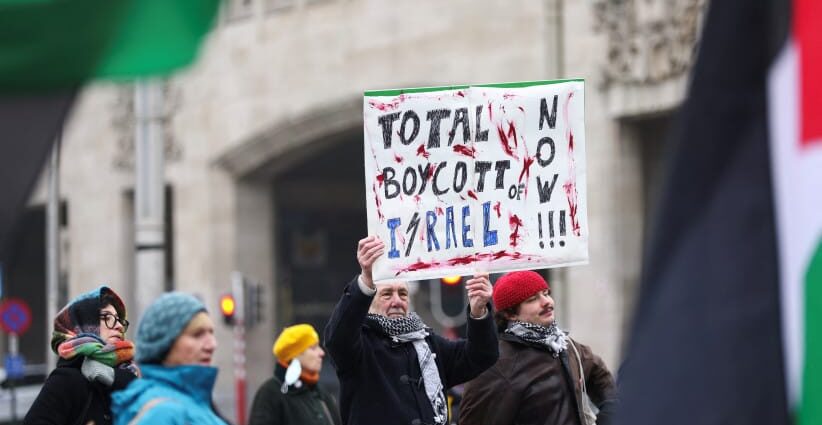
With regard to left-wing extremism, OCAD linked the increase in activity in this sphere to the strong mobilization surrounding the war in Gaza and tensions in the Middle East. In addition, it noted numerous acts of vandalism targeting companies, banks, or research institutions with ties to Israel. Some of these actions caused relatively significant material and financial damage.
OCAD said that certain extremist actors repeatedly attempted to “instrumentalize the narrative surrounding the violence in Gaza and the West Bank, as well as the perceived injustice toward Palestinians, for propaganda purposes or to attract sympathizers.”
“As many as 86% of the persons in the ‘Joint Database on Terrorism, Extremism, Radicalization Process’ are Muslim, but only about 8% of the population in Belgium is Muslim,” said Belgian MP Sam van Rooy. “This is therefore an enormous, gigantic over-representation.”
“Mainstream media and politicians will now try to gloss this over by focusing on the means that is increasingly being used to radicalize (online, TikTok), as well as on a new category devised by OCAD, namely ‘nihilistic extremism.’ Meanwhile, the Islamization of our society is proceeding at breakneck speed.”




