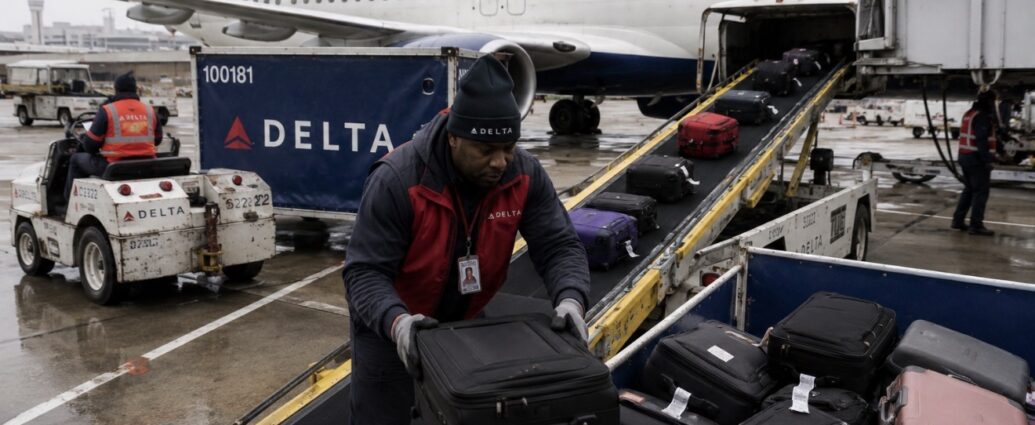
Delta Air Lines is using a homegrown artificial intelligence system to move more than 100,000 bags every day through Hartsfield-Jackson Atlanta International Airport, the busiest airport in the world by passenger traffic.
The system is part of a broader operational overhaul as airlines head into the busiest travel stretch of the year and increasingly turn to artificial intelligence to manage complex physical logistics in real time.
Paul Buckley, Delta’s director of operations in Atlanta, described the scale of the operation bluntly:
“Atlanta is an enormous operation, Delta’s biggest by a long way.”
The company says the AI-driven system has improved baggage transfer success rates by as much as 20%, a major operational gain in an industry where lost or delayed luggage remains one of the biggest customer frustrations.
The scale of the challenge is enormous.
On busy days, Delta handles well over 100,000 bags in Atlanta alone. Roughly three-quarters of those bags are connecting between flights rather than starting or ending their journeys there.
Each suitcase moves through a fast-moving network involving:
- Aircraft unloading
- Conveyor systems
- Scanning stations
- Ramp crews
- Tug drivers
- Gate transfers
- Connecting departures
Even minor delays can result in bags missing flights.
The new AI platform is designed to reduce exactly that problem.
Previously, baggage tug drivers received lists of assignments and largely determined routing themselves.
The new system functions more like a real-time logistics engine.
Using live operational data, the AI constantly analyzes:
- Aircraft arrival times
- Gate changes
- Weather conditions
- Connection windows
- Available drivers
- Tug locations
- Aircraft departure schedules
The software then dynamically routes baggage teams toward the most urgent transfers at any given moment.
Delta employees still physically move the bags, but the AI increasingly determines the fastest and most efficient way to do it.
The technology has already produced measurable improvements.
According to Delta, transfer success rates for connecting bags have improved significantly since implementation, reducing both delayed luggage claims and operational costs tied to baggage recovery.
The system is especially valuable during heavy travel periods when storms, delays, and gate changes create cascading operational pressure across airport systems.
The airline plans to expand the technology beyond Atlanta later this year, including deployments in Detroit and Minneapolis-St. Paul.
For Delta, Atlanta serves as the testing ground because few airports in the world present greater operational complexity.
The AI rollout also highlights a broader trend unfolding across corporate America:
artificial intelligence is increasingly moving beyond chatbots and software into large-scale physical operations.
Companies across logistics, retail, manufacturing, and transportation are now using AI systems to optimize movement, staffing, inventory, routing, and predictive maintenance.
In Delta’s case, the technology is being applied to one of aviation’s most difficult logistical challenges.
Importantly, the company says the system is not designed to replace workers.
Delta executives have emphasized that the AI functions as a decision-support tool rather than an automation replacement program.
The company says the software has proven especially helpful for newer baggage crews who may not yet have years of operational experience navigating Atlanta’s massive airfield efficiently.
The timing of the rollout is critical.
The Transportation Security Administration expects record summer passenger volumes this year as travel demand remains strong despite higher airfare and fuel costs.
Atlanta alone processes tens of millions of travelers annually, with Delta operating hundreds of departures daily from the airport.
For passengers, baggage systems typically go unnoticed when everything works correctly.
But delayed or lost bags remain among the most visible operational failures airlines face.
That makes improvements even at the margins financially meaningful for carriers.
The move also comes as airlines face increasing pressure to modernize aging infrastructure and improve reliability after several years of operational disruptions tied to weather events, staffing shortages, software failures, and record passenger demand.
For Delta, the technology represents a quieter but highly practical form of artificial intelligence deployment.
It is not flashy consumer AI generating images or writing essays.
Instead, it is software deciding which baggage tug should move which suitcase across one of the busiest airports in the world — and exactly when it needs to happen.
As summer travel volumes ramp up, the coming months will provide the largest real-world test yet for Delta’s expanding AI logistics system.
JBizNews Desk — Atlanta
© 2026 JBizNews. All Rights Reserved. Reproduction or distribution without written permission is prohibited.