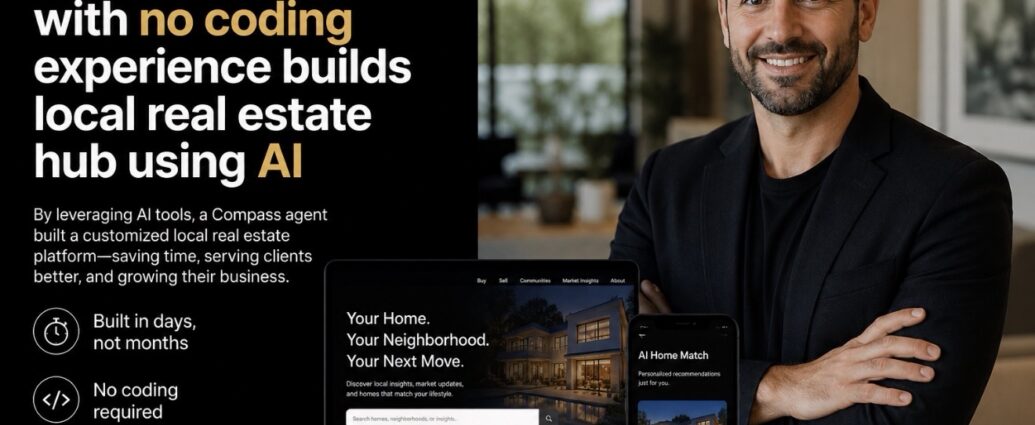
A real estate agent with no technical background spent 11 months using artificial intelligence (AI) to build a hyperlocal educational website — aiming to replace what she calls a fragmented online landscape for buyers and sellers.
Irina Norrell, who leads Compass’s Irina Norrell Team in the Washington, D.C., metro area, told HousingWire she grew frustrated with clients spending initial meetings covering basic market mechanics.
“[The need to explain the basics] isn’t because my clients aren’t informed — they’re some of the most educated people in the country — but because our industry does a terrible job of explaining itself,” she said.
After a failed attempt to hire a developer, Norrell began editing the backend herself.
When manual efforts began to hit roadblocks, she turned to Claude, Anthropic’s AI tool, and now describes her relationship with the technology as a true partnership.
“A lot of people look at me weird when I say that [working with Claude] is a partnership, but it really is,” Norrell said. “You cannot just blindly take everything that Claude or any other AI gives you and accept it and just put it on your website.
“Of course, with the coding and SEO and calculators, I rely completely on Claude, but I do now know a little bit more about all three, so I’ve managed to progress there.”
Since launching the site, Norrell said she’s been brainstorming ways to stand out from larger real estate portals.
“People are not used to having so much information and such detailed information on very local websites,” she said. “Then can be Googling, say, ‘What are the closing costs in Washington, D.C. area?’ My website has calculators but [also] gives you the exact laws and all of those things, I’m still not going to come up on top of searches, just because all the bigger brokerage sites or portals will be on the top.”
A moment of inspiration
Norrell said she was on the verge of abandoning work on the site after another 12-hour day.
She was turning off her computer when she saw Claude’s app still open.
Until that moment, her use of AI had been limited to writing and researching. But she had kept reading about Claude being very good at coding.
“I was thinking, ‘Coding, coding,’ and an idea came to me,” Norrell said. “That section I’d been fighting with all day, where one line of text kept sitting misaligned for reasons I couldn’t figure out — what if I showed Claude what I was trying to do and it could code it correctly?”
She found an HTML widget, asked Claude to explain how to use it and then requested they code the problematic section together. She copied the code, pasted it and kept working past 1 a.m.
“My house was quiet except for my loyal pug snoring up a storm at my feet,” Norrell said. “I was exhausted — emotionally, physically — but I knew I wasn’t done. I wasn’t going back to the developer. I knew I might just pull this off and create the site I envisioned.”
Looking back after launching the site, Norrell said her biggest mistake was starting too big.
“I started with this huge vision, and it just kept getting bigger and bigger,” she said. “It doesn’t have to be this way. You can add on later. You can start the process and start showing people your value and the value of your team and have a basic website and just add to it. I did it a little bit the other way around, and it was not the easiest way, for sure.”
Client education post-NAR settlement
Norrell said lawsuit settlements changing how buyer agent commissions are communicated has made transparency more urgent and more welcome.
“All of us — clients and agents — were always, not ashamed, but it was always almost like a taboo to talk about your commission,” she said. “This is something that is so much money that was basically talked through very fast; either you agree to this or you don’t agree to this.
“I welcome [new transparency] tremendously. Although sellers and buyers still are kind of confused about how all this works and how the buyer’s agent commission now becomes part of the contract, it’s allowed us as listing agents and buyer’s agents to talk about it openly.”
She said hyperlocal education is what distinguishes a knowledgeable agent from someone selling million-dollar houses on television.
“This is exactly the part that brings value,” Norrell said. “This is why sellers and buyers pay us this money. Hyperlocal education shows people that you know what you’re talking about, and it should not be behind a paywall.”
She added that her website includes a blueprint for selling a home, available to anyone — even those who choose not to hire an agent.
“Once you are open and once you are showing people what our job is and what our value is, a lot of them decide [to hire an agent],” said Norrell. “It’s because all of a sudden they do realize, ‘Yes, I can sell it for sure — because everybody can — but there are so many things that can go wrong,’”
A future industry standard?
Norrell said she is not sure whether AI-powered local resources will eventually become expected for top-producing agents and teams.
“I think what is probably going to happen is going to be some kind of hybrid,” she said. “It will be AI, powered by a third party platform, but because of being AI powered, it would still allow it to also be more local than they are right now.”
For now, she is putting her own AI partnership into the world to serve as inspiration for fellow agents looking to expand their own tech horizons — while also keeping clients better informed.
“Is this a useful resource for my clients? I very much hope so,” Norrell said. “I guess what comes next is just putting it out there and finding out if I’m right. Are consumers looking for this kind of resource — the knowledge to make better choices with their biggest investment? Or am I misreading the data and drawing conclusions that fit my own worldview?
“Could be. But I’d rather put it out there and find out than spend another year wondering.”