By JBizNews Desk
Picture this. A regime that was broke three months ago is sitting in a hotel suite in Doha, Qatar, talking about getting $100 billion back. Their currency had collapsed. Their oil exports were near zero. Their people were furious about food prices.
And now they are about to walk away with a deal.
How did that happen? Let’s walk through it.
Who is at the table?
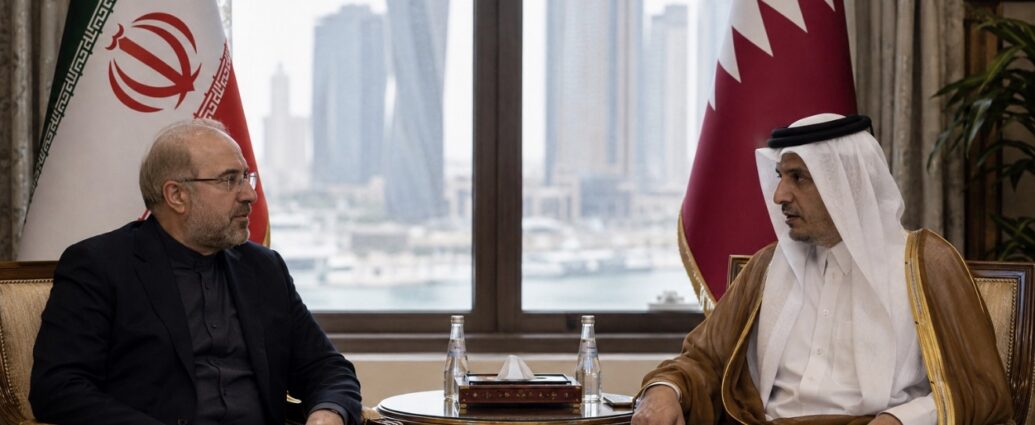
On the Iranian side, the chief negotiator is Mohammad-Bagher Ghalibaf, the Speaker of Iran’s Parliament. He flew to Qatar on Monday, May 25, 2026, and met with Qatari Prime Minister Sheikh Mohammed bin Abdulrahman Al Thani. He flew home to Tehran on Tuesday. With him in Doha were Iranian Foreign Minister Abbas Araghchi and Central Bank Governor Abdolnaser Hemmati. The central bank governor being in the room tells you everything. This is about money.
On the American side, President Donald Trump’s Middle East envoy Steve Witkoff is running point.
What does Iran want?
Two things, and Iranian officials are openly telling Arab mediators what they are. First, they want their money back — roughly $100 billion in assets that the West froze. Second, they want to sell oil on the world market again.
But there is a third goal, and this is the one that should make every American pay attention. Iranian officials told the mediators they want to give up just enough on their nuclear program to get the money — but not enough to let President Trump stand up and say he won.
In plain English: Iran wants the cash, but it does not want Trump to look like a winner.
What is America getting?
Here is where the story gets uncomfortable. The U.S. wants Iran to reopen the Strait of Hormuz, the narrow waterway where roughly one out of every five barrels of the world’s oil normally passes through. Iran mined it during the war. Ships cannot move. American drivers are paying more at the pump. That is the pressure squeezing the White House right now.
In exchange for reopening the Strait, Trump is offering Iran a 60-day window where sanctions get lifted, oil sales restart, and the frozen money starts moving.
What about Iran’s nuclear weapons program? That is supposed to get negotiated during those 60 days. Over the weekend, Trump softened one of his biggest demands. He had wanted Iran to ship its enriched uranium to the United States. Now he says he would accept Iran destroying it or sending it to another country.
That is a big walkback. Iran is sitting on 440.9 kilograms of uranium enriched to 60% purity, according to the International Atomic Energy Agency. That is one technical step away from a bomb.
Did they really keep talking while shooting at each other?
Yes. And this part tells you how desperate the regime is.
Late Monday night, U.S. Central Command struck Iranian speedboats it said were laying mines in the Strait of Hormuz. Iran fired on U.S. planes. The U.S. hit back at missile-launch sites in southern Iran. Several Islamic Revolutionary Guard Corps fighters were killed.
And what did Tehran do? It delayed announcing the deaths of its own soldiers so the talks in Doha would not blow up. Think about that. The regime would rather hide its own casualties from its own people than walk away from this deal. That is how badly Iran needs the money.
Why is Iran so desperate?
Because the regime is broke. Inflation hit 48.6% in October 2025 and 42.2% in December. The rial collapsed. Trump’s maximum-pressure order in February 2025 cut Iran’s oil exports to almost nothing. Then the war in February 2026 shut down the Strait. The regime ran out of room.
What does Israel think?
Israel hates this deal. A senior Israeli official told reporters this week that the agreement “is bad because it signals to the Iranians that they possess a weapon no less effective than a nuclear one, and that is the Strait of Hormuz.”
That is the Israeli argument in one sentence. Iran just learned that if it chokes the world’s oil supply, the United States will rush to the table and write a check. Why would Iran ever give that lever up?
Another person familiar with the talks told reporters that Israel is “very unhappy” with the deal and “angry” at Witkoff for “pushing a deal at any cost.”
What does the market think?
The market thinks something is coming. Brent crude dropped as much as 6.4% on Monday to $96.90 a barrel. WTI traded near $91. Charu Chanana, chief investment strategist at Saxo Markets in Singapore, told clients the two sides may be closer on a ceasefire but they are still far apart on sanctions and on the nuclear program. The market, she said, has priced in relief — but not a real fix.
According to the International Energy Agency’s May 2026 oil report, Brent has swung from a high of $144 a barrel all the way down below $100 and back up to about $110. More than 14 million barrels a day of Gulf oil has been shut in. The world has already lost more than one billion barrels of supply since the war began.
So yes, getting oil flowing again would help every American. That is real. That matters at the gas pump.
So what is the catch?
The catch is this. Iran gets oil sales, frozen funds, and a sanctions break. America gets verbal promises and a 60-day window to figure out the nuclear file. There is no signed cap on Iran’s uranium enrichment. There is no signed inspection deal. There is no signed plan to destroy the stockpile before the cash flows.
And in Tehran, lawmaker Ebrahim Rezaei, a spokesman for the parliament’s National Security and Foreign Policy Commission, posted on X this week that the Iranian delegation in Doha “must negotiate from a position of victorious power” and “not whitewash the red lines.” He called Iran “the definitive victor of the war.”
That is the message the regime is sending to its own people. They won. America blinked.
So who actually wins?
If the deal goes through, oil prices fall and gas gets cheaper. That helps Trump. That helps American families heading into summer.
But strategically? Iran is the regime that came in needing this. Iran is the regime that gets to keep its uranium. Iran is the regime that learned how powerful the Strait of Hormuz is as a weapon. And Iran is the regime that is privately telling Arab mediators that the whole goal is to walk away with the money — without giving Trump a clean win.
Secretary of State Marco Rubio said this week the Strait of Hormuz “will open one way or the other.” He is right that it will open.
The harder question is on whose terms.
For now, it looks like Tehran’s.
JBizNews Desk — Middle East
© JBizNews.com All Rights Reserved. Reproduction or distribution without written permission is prohibited.