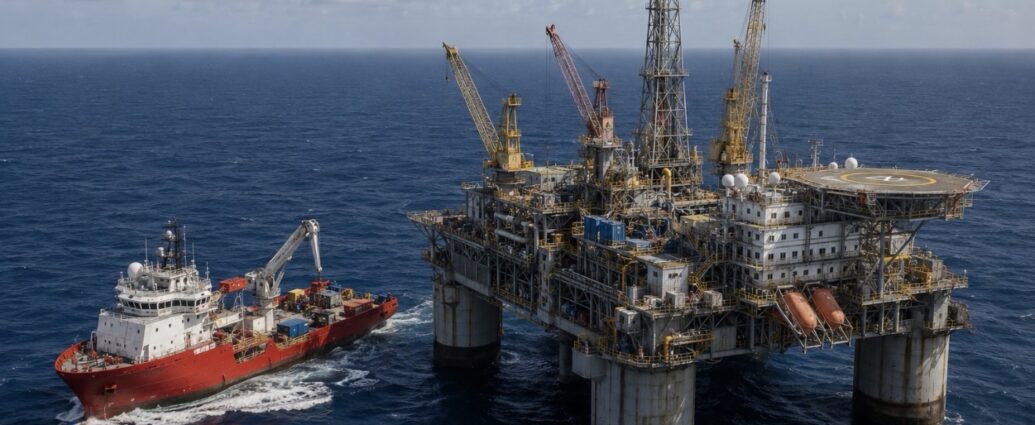
WASHINGTON — The U.S. Interior Department, led by Secretary Doug Burgum, announced that it is combining two major federal offshore drilling regulators into a single new agency called the Marine Minerals Administration, a restructuring that will oversee the largest expansion of American offshore energy development in decades and open new waters across the Gulf of Mexico, Alaska, California and Florida to oil, gas and seabed mining.
The move represents one of the most consequential energy-policy shifts of President Donald Trump’s second term and signals the administration’s determination to dramatically increase domestic energy production while reducing dependence on foreign mineral supplies, particularly from China.
At its core, the change merges two agencies created after the 2010 Deepwater Horizon disaster.
The first is the Bureau of Ocean Energy Management (BOEM), which has handled offshore lease sales and managed the commercial side of offshore energy development.
The second is the Bureau of Safety and Environmental Enforcement (BSEE), which has been responsible for inspecting offshore rigs, enforcing safety standards and responding to oil spills.
Both agencies were established in 2011 after investigators concluded that the previous regulator, the Minerals Management Service, had become too closely aligned with the oil industry it was supposed to oversee.
That conclusion followed the catastrophic Deepwater Horizon explosion in April 2010, when a BP-operated drilling rig exploded in the Gulf of Mexico, killing 11 workers and releasing nearly 5 million barrels of crude oil into the ocean over three months in what became the worst offshore oil spill in U.S. history.
Before that disaster, one agency handled both lease sales and safety enforcement. Critics argued the structure created an inherent conflict of interest because the same officials approving drilling projects were also responsible for policing the companies operating them.
The Obama administration broke the agency apart. The Trump administration is now putting those functions back together.
In announcing the merger, Burgum said the new structure would create a “streamlined approach” with “clearer coordination, better service to the public and stronger, more integrated oversight of offshore energy development.”
Critics, however, say the reorganization recreates many of the same structural risks exposed after Deepwater Horizon. Representative Jared Huffman, the top Democrat on the House Natural Resources Committee, has publicly opposed the merger, arguing that combining leasing and enforcement responsibilities under one roof weakens independent oversight.
The new agency will oversee three major initiatives.
The first is a dramatic expansion of offshore drilling.
In November 2025, the Interior Department proposed the 11th National Outer Continental Shelf Oil and Gas Leasing Program covering 2026 through 2031. The plan includes 34 offshore lease sales — including 21 in Alaskan waters, 7 in the Gulf of Mexico and 6 in Pacific waters off California — while also reopening areas near Florida that have not seen offshore lease activity in decades.
The scale marks a major reversal from the prior administration. President Joe Biden’s offshore leasing program proposed just three lease sales over five years, the smallest schedule ever offered by a U.S. administration.
The second major mission of the new agency is even more ambitious: building America’s first large-scale offshore mining industry.
The Marine Minerals Administration will oversee seabed mineral leasing in waters near Virginia, Alaska, Guam and the Northern Mariana Islands, targeting deep-sea deposits rich in nickel, cobalt, copper and rare earth elements — critical minerals used in batteries, electric vehicles, defense systems, semiconductors and advanced electronics.
The strategic significance is enormous because the United States currently depends heavily on Chinese-controlled supply chains for many of those materials.
Administration officials increasingly frame seabed mining not simply as an energy issue but as a national-security priority tied to competition with China in electric vehicles, artificial intelligence, military technology and semiconductor manufacturing.
The third mission of the agency is continuing the safety and spill-response role previously handled by BSEE, including rig inspections, environmental enforcement and emergency response operations.
There is one major complication: staffing and budget pressure.
Both BOEM and BSEE have lost personnel in recent years, and the Trump administration’s latest budget proposal reduces funding for the newly combined agency even as its responsibilities expand dramatically. Industry groups argue the merger will reduce duplication and improve efficiency, while critics warn the agency could become overstretched overseeing both aggressive leasing expansion and safety enforcement simultaneously.
The economic implications are substantial.
Offshore drilling already accounts for roughly 15% of total U.S. oil production, and federal estimates suggest the Outer Continental Shelf still contains approximately 68.8 billion barrels of recoverable oil and 229 trillion cubic feet of natural gas.
For major Gulf operators including Chevron, ExxonMobil, Shell and BP, the restructuring is expected to accelerate permitting and expand access to offshore acreage. Additional domestic production could eventually help moderate gasoline and natural gas prices, although most offshore projects require years of development before significant production begins.
The political response varies sharply by region.
Energy-producing states along the Gulf Coast, including Texas, Louisiana, Mississippi and Alabama, are expected to benefit economically from increased drilling activity, port traffic and infrastructure investment.
Meanwhile, officials in California, Florida and parts of Alaska are raising concerns about environmental risks, particularly the potential impact of spills on tourism, fisheries and coastal ecosystems.
The broader message from Washington is becoming increasingly clear. The Trump administration is pursuing the most aggressive expansion of offshore energy production and seabed mineral development the United States has seen in a generation — while simultaneously rolling back a regulatory structure created after the worst offshore environmental disaster in American history.
Supporters call the merger efficiency. Critics call it a return to the conditions that failed before Deepwater Horizon.
The administration is expected to finalize the new offshore leasing program by October 2026.
Washington — JBizNews Desk
© JBizNews.com All Rights Reserved. Reproduction or distribution without written permission is prohibited.