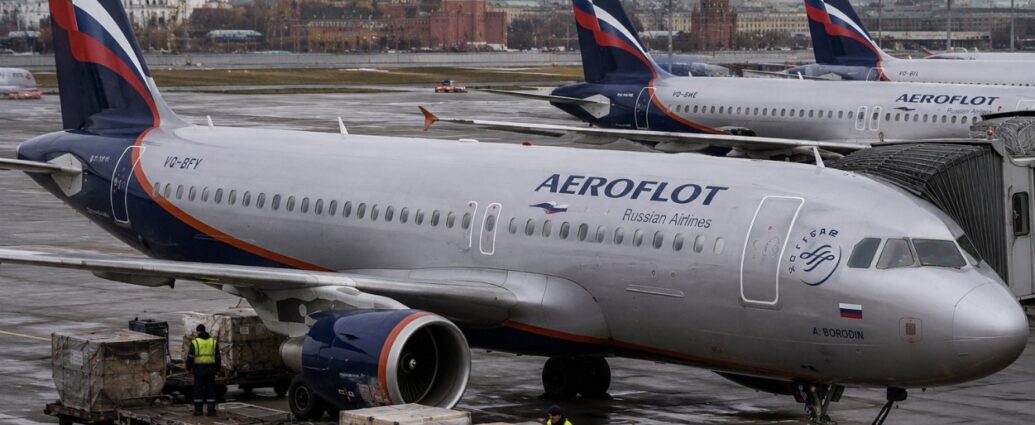
MOSCOW — Four years after the United States, Europe and Britain moved to cripple Russia’s commercial aviation sector following the invasion of Ukraine, the country’s airlines are still flying — and in many cases carrying passenger volumes approaching prewar levels — thanks to a sprawling shadow supply network moving Boeing and Airbus parts through intermediaries across China, India, Turkey, the United Arab Emirates and Central Asia.
What Western sanctions were supposed to do was straightforward: starve Russian carriers of spare parts, maintenance support and aircraft servicing until large portions of the fleet became unusable.
That has not happened.
Instead, a sophisticated gray-market ecosystem involving brokers, shell companies, repair shops and transit hubs has emerged to keep airlines such as Aeroflot, S7 Airlines and Ural Airlines operating despite formal bans on supplying Western aircraft parts to Russia.
The scale is enormous.
According to customs records compiled by Trade Data Monitor, China alone shipped at least $961 million worth of aircraft parts into Russia between March 2022 and February 2026, more than four times the level recorded before the war. Trade records also show recurring transit activity through India, Turkey, the UAE, Kazakhstan and Kyrgyzstan, with many shipments routed through multiple jurisdictions before reaching Russian operators.
Aviation experts say the most remarkable part of the trade is not small components — it is the movement of entire jet engines.
Oleksandr Laneckij, chief executive of Lithuania-based aviation consultancy Friendly Avia Support, said the underground flow of engines into Russia “remains widespread,” estimating that as many as 50 complete engines per year are reaching Russian carriers despite sanctions.
That figure is striking because modern commercial aircraft engines are among the most expensive and tightly tracked components in global aviation.
One transaction trail illustrates how the system works.
In December 2025, a Florida-based aviation supplier called LogAir LLC sold an older CFM56-5A engine — commonly used on Airbus A320 aircraft — to an Indian firm named Chandsara for approximately $3.6 million.
Roughly two weeks later, another Indian company, Shreegee Pvt. Ltd., shipped the same engine onward to Russian airline S7 for about $5.75 million.
The transaction drew attention because the U.S. Treasury Department had already sanctioned a related company, Shreegee Impex Pvt. Ltd., in 2024 for allegedly supplying Russia with hundreds of dual-use items, including aviation components. The companies reportedly shared addresses, logos and directors.
The broader pattern appears deliberate and highly structured.
Aircraft parts often leave legitimate American or European distributors with paperwork showing apparently lawful destinations in third countries. Brokers and intermediaries then reroute the parts into Russia through shell entities created specifically for single transactions.
When Russian repair facilities cannot service components domestically, the parts are sometimes exported again under foreign ownership, repaired abroad, then quietly reintroduced into Russia through what aviation specialists describe as “one-day companies” established solely to obscure the chain of custody.
Both Boeing and Airbus publicly insist they are not participating in the trade.
Boeing says it halted parts, maintenance and technical support to Russian customers in early 2022 and continues complying with U.S. sanctions. Airbus has similarly told European investigators there is “no legal method” for aircraft, parts or technical documentation to be exported into Russia.
But both companies also acknowledge a major limitation: once parts enter the global aftermarket — the enormous web of brokers, repair stations, leasing firms and resellers operating worldwide — manufacturers have limited visibility into where components ultimately end up.
The sanctions themselves were expected to force Russian airlines to begin grounding Western-made aircraft.
Instead, the number of operational Airbus and Boeing aircraft inside Russia has barely declined since 2023, while domestic seat capacity has recovered close to 2021 levels, supported by strong internal travel demand and the lack of alternative transportation across Russia’s vast geography.
The growing concern now is safety.
Russian state agencies recorded 11 engine failures on civil aircraft between December 1, 2024 and January 20, 2025, more than double the figure reported during the same period a year earlier. Independent aviation monitors estimate Russian aviation incidents are rising at roughly 25% annually.
One widely discussed case involved a Ural Airlines Airbus A321 returning from Egypt in early 2025 after suffering a left-engine failure shortly after takeoff. The aircraft landed safely, but reports indicated the plane remained grounded because sanctions prevented access to a fully certified replacement engine.
The Kremlin has increasingly tried to frame the sanctions issue as a passenger-safety matter rather than simply an economic dispute.
At the International Civil Aviation Organization (ICAO) assembly in Montreal in 2025, Russian officials argued Western restrictions on spare parts were “discriminatory and coercive” and endangered civilian aviation safety.
Western governments rejected that argument, pointing out Russia itself seized roughly 500 Western-leased aircraft valued at approximately €10 billion after foreign leasing firms terminated contracts in 2022 following the invasion.
Russia is simultaneously trying to reduce dependence on Western aviation entirely.
The government has committed roughly $14.5 billion toward expanding domestic aircraft production through the end of the decade, aiming to raise the share of Russian-built aircraft to 81% of the national fleet by 2030.
Progress, however, has been uneven.
The Russian-built version of the MC-21 narrowbody jet only recently completed key flight testing, while production timelines for the Sukhoi Superjet and other domestic programs have repeatedly slipped because of missing Western components and ongoing supply-chain bottlenecks.
For now, the shadow supply chain remains the backbone of Russian commercial aviation.
But aviation experts warn the workaround becomes riskier with time.
Aircraft engines eventually wear out. Avionics drift outside certification standards. Maintenance histories become increasingly unreliable when parts pass through opaque gray-market channels.
Each additional year of cannibalized fleets, uncertified repairs and undocumented components raises the probability of a serious aviation accident.
And if a major crash were linked to sanctions evasion or uncertified parts, it could trigger an even harsher new round of restrictions from Western governments already struggling to contain the network.
The broader lesson for global sanctions policy is increasingly uncomfortable for Western policymakers.
Russia’s aviation industry was once viewed as one of the easiest sectors to isolate — highly dependent on Western manufacturers, globally integrated and impossible to replace quickly.
Yet four years later, the planes are still flying, the parts are still moving, and the underground network supplying them appears more sophisticated than ever.
Europe — JBizNews Desk
© JBizNews.com All Rights Reserved. Reproduction or distribution without written permission is prohibited.