By JBizNews Desk
WASHINGTON — Americans are consuming more honey than ever, but U.S. beekeepers are nowhere close to producing enough of it — a widening supply gap now being filled by record imports from countries that, in some cases, American producers say do not even have enough bees to justify the export volumes they report.
The imbalance is becoming one of the clearest examples of how the modern “clean eating” movement is colliding with fragile agricultural supply chains, rising production costs and growing concerns about imported food fraud.
The numbers are stark.
According to the U.S. Department of Agriculture, the United States produced roughly 134 million pounds of honey in 2024, down 4% from the prior year. American consumers, meanwhile, used an estimated 550 million pounds over the same period.
That means nearly three out of every four jars or squeeze bottles of honey consumed in the United States came from overseas.
In 2023, the U.S. imported approximately 429 million pounds of honey, with India, Argentina, Brazil and Vietnam supplying nearly 80% of total imports.
The demand boom itself is easy to explain.
Honey has become one of the signature ingredients of the broader “clean eating” and wellness movement, where consumers increasingly avoid refined sugar, high-fructose corn syrup and artificial sweeteners in favor of products marketed as natural, minimally processed and traceable.
Honey checks nearly every modern food-marketing box: single ingredient, minimally processed, recognizable and associated — fairly or not — with health and wellness.
Restaurants, protein-bar companies, beverage brands and premium grocery chains have steadily increased honey usage over the past decade as consumers became willing to pay more for products positioned as “natural.”
That demand is now running directly into the realities of the American bee industry.
Janel Inouye, co-owner of Magpie Cafe in Sacramento, California, said her restaurant goes through a five-gallon bucket of honey roughly every three weeks for dishes including crispy pork belly and house-made honey lemonade.
She told reporters she is paying roughly 30% more for honey than she was five or six years ago.
“I don’t know that I’ve seen anything that has been a sticker shock the way that we’ve seen honey jump,” Inouye said, adding she would sooner remove dishes from the menu than substitute another sweetener.
The problem for U.S. beekeepers is that even rising retail prices have not translated into industry stability.
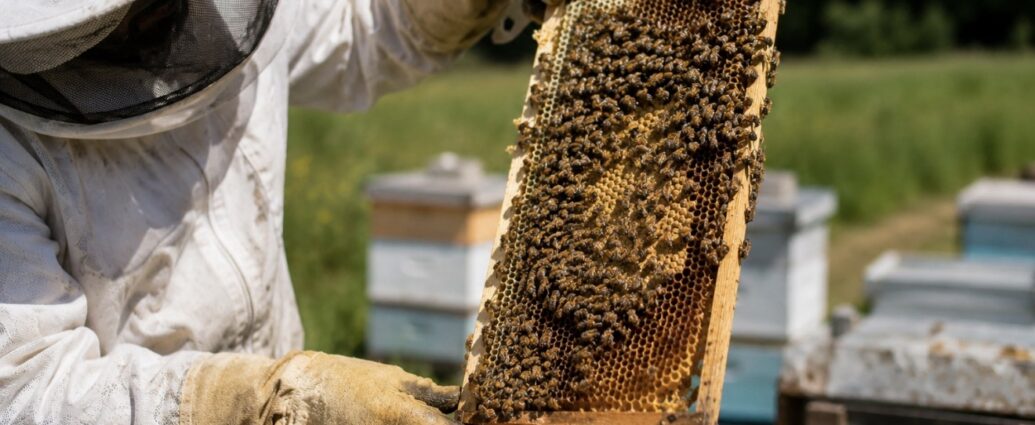
The biggest threat remains the varroa mite, a parasitic insect that attaches to honey bees and spreads viruses capable of wiping out entire colonies.
Researchers at Washington State University projected earlier this year that commercial U.S. honey bee colony losses could reach between 60% and 70% in 2025, dramatically above the already devastating 40% to 50% annual losses that have become common in recent years.
Pesticide-resistant mite strains are now widespread across parts of the industry.
At the same time, operating costs for commercial beekeepers have surged.
Large U.S. operators routinely truck hives across multiple states throughout the year, following crop bloom cycles — almonds in California, apples in Washington, blueberries in Maine and dozens of other pollination markets.
That makes fuel prices critically important.
The current Middle East conflict and elevated oil prices — with crude trading roughly between $100 and $106 per barrel — are feeding directly into diesel, shipping and feed costs for commercial bee operations.
“For most markets, the price is still below the actual cost of production,” said Ryan Burris, president of the California State Beekeepers Association.
Tim Hiatt, legislative liaison for the Washington State Beekeepers Association and vice president of the North Dakota Beekeepers Association, was even more blunt.
“For now, we’re just going to bite the bullet and hope the Iran War doesn’t last long so fuel and fertilizer prices go down,” Hiatt said.
Then there is the import controversy — part trade dispute, part quality scandal.
The United States remains the world’s second-largest honey market, and many of its biggest foreign suppliers are already subject to U.S. anti-dumping duties.
Current country-wide rates imposed by the U.S. Department of Commerce include 4.7% on Argentina, 2.31% on Brazil, 2.31% on India and a massive 121.97% duty on Vietnam.
Those tariffs come on top of the broader 10% blanket import tariff imposed during President Donald Trump’s second term.
The duties are intended to protect American producers from artificially cheap foreign honey.
But imports continue flooding in, and American beekeepers increasingly argue the trade data itself does not make sense.
Richard Adee, one of the largest commercial beekeepers in the United States and a former president of the American Honey Producers Association, has publicly questioned how countries like India could physically produce the export volumes they report.
“India doesn’t have anywhere near the capacity — enough bees — to produce 45 million pounds of honey,” Adee said publicly. “It has to come from China.”
That accusation matters because Chinese honey has long faced some of the steepest U.S. trade restrictions in the food sector due to prior allegations involving dumping, illegal antibiotics and pesticide contamination.
American producers argue Chinese honey is frequently rerouted through third countries and relabeled to bypass tariffs and inspections.
The authenticity problem has become so severe that organizers of the 2025 World Beekeeping Awards in Copenhagen canceled the honey competition entirely, citing widespread adulteration concerns.
In many cases, investigators say imported “honey” is diluted with cheaper sweeteners such as rice syrup or corn syrup while still marketed as pure honey.
For consumers, the implications are practical.
A premium jar of traceable, single-origin American honey sold at a specialty grocer may bear little resemblance to inexpensive imported honey sold in bulk squeeze bottles at discount retailers — even though both carry the same label.
The long-term market opportunity, however, remains substantial.
Industry researchers estimate the U.S. honey market was worth roughly $2.21 billion in 2025 and could grow to approximately $3.21 billion by 2035.
And honey itself is only part of the economic story.
When pollination services are included, American beekeepers contribute an estimated $15 billion annually to U.S. agriculture by supporting crops including almonds, apples, blueberries and dozens of other fruits and vegetables.
In practical terms, bees are not merely part of the sweetener business.
They are critical agricultural infrastructure.
Yet at the very moment demand is accelerating, federal support for bee research is shrinking.
The U.S. Department of Agriculture recently announced plans to close the Beltsville Agricultural Research Center in Maryland, home to the Beltsville Bee Research Lab, one of the nation’s most important bee disease and colony-testing facilities.
Commercial beekeepers have long relied on the lab to diagnose unexplained colony collapses and disease outbreaks.
Its closure would remove one of the few major federal support systems the industry still has during a period of historically severe losses.
For investors, food manufacturers and specialty grocery chains, the broader trend is becoming increasingly clear:
American demand for honey is rising rapidly. Domestic production is stagnating or falling. Imports remain politically contentious and increasingly suspect on quality grounds.
That combination should, in theory, benefit premium American honey producers and traceable domestic brands.
But whether U.S. beekeepers can capitalize on the opportunity depends on whether the industry can survive long enough to meet it.
Right now, consumers want more honey than America can produce.
The bees are struggling.
And the gap is increasingly being filled by foreign suppliers the U.S. government itself has already accused of unfair trade practices.
Washington — JBizNews Desk
© JBizNews.com All Rights Reserved. Reproduction or distribution without written permission is prohibited.