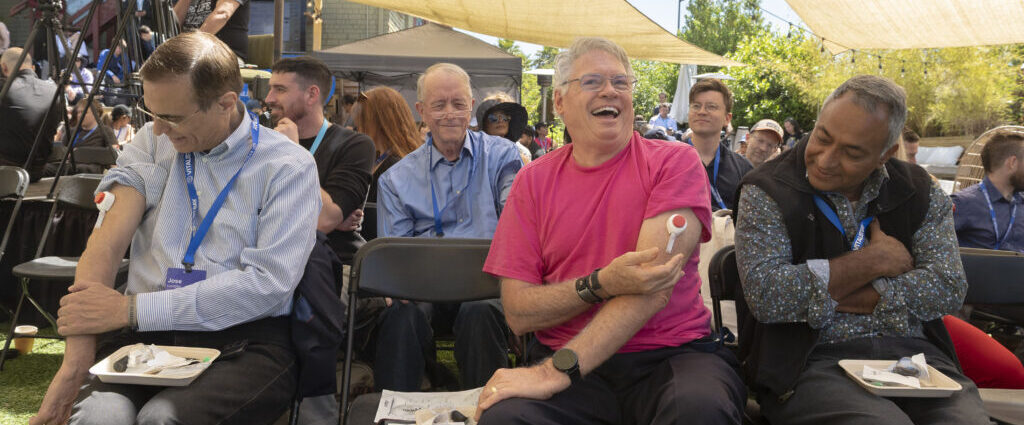
BERKELEY, Calif. — On a sunny Thursday morning, around 100 people sat on folding chairs beneath a lawn tent preparing to do a mass blood draw. Standing onstage with a tangle of morning glories as his backdrop, Robby Wade, CEO of at-home testing company Rythm Health, warned that the process might be a little chaotic given the size of the crowd.
Wade explained how to activate the heating pads by popping a small silver coin, prompting a chorus of admiring oohs from the audience as rays of warming crystallized gel spread like the sun. Within a few minutes, everyone, me included, had matching stick-on Tasso devices trickling blood from our upper arms into test tubes that promised to give insights into the health of our hormones, metabolisms, various organs, and biological age.
“It’s like Theranos, but it works,” said the gentleman sitting in front of me, who had recently given a talk on bodyoids — creating headless sacs of organs to replace aging people’s failing hearts and kidneys.
It was the first day of Vitalist Bay, a longevity conference-slash-festival launched last year that brings together founders, investors, biohackers, researchers, and the generally death-averse to discuss how to forestall, or even beat, our demise. Held at an event space (and rationalist AI doomer hub) called Lighthaven, the grounds were dotted with well-padded wicker patio furniture and taffy-pink rose bushes. Along with hearing talks on topics like cryopreservation and delaying menopause, attendees might opt to attend a workshop on longevity therapeutics led by a co-founder of BioAge Labs, drop by a Krav Maga lesson, or take a sound bath. The mood was buoyant, the Oura rings ubiquitous, the stakes existential.
“Are we just going to give up and die like every other generation?” Adam Gries, co-founder of the conference and larger Vitalist movement, asked in his opening remarks.
Giving up and dying had been basically my plan, though hopefully not for a long time. Perhaps that was because I hadn’t given enough thought, as the people at Vitalist Bay had, to considering the alternatives. As the field works to make the showdown against death and aging mainstream, the longevity community is now in the midst of shifting from “a movement to really more of an industry,” said Christine Peterson, co-founder of the Foresight Institute, which focuses on research on longevity and nanotechnology.