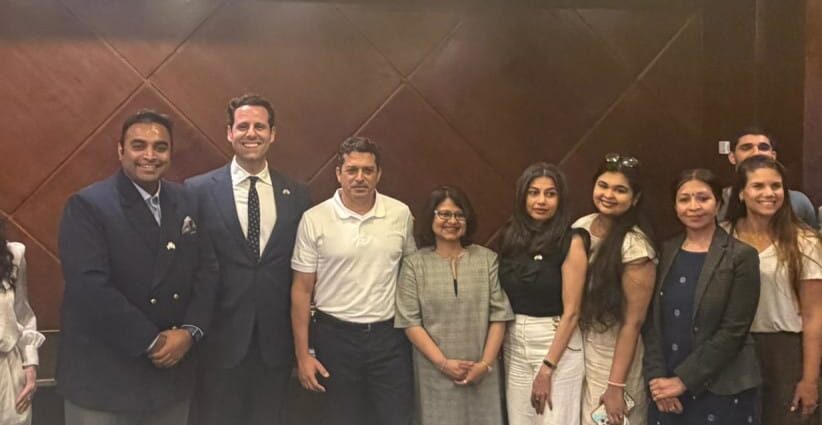
The partnership between India and Israel is fortified by shared problems, mentalities, and opportunities, and the friendship between the two nations is only set to grow in the future, a group of Indian political figures, entrepreneurs, activists, influencers, journalists, and commentators told The Jerusalem Post.
Speaking during a visit to Israel earlier this month, the group, an Indian delegation hosted by the Israel-India Friendship Club (IIFC), said they were proud of Indian Prime Minister Narendra Modi’s February visit to Israel.
“Prime Minister Modi and Prime Minister [Benjamin] Netanyahu, what they cemented during this visit was that we are civilizational partners,” said Vijeth Umbalagodu Thirthamallesh, an international collaborations strategist for an Indian Member of Parliament. “I really love that the prime minister [Modi] very categorically and clearly mentioned here that India stands with Israel today, tomorrow, and for a long time to come.”
During Modi’s visit, he and Netanyahu oversaw the signing of 16 economic, security, and diplomatic agreements between the two countries. Among the agreements signed was one allowing 50,000 Indian workers to come to Israel over the next five years. Modi also became the first-ever recipient of the Knesset Medal.
“What [the visit] showed to the world was that we find each other as natural partners for humanity, natural partners in technology, wherein we are very open as a brother nation,” Thirthamallesh added.
One of the common topics that came up among the delegates was India’s security concerns, particularly in relation to Pakistan, which they compared to Israel’s fight against regional terror groups.
Many also expressed empathy with the victims of Palestinian terrorism in Israel.
“When October 7 happened, I was hurt, I was deeply shattered,” Nikhil Chandwani told the Post.
Chandwani has around two million followers on Instagram and is the founder of Sindhi Hindu, an organization that says it has successfully evacuated and rehabilitated over 9,000 persecuted Hindu and Sikh minorities from Pakistan and Bangladesh.
He went on to lament what he described as a “muted response” to the Hamas-led massacres from the international media, saying it quickly engaged in “what-aboutism” directed at Israel.
India, Israel both ‘understand terrorism,’ Indian delegation member says
“India understands terrorism. Israel understands terrorism,” he said. “That is perhaps why Modi and Netanyahu came together and signed a lot of pacts. We now have joint defense pacts. Going forward, I feel this will only increase, only rise.”
In addition to agreements related to the defense sector, delegates also pointed to agriculture as a key area of cooperation between Israel and India.
Arushi Sana, a renewable energy entrepreneur who represented India at COP28, remarked that despite being in the Middle East and having large desert areas, Israeli technological innovations had “done wonders” for its agricultural industry.
“India is home to the world’s largest population, so for us, food security is everything,” she said. “We need to be able to feed all of our people. Our farming techniques are already very good, but I think they can also be a little more climate smart.”
Sana, the co-founder of Santerra Industries, a company that manufactures bio-pellets from agricultural waste as a renewable alternative to coal, pointed to agricultural innovation as an area where India could learn from Israel.
“We have a huge desert area there in the western part of our country, in Rajasthan, so it would be nice to start being able to use that land for agriculture,” she remarked.
Kavya Kriti, an Indian geopolitical analyst, social media influencer, and journalist, highlighted the commonalities between India and Israel, saying the two countries are “natural allies.”
“India and Israel, culturally we are two very ancient civilizations,” she said. “We’re facing a similar enemy, and this is why we always see that India is always clear and very vocal in its support for what Israel is going through and what the Jewish people are going through.”
She added, though, that she felt there should be more cultural exchange between the two nations.
“We see a lot of Israelis in India, but I don’t nearly see enough people like me coming over and experiencing Israel,” she said. “So, if we could just facilitate that, that would really help with combating the narratives that are said about Israel in the mainstream [discourse] right now.”
Bolstering the India-Israel ‘people-to-people connections’
Paushali Lass, an Indian-German geopolitical consultant and fellow of the IIFC, said she was dedicated to building these “people-to-people connections.”
Lass noted that she had traveled to Israel nine times since the October 7 massacre and that combating misinformation about the Jewish state was a priority in her work. Part of her strategy, she said, is mobilizing the masses in India.
“You can do deals on a governmental level, but unless you bring the people together, there’s no way for barriers to fall,” she said. “You have the world’s biggest democracy, the world’s biggest population [in India]. Israel needs to get more and more people to connect with it.”
Strengthening connections and alliances, not just between India and Israel but also between the broader Jewish and Indian diasporas around the world, is one of the missions of the IIFC, the organization’s co-founder, Dan, told the Post.
“The mission behind this is basically that we feel like we don’t have a lot of friends. In Western Europe, that increasingly feels true,” he said. “But actually, we have what I call a ‘sleeping giant friend’ in India.”
Dan asked not to be identified by his last name out of concern for reprisal and doxxing outside Israel.
He went on to say that India was unique in that, in addition to having a massive population, it has a history without antisemitism.
Dan added that India did not have any “blood libel baggage” and, being majority Hindu, the people there lacked a theological basis for pre-developed prejudices against Jews.
He added that the commonalities between Israel and India, as well as the lack of historical hatred for Jews in the South Asian country, presented an opportunity for mutual benefit, cooperation, and an ability to relate to each other’s struggles.
“There’s so much that we have in common in terms of our history,” he said, adding that India could be part of the answer in turning the public relations tide. “If there’s a billion people who potentially love us, if we convert even a small amount of that, that’s a game changer for Israel.”
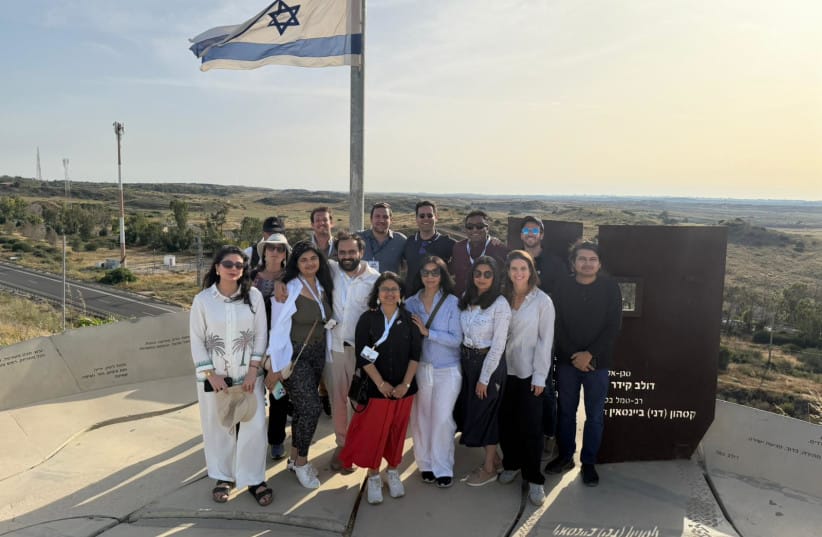
During the IIFC delegation’s visit to Israel, participants were taken around the country, including to Jerusalem, Tel Aviv, and areas near the Gaza border.
They also met with Israeli leaders, such as Diaspora Minister Amichai Chikli, and visited prominent sites, including Jerusalem’s Old City, the Yad Vashem Holocaust Museum, and the site of the October 7, 2023, Nova music festival massacre.
To learn more about the IIFC’s work, visit its website here: https://www.iifc.io/