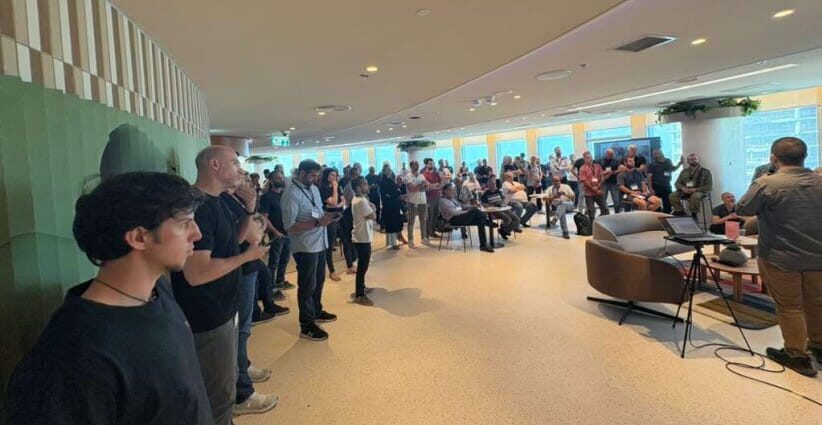
More than 200 members of Israel’s defense-tech community met on Tuesday for an urgent closed-door session to discuss how to accelerate deployment of solutions addressing the use of fiber optic and first person view (FPV) drones to attack IDF forces in southern Lebanon and northern Israel.
The gathering, organized by The CET Sandbox and called “Operation Northern Shield”, was assembled within days after they received direct operational requests from IDF units who have been dealing with the threat on a daily basis.
Writing on LinkedIn after the event, David Yahid, Co-Founder of The CET Sandbox recalled how “a friend from a special ops unit deployed in Lebanon sent a message. Bro, I just got back to reserve duty. What do you have against fiber optic suicide drones? Urgent.”
The initiative brought together a broad cross‑section of Israel’s defense ecosystem. Senior officers from northern‑sector counter‑drone units, special operations representatives, MAFAT (DDR&D) officials, early‑stage startups, and major defense primes all participated in the event that was designed to enable candid operational collaboration. Companies that attended included Intel, Elta, Xtend, Sharpshooter, Heven Drones, Axon Vision, Airwayz, Aerosentry Technologies and others.
According to Yahid, while the venue capacity was at 150, over 350 people signed up within 48 hours of the event being quietly publicized. Due to the participation request, those who could not physically attend joined a virtual session that ran in parallel.
“Operation Northern Shield reflects a new model for defense innovation, the same shift we’re seeing in the US with procurement reform” said Yahid. “The people experiencing the operational problem and the people building the technology were sitting at the same table, with capabilities being battle-tested in real time, not in a lab two years from now.”
Hezbollah’s fiber‑optic drones have emerged as one of the most challenging threats on the northern front killing and injuring troops and officers. Unlike traditional UAVs, these systems are physically tethered to their operators, making them effectively immune to electronic warfare and jamming. Their low cost-often under $1,000- enables mass deployment by Hezbollah and their onboard autonomy allows them to navigate and target with minimal external guidance.
During the session operators shared recent footage and firsthand accounts of encounters with these drones. At least one elite special operations unit moved immediately towards procurement discussions with a company and placed an order on the spot.
Amit Cherniak, CEO of Aquila Dynamics, a counter‑drone startup that participated in the session, noted that the urgency of the threat created an unusually collaborative environment. “Everyone was here to create solutions. Egos were left at the door,” he said.
The CET Sandbox serves as a nonprofit innovation hub dedicated to advancing Critical & Emerging Technologies (CET) between Israeli startups and key stakeholders across the US defense, government, and industrial sectors. Operating as a neutral bridge, the Sandbox helps Israeli innovators navigate the complex landscape of US national security and defense ecosystems, ensuring that the most promising technologies find a clear path to integration into the US ecosystem.
The organization now engages more than 700 companies and institutions across defense, government, venture capital, and industry. Its sister organization, CET Ventures, invests in Israeli companies positioned for rapid transition into US operational use, giving it early visibility into technologies aligned with American and allied demand signals.
The implications extend beyond Israel. Allied militaries, including the United States and NATO partners, are increasingly concerned about the rise of low‑cost autonomous systems that can bypass traditional defenses. But for Israel’s northern units, the threat is immediate. The developments unfolding between the IDF and Hezbollah are a warning to other militaries who don’t learn from frontlines far from their own and offer a preview of the next phase of drone warfare.
“We have a necessity to find a solution,” said a former IAF officer who attended the session. “That urgency is what produces results others can’t replicate.”