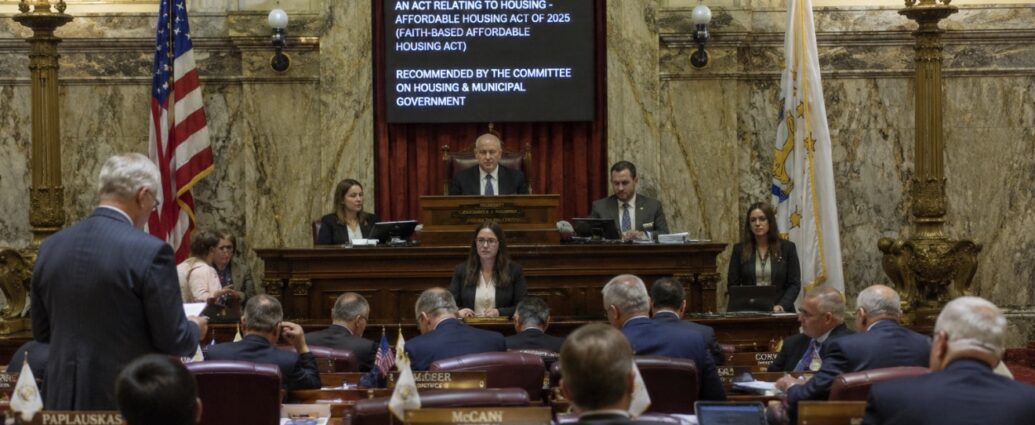
Rhode Island moved closer to joining a small group of states whose lawmakers are working to unlock religious institution land for affordable housing development.
At the same time, a major shift in the Ocean State’s House leadership may possibly derail the bill and a companion measure in a broader housing reform package.
Last week, the Senate Housing and Municipal Government Committee passed the Faith-Based Affordable Housing Development Act. The bill now heads to the full Senate.
The legislation draws from a national movement advocates call “Yes in God’s Backyard,” or YIGBY — a play on the “Not in My Backyard” opposition that has chronically stymied affordable housing. Supporters argue that faith-based institutions hold vast tracts of underutilized land in established, infrastructure-rich neighborhoods – prime sites for housing that would otherwise face years of local opposition.
Sen. Meghan E. Kallman’s bill would allow faith-based organizations to develop affordable and mixed-use housing on land they own as a by-right use. It also sets statewide development standards, limits local approval barriers and streamlines permitting.
Kris Brown, executive director of housing advocacy group Neighbors Welcome! Rhode Island told The Builder’s Daily that the bill’s Senate prospects are strong.
“When a committee chair brings it to a committee vote, they have solid support to pass it out of committee,” Brown said. “And then generally, bills that get to the Senate floor do pass.”
Shifting leadership creates uncertainty
The House bill has not moved out of committee, along with legislation legalizing single-room occupancy and incentivizing commercial-to-residential conversions. The Senate could act on the faith-based housing bill first, potentially sending its version to the House while representatives still weigh their own measure.
Rhode Island’s legislative session was thrown off course two weeks ago when House Speaker Joe Shekarchi resigned to pursue an open seat on the state Supreme Court. Shekarchi passed five housing reform packages and was pursuing a sixth this session.
His replacement, state Rep. Christopher Blazejewski, is considered more liberal than Shekarchi. It remains unclear how aggressively he will advance major legislation this session. Shekarchi groomed Blazejewski for the role and backed his elevation to Speaker.
“He’s been very loyal to Joe Shekarchi over the years,” Joe Fleming, a local TV news political analyst, said. “He’s obviously worked his way up.”
State Rep. June Speakman, who chairs the House Commission on Housing Affordability and sponsored the legislation, could be pivotal.
“Representative Speakman is certainly a housing champion in Rhode Island,” Brown said. “She’s been studying the housing crisis from multiple angles for several years now and really working to bring national best practices and evidence-based policy to Rhode Island to also respond to issues in the market and the regulatory environment locally.”
Following others
If the legislation passes, Rhode Island would join a handful of states that have enacted similar laws. California led the way in 2023, allowing faith-based and nonprofit college-owned land to be used for affordable multifamily housing by right.
Colorado followed in 2025, requiring local jurisdictions to permit residential development on qualifying faith-based and educational properties beginning later this year.
Virginia enacted its own version in April, when Gov. Abigail Spanberger signed legislation eliminating the rezoning requirement for faith-based affordable housing. It takes effect Jan. 1, with a sunset provision in 2031, and Florida updated its Live Local Act to include faith-based housing provisions.
Gov. Dan McKee has signed several housing reform packages in recent years. His office has not publicly commented on this legislation.