By JBizNews Desk
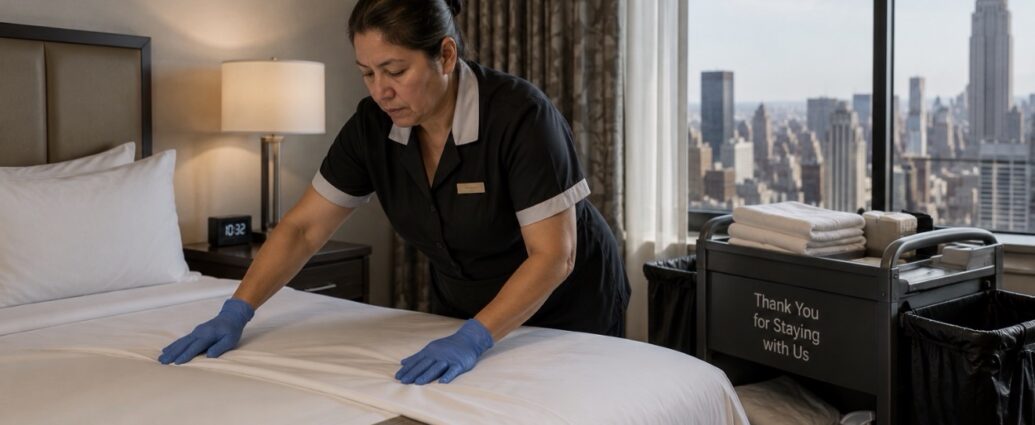
The people cleaning hotel rooms in New York City are on track to become some of the highest-paid hospitality workers in the United States.
Under a new tentative eight-year labor agreement reached between the Hotel and Gaming Trades Council and the Hotel Association of New York City, nearly 30,000 union hotel workers across more than 250 properties in the five boroughs secured what union leaders are calling the largest wage increase in the organization’s nearly century-long history.
By the end of the contract in 2034, the average New York City hotel housekeeper is projected to earn more than $100,000 annually, with hourly wages climbing from roughly $40 today to more than $61 per hour under the final years of the agreement.
Non-tipped hotel employees will see hourly compensation rise by approximately $21.20 over the life of the contract, representing average annual increases exceeding 5% per year — more than double the pace of raises in the prior agreement.
The contract was ratified by hotel operators on May 18 and approved by union members later that week, eliminating what hotel executives feared most: a labor disruption during the 2026 FIFA World Cup, which is expected to flood the New York metropolitan region with international tourists and drive hotel occupancy to near-record levels throughout the summer.
But the significance of the deal stretches far beyond organized labor.
It is also a direct test of how much additional cost the New York tourism economy can absorb before consumers begin pushing back.
The economics behind the agreement are unusually straightforward because both labor leaders and hotel operators effectively acknowledged the same reality: the bill eventually reaches the guest.
New York City already operates one of the most expensive hotel markets in the world, with average room rates hovering around $335 per night and occupancy levels near 84%, among the highest urban occupancy rates in the United States.
That pricing strength gave hotel operators confidence they could ultimately pass much of the labor increase into future room rates.
Mayor Zohran Mamdani described the agreement as a victory for “our hospitality industry, our economy, and for a city that works best when the people who keep it running can afford to live here too.” City Council Speaker Julie Menin similarly framed the deal as an economic-stability measure for workers and the broader city economy.
Behind the political messaging sits a simpler business calculation.
Hotel inventory is perishable. Every unsold room night disappears permanently once the night passes, creating powerful incentives for operators to continuously test how high prices can rise before demand weakens.
And right now, the ceiling appears unusually high.
American Express Global Business Travel’s Hotel Monitor 2026 had already forecast New York hotel prices rising roughly 4% this year before the union contract was finalized. Industry participants now expect actual pricing increases to exceed those projections.
Hotel owners themselves are openly acknowledging the pressure.
Hotelier John Born told The Real Deal that the agreement would “absolutely, positively” affect hotel profitability, adding that operators would rely on future room-rate increases to offset escalating payroll obligations.
“The raises are substantial and they compound over time,” Born said.
That may be the clearest explanation of what travelers booking New York hotel rooms are about to experience.
The labor agreement extends far beyond wages alone.
The contract preserves fully employer-funded healthcare coverage for roughly 27,000 workers and their families, while increasing hotel contributions to the union’s Health Benefits Fund from 27.25% to 30.25% of payroll — representing nearly $65 million annually in additional employer healthcare spending.
The deal also creates new employer-funded housing and childcare programs, expands paid time off, increases pension contributions, guarantees paid family leave for new parents and establishes paid leave for workers to vote in elections.
None of those expenses appear directly on a hotel invoice.
Eventually, all of them become embedded in nightly room pricing.
For the broader hospitality industry, the New York agreement is now viewed as a national benchmark.
Union organizers in Los Angeles, Chicago, Boston, San Francisco and Las Vegas have already begun citing the NYC contract in their own negotiations, according to industry participants and labor analysts. Hotel executives privately acknowledge the agreement will likely reset wage expectations across unionized hospitality markets nationwide.
That makes the New York contract more than a local labor story.
It is increasingly being viewed as the beginning of a broader wage repricing across the U.S. hospitality sector.
There is also a significant small-business angle often overlooked in the headline numbers.
While some of the city’s largest luxury properties fall under the agreement, many of the roughly 250 covered hotels are mid-market and independently operated businesses with thinner margins and far less flexibility to absorb rising labor costs.
Industry participants credited advocacy from the Multicultural Business Coalition, which worked alongside the Hotel Association of New York City during negotiations and pushed for phased wage increases designed to give smaller operators more time to adapt pricing structures and operating models before the highest-cost years of the agreement arrive.
The reason this contract matters beyond tourism is because it captures one of the defining tensions inside the broader American economy right now: organized labor is demanding larger gains in high-cost cities at the same moment consumers are already struggling with inflation-sensitive pricing.
The hotel worker earning six figures is the same New Yorker city leaders argue deserves the ability to live in the city they help operate.
The tourist paying $400 for a Manhattan hotel room is the same consumer whose spending supports the city’s restaurants, theaters, retail stores and service economy.
Both numbers are now rising together.
And for the next eight years, the answer to the question “Who pays for the raise?” increasingly points to the same person every time they check into a hotel.
New York — JBizNews Desk
© JBizNews.com All Rights Reserved. Reproduction or distribution without written permission is prohibited.