There is a contradiction running through the American economy right now that touches every household in the country, and on Wednesday morning, the chief executive of the largest U.S. airline put it in plain English. The same Americans who are telling pollsters they are nervous about the economy, worried about inflation, and unsettled by the war in the Middle East are also booking summer vacations, business trips, and weekend getaways at a pace that has the country’s airlines reporting some of their strongest demand of the year.
“People still want to travel and travel is still a bargain,” Robert Isom, the chief executive of American Airlines, told Bloomberg TV. Isom said American is now seeing strong demand across international and domestic travel, as well as for its premium offerings — the higher-margin first-class and business seats that airlines have spent the past several years trying to sell more aggressively. The numbers behind that statement are striking. American is already roughly 80% booked for the second quarter. Corporate travel is up 13% year-over-year. Leisure demand, in Isom’s word, is “incredibly” strong. The airline expects second-quarter revenue to rise 15% from a year ago on about 5% capacity growth — meaning each flight is generating about 10% more revenue than it did a year ago, even as gas prices for the jet fuel that powers the planes have surged.
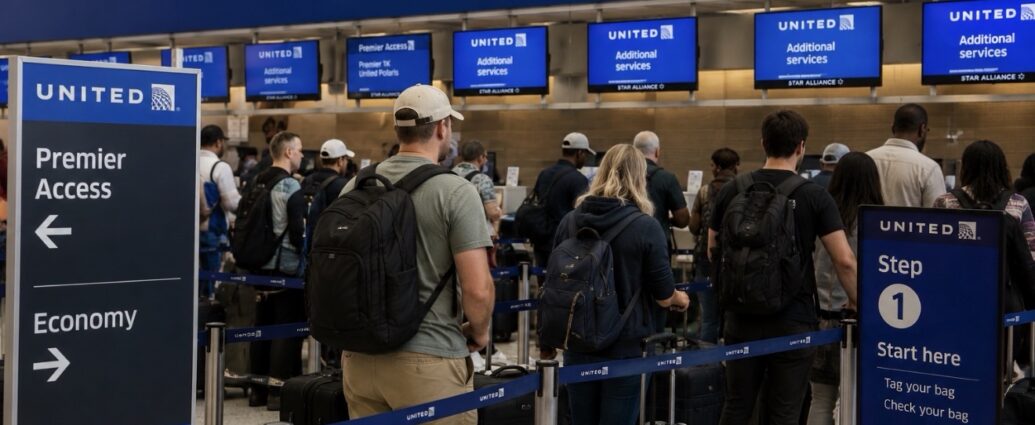
United Airlines Holdings Inc. said the same thing on the same morning. Demand at United, the country’s other major full-service carrier, also continues to be robust. The picture coming out of the two biggest U.S. airlines is consistent: Americans are still flying, still spending, and still booking.
For ordinary readers trying to understand why this matters, the story is much bigger than the airline industry. The reason economists and journalists watch consumer travel spending so closely is that flying somewhere is one of the most purely discretionary things a household can do. Nobody has to take a trip. When families are genuinely worried about money, the summer vacation is usually one of the first things to go. When companies are cutting costs, business travel is one of the first line items the finance department slashes. So when the airlines say bookings are strong, it is one of the cleanest real-world signals available that the American economy — at the household level — is still in better shape than the headlines suggest.
That signal sits in direct tension with what the consumer survey numbers are showing. The Conference Board reported on Tuesday that its closely watched consumer confidence index dipped to 93.1 in May, down 0.7 points from April. It was the first decline in four months. The Present Situation Index, which measures how Americans feel about the economy right now, fell more sharply — down 3.2 points to 121.2. The Expectations Index, which measures the six-month outlook, has now been below the recession-warning threshold of 80 for more than a year, sitting at 74.4 in May. Dana M. Peterson, the Conference Board’s chief economist, said in the release that “consumer confidence edged downward in May as the inflationary impacts of the war in the Middle East intensified,”  and that survey respondents are increasingly mentioning prices, oil and gas, war, and geopolitical conflict in their written-in concerns about the economy.
Two things can be true at the same time, and right now in America, they are. Households are nervous about the economy in surveys. The same households are still spending money on plane tickets, hotel rooms, restaurant meals, and summer vacations. The gap between what people say in a survey and what they actually do with their wallets is one of the most important economic stories of 2026, and air travel is the cleanest place to see it.
The reason ordinary Americans should care about this disconnect is that it changes what the rest of the year is likely to look like. If consumer confidence surveys turned out to be the right signal — meaning Americans were about to pull back hard on discretionary spending — the country would likely be heading into a meaningful slowdown by the end of the summer, with airlines, hotels, restaurants, and retail all feeling the pinch. If the actual booking and spending data turn out to be the right signal — meaning Americans are still spending despite their nervousness — the second half of 2026 could deliver another quarter of resilient growth, holding off the slowdown the surveys have been predicting since early last year. The airlines just placed their bets. They believe the real-world spending data is the truer signal.
The history of the past eighteen months gives Isom and his peers some reason for that confidence. American Airlines, along with most of the rest of the U.S. airline industry, had a very difficult spring of 2025. After President Trump’s “Liberation Day” tariffs in April 2025 sent global markets into chaos and rattled household confidence, leisure travel demand fell off sharply. American, Delta, Southwest, and United all pulled their full-year financial forecasts within weeks of each other, citing what Isom called the “reluctance of domestic passengers to get in the game.” Domestic main-cabin travel — the economy-class seats that ordinary American families fill — went soft. The airlines spent the rest of 2025 trying to figure out where the bottom was.
The picture in 2026 has been very different. Despite the war with Iran, despite oil prices that are pushing higher gasoline costs through the entire economy, despite a consumer confidence reading that has now spent more than a year flashing warning signs, Americans are still booking. The reason that matters is that the 2025 episode showed exactly how quickly travel demand can disappear when consumers genuinely panic. The fact that the same kind of collapse is not happening now, in conditions arguably more difficult than 2025, suggests that whatever is going on inside American households is not the kind of fear that ends with people canceling their summer trips.
The cost side of the airline business, however, is a real problem and worth understanding plainly. American Airlines said last month that it expects its 2026 jet fuel bill to rise by more than $4 billion compared to last year, a number that single-handedly explains why the airline cut its full-year profit forecast from a range of $1.70 to $2.70 per share down to a range of a 40-cent loss to a $1.10 profit. The Iran war’s effect on oil prices is hitting American directly. The reason the airline still expects to “repeat the profitability we had last year,” as Isom said Wednesday, is that the demand strength on the revenue side is large enough to absorb the cost hit on the fuel side. Travelers paying more for tickets, more corporate travel, and more premium-cabin bookings are covering the higher fuel bill. That math only works if demand stays where it is. If consumers genuinely pull back in the second half of the year, American’s 2026 profitability could disappear quickly.
The competitive backdrop is also worth noting because it explains some of what is happening to prices in the U.S. airline industry this summer. Spirit Airlines — the ultra-low-cost carrier that has been the price floor for budget-conscious American travelers for nearly two decades — filed for bankruptcy protection during 2025 and has materially reduced its capacity. The result is that the entire low-end of the U.S. domestic travel market is operating with fewer seats than a year ago. Less ultra-low-cost competition means slightly higher prices across the board, including at the larger carriers like American, Delta, United, and Southwest, which can sustain higher base fares because the cheapest competitor has gotten smaller. Isom was careful Wednesday not to declare the ultra-low-cost carrier model dead, but he was clear that American’s network, scale, and product mix gave it an advantage as consumers continued to spend on travel experiences.
There is also a labor and operational layer underneath the demand story that ordinary travelers should know about. American Airlines has been in an ongoing dispute with its flight attendants’ union, which passed a no-confidence vote in Isom’s leadership in February citing operational issues during winter storm disruptions. The company’s pilots have also issued no-confidence messaging. None of those internal labor problems have shown up yet in the demand picture, which is part of what makes Isom’s Wednesday comments striking. Even with a workforce in open conflict with management, with a fuel bill rising by billions of dollars, with a war in the Middle East dragging on, and with consumer confidence surveys flashing warning signs, the planes are filling up.
The biggest practical takeaway for ordinary American households reading this is that the summer travel market is not going to soften the way some of the survey data might suggest. Flights are already 80% booked for the second quarter at the country’s largest airline. Hotels, especially in cities preparing for the FIFA World Cup, are filling up. Rental car availability is tightening. Anyone who has been waiting to book a summer trip in hopes that prices will come down is unlikely to find them coming down. The combination of strong demand, reduced low-cost-carrier capacity from Spirit’s bankruptcy, and higher fuel costs being passed through to ticket prices means that the cost of summer travel in 2026 is now structurally higher than it was a year ago.
The bigger lesson for the country is the one Isom delivered in a single sentence on Bloomberg TV. People still want to travel. Travel is still a bargain — meaning that even at higher prices, Americans are looking at what they get for the money and concluding it is worth it. That is not the behavior of a country sliding into recession. It is the behavior of a country that is worried in surveys but still confident in its day-to-day spending decisions. Which of those two signals turns out to be the more accurate description of where the economy is actually heading is the question that will determine the rest of 2026 — and the airlines have just told the country, in dollars and bookings rather than words, where they think the answer lies.
For the moment, the planes are full. The summer is sold out. And the gap between what Americans say about the economy and what Americans do with their money is the most important economic story of the year.
JBizNews Desk
© JBizNews.com. All rights reserved. This article is original reporting by JBizNews Desk. Unauthorized reproduction or redistribution is strictly prohibited.