By JBizNews Desk
The world’s legacy automakers are no longer fighting to win in China. Increasingly, they are fighting to preserve their position in the global auto industry itself.
Ford Chief Executive Jim Farley has emerged as one of the most outspoken Western executives warning about the scale of the threat coming from China’s electric-vehicle industry. Speaking in Paris while announcing a small-EV partnership with Renault, Farley said the global auto sector is now in “a fight for our lives,” describing China’s rise as even more disruptive than Japan’s automotive expansion in the 1980s.
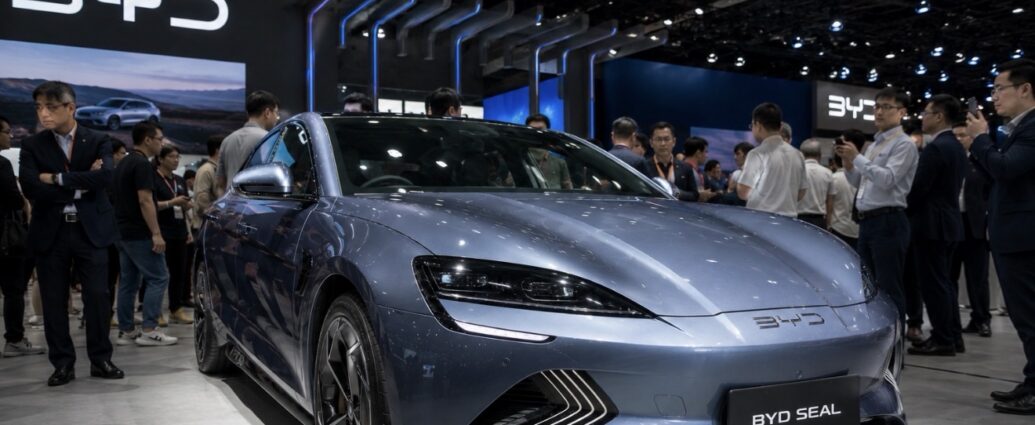
What began as a competitive problem inside China has evolved into something much larger. Chinese automakers including BYD, Geely, Chery, Nio, and Xiaomi are no longer simply dominating their home market. They are exporting aggressively, building factories across multiple continents, reshaping global pricing, and forcing established Western manufacturers into defensive mode.
The numbers are becoming difficult to ignore.
BYD delivered approximately 4.6 million new-energy vehicles in 2025, overtaking Tesla in global battery-electric vehicle sales for the first time. More than one million of those vehicles were sold outside China, more than doubling the company’s overseas sales from the previous year. Executives at BYD have signaled ambitions to expand even further in 2026, with overseas sales targets reportedly reaching as high as 1.5 million vehicles.
This is no longer simply about cheap labor or lower-cost exports. It is increasingly viewed by Western policymakers and executives as the result of a coordinated industrial strategy.
Research firm Rhodium Group estimates that Beijing has poured tens of billions of dollars into electric-vehicle and battery manufacturing through subsidies, financing programs, infrastructure investment, and supply-chain support. European and American officials argue the support has distorted global competition. But the strategy has also succeeded in producing scale, advanced manufacturing capacity, and lower-priced EVs that consumers worldwide are increasingly willing to buy.
The impact is now appearing directly inside Western automakers’ earnings reports.
BMW reported a significant decline in pre-tax profit last year, while warning investors that growth in China remains weak and profitability is under pressure from both tariffs and falling demand. Mercedes-Benz and Volkswagen have also struggled with declining Chinese market share and slower-than-expected EV transitions.
Even luxury segments once considered untouchable are beginning to shift.
In China’s premium vehicle market, imported luxury sedans from Porsche and BMW are now facing direct competition from technology-driven domestic brands backed by companies such as Huawei. The emergence of Huawei-backed luxury models reflects how China’s technology ecosystem is increasingly converging with its automotive sector, blending software, AI systems, entertainment platforms, and advanced battery capabilities directly into vehicles.
Western manufacturers are attempting to respond.
At recent auto shows in Beijing and Shanghai, European and American automakers unveiled a wave of new China-focused models aimed specifically at local consumer tastes and software preferences. Consulting firms including McKinsey have warned global manufacturers that the coming decade will determine which companies remain globally competitive in electric vehicles and which fall behind permanently.
But Chinese companies continue expanding rapidly.
BYD is already building or operating facilities in countries including Hungary, Brazil, Thailand, Turkey, and Indonesia, while evaluating additional European manufacturing expansion. The company has also announced plans for ultra-fast charging networks and next-generation battery systems capable of dramatically reducing charging times — one of the key areas where consumers still hesitate to adopt EVs.
The competitive challenge is no longer only about price.
Chinese automakers are increasingly competing on software integration, battery efficiency, charging speed, user interface design, and consumer technology ecosystems — areas traditionally dominated by Western and Japanese brands.
Farley has repeatedly warned that the United States cannot assume tariffs alone will permanently shield domestic manufacturers.
“The Chinese auto industry has enough capacity to serve the entire North American market,” Farley warned during a televised interview last year. “If we lose this, we do not have a future Ford.”
For now, steep U.S. and European tariffs continue limiting the direct flow of Chinese-built EVs into some Western markets. But much of the developing world — including parts of Latin America, Africa, Southeast Asia, and the Middle East — remains far more open, allowing Chinese brands to rapidly gain global market share.
The larger concern for Western executives is that once Chinese companies achieve global manufacturing scale, software dominance, and brand recognition, competing against them could become significantly harder even inside historically protected markets.
For more than a century, American, European, and Japanese automakers largely dictated the rules of the global car industry. Increasingly, that balance of power appears to be shifting eastward.
And for the first time in generations, legacy automakers are confronting the possibility that they may no longer be setting the pace of the industry they once controlled.
Global Markets — JBizNews Desk
© JBizNews.com All Rights Reserved. Reproduction or distribution without written permission is prohibited.