By JBizNews Desk
Something has quietly changed in the American car business, and the people who run it have stopped pretending it’s temporary.
For five straight years before 2020, Americans bought more than 17 million new cars a year. Last year they bought 16.3 million. That gap — roughly one million buyers — has not closed in six years.
The industry now believes those buyers are not coming back any time soon.
“The new norm because of reduced affordability is closer to 16 million,” Jonathan Smoke, the chief economist at Cox Automotive, has told reporters. “We’ve lost about 10% of the buying pool.” His blunt explanation: those buyers were “literally priced out of the market.”
Patrick Manzi, the chief economist at the National Automobile Dealers Association, told dealers at the NADA Show in February that 17 million is not coming back for years. His April report said sales were running at a 15.9 million pace — the eighth straight month of declines.
So where did the missing buyers go?
The simple answer is: they looked at the sticker, looked at the monthly payment, and walked away.
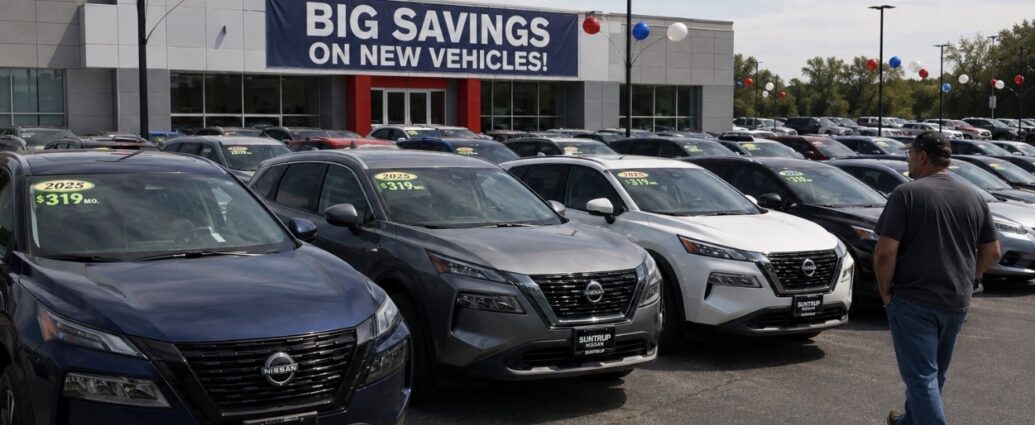
The average new car in America today costs about $49,000. The average sticker price has been above $50,000 for ten months in a row. Average monthly payments hit a record $772 in the last three months of 2025. One out of every five people who financed a new car last quarter signed up for a payment of $1,000 a month or more.
That is the kind of monthly bill that used to belong to a mortgage.
A natural question is whether leasing — long the industry’s tool for getting people into cars they cannot quite afford to buy — is helping.
The answer is: only for one slice of the market.
Electric vehicles are leasing for as little as $239 a month right now, less than half the national average payment. But the federal EV tax credit that made those deals work expired on September 30 of last year, new EV sales fell 28% in the first quarter of 2026, and Cox Automotive expects EV leasing to shrink this year.
For the gas-powered cars most Americans actually shop for — the Toyota RAV4, Honda CR-V and Ford F-150 — there is no cheap lease waiting on the lot.
There is another change worth understanding, because it explains why the industry is not panicking.
The people still buying new cars are richer than they used to be.
Cox Automotive found that households earning $150,000 or more now account for 43% of new-car sales. Households earning under $75,000 account for about 25%. Six years ago, those two groups were roughly equal.
Smoke put it more sharply: new cars today “almost exclusively go to the top 20%” of American households.
Automakers are not trying to reverse this. They are leaning into it.
Small, affordable cars — the kind that used to bring first-time buyers in the door — have been quietly killed off across the industry, replaced by bigger pickups and SUVs that carry bigger profits.
It is working, on their terms.
Americans spent $620 billion on new cars in 2025, up nearly 6% from the year before — even though they bought roughly the same number of cars. Fewer customers, more dollars per customer.
The showroom in 2026 reflects all of this.
S&P Global Mobility projects March sales of about 1.37 million cars, well below last year. J.D. Power says incentives are climbing — Toyota is offering up to $5,000 off some Tundras, GMC is discounting Sierras by up to 20%, Hyundai and Kia are offering zero-percent financing with deferred payments.
None of it is bringing the missing million back.
What it is doing, in Cox Automotive’s words, is pushing more shoppers to the used market — where 76% of car purchases this year have landed.
The industry is now budgeting around a 16-million-car America instead of a 17-million one. Factory capacity, dealer staffing, advertising budgets and lender underwriting are all being reset to the smaller, richer market.
The missing million have not disappeared. They are still driving.
They are just driving cars somebody else used to own.
Whether they ever come back to the new-car lot depends on whether wages catch up to a $50,000 sticker — or whether automakers eventually decide they would rather sell to them than around them.
For now, neither side is moving.
New York — JBizNews Desk
© JBizNews.com All Rights Reserved. Reproduction or distribution without written permission is prohibited.