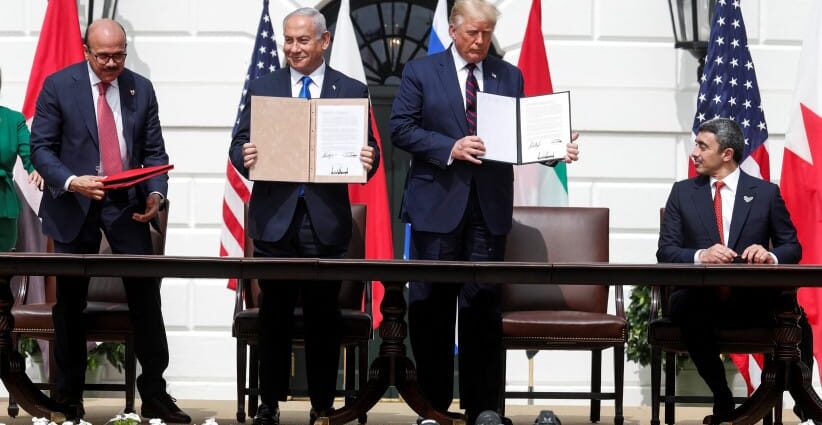
Gulf states are likely not taking US President Donald Trump’s demand that they join the Abraham Accords seriously, viewing such a demand as “premature and disconnected,” two experts on the region told The Jerusalem Post this week.
Trump suggested on Wednesday that a deal with Tehran would largely hinge on Saudi Arabia, Qatar, Kuwait, and other Gulf nations normalizing ties with Israel, confirming in a cabinet meeting, “I’m not sure we should make the deal if they don’t… join the Abraham Accords.”
The US president made the first public demand for normalization on Sunday, which was outright rejected by mediator Islamabad.
Though not yet accepted by many of the countries enlisted to join the accords, some have previously expressed a willingness on the condition of the establishment of a Palestinian state, a condition which has not yet been met.
“Across much of the Persian Gulf, the proposal is viewed as premature and somewhat disconnected from post-war realities,” Mojtaba Dehghani, a senior political analyst who has authored multiple articles on the Islamic regime for Independent Persian, told the Post.
While Saudi Arabia’s addition to the accords remains hinged on the prospect of Palestinian statehood, Dehghani said that “Doha, and Muscat are currently more focused on constructing a regional balance that restrains both Iran and Israel, rather than joining a clearly anti-Iranian or pro-Israel bloc.”
UAE: A financial, technological, and commercial hub of a ‘new Middle East’
“The sudden reintroduction of the Abraham Accords framework may raise more questions about Trump’s broader strategic intentions than strengthen support for a deal itself,” he claimed.
Dr. Arash Azizi, an Iranian-American expert on the region, said he doubted that Trump or countries in the region were taking his condition seriously, asserting that “obviously” no country would be willing to normalize with Israel as long as it continues its current policies and is “headed by a prime minister indicted for war crimes.”
While new agreements seemed unlikely to both experts, Dehghani noted that such a trend would not apply to the United Arab Emirates, which is already a party to the accords and therefore has more to lose.
Abu Dhabi’s assessment is not limited to the “lens of energy security or Iran containment,” but must also consider its influential regional competitor, Riyadh, he explained.
For the past decade, the UAE has centered Israel’s security role in its plans to become an “agile financial, technological, and commercial hub of a new Middle East,” making it more risky should a “weakened but intact” Islamic Republic be left capable of continuing to disrupt shipping routes, ports, infrastructure, and the region’s economic stability.
Both Azizi and Dehghani asserted that regional trust in Washington was in question, even if the reopening of the Strait of Hormuz was largely considered an important first step.
Azizi warned that regional priorities now lay with “defining their relations with Tehran in a new era in which the US’s commitment to the Gulf, and its abilities to hold on to such a commitment, are in question.”
Gulf states, unprepared for war, would be further angered if the conflict continued, he told The Post hours before Tehran launched a new wave of attacks on Kuwait.
Dehghani added that the consequences of the latest Iran war “eroded confidence in the traditional US-led security architecture” in the region and that a lack of real resolution to the conflict would likely see “greater security diversification,” which would see relationships deepened with actors like China and Turkey.
‘Enormous cost’ and ‘limited gains’ of American intervention
The ramifications of such a regional pivot would likely also impact trust in Washington from countries outside the Middle East, he continued, “reconsider excessive dependence on the United States as their sole security guarantor.”
Both Azizi and Dehghani acknowledged that Gulf pressure had likely contributed to Washington agreeing to negotiate a deal with Tehran, though Dehghani concluded that the “enormous cost” of the American military action compared to the “limited gains” had led Trump to the conclusion that the war would not complete its objectives anytime soon.
“The war and the Hormuz crisis demonstrated that Persian Gulf economies are directly hostage to maritime security. Attacks on infrastructure and energy routes sent a clear message to regional governments that even carefully maintained neutrality offers little protection,” he explained.
“As a result, countries such as Saudi Arabia, Qatar, and Oman had strong incentives to encourage Washington toward de-escalation and diplomacy, even if their pressure was not the decisive factor by itself.”