By JBizNews Desk
WASHINGTON — May 28, 2026 — The gap between what American companies earn and what American workers take home widened further in the first quarter, reaching levels that help explain why many households remain frustrated despite an economy that continues to grow.
New data released Thursday by the Bureau of Economic Analysis (BEA) showed the U.S. economy expanded at a 1.6% annualized rate during the first three months of 2026, down from the agency’s earlier estimate of 2.0%. The revision reflected weaker business investment and softer consumer spending than previously reported.
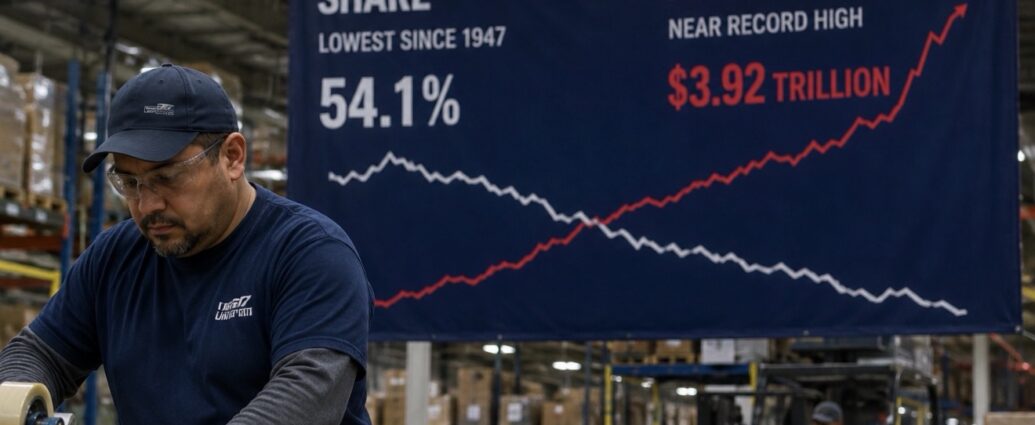
At the same time, after-tax corporate profits climbed to approximately $3.92 trillion at an annual rate, up 17.4% from a year earlier, according to the BEA’s accompanying corporate profits report.
The contrast between slowing economic growth and surging profits highlights a trend that economists say has been building for decades but is becoming increasingly visible across the economy.
According to data released earlier this month by the Bureau of Labor Statistics, labor’s share of economic output — the percentage of national income paid to workers through wages and benefits — fell to 54.1% in the first quarter, the lowest level since government records began in 1947.
The decline means a smaller portion of every dollar generated by the economy is flowing to workers, while a larger share is going to corporate profits and investment income.
In practical terms, the economy is producing more wealth, but workers are receiving a smaller slice of it.
The trend helps explain why consumer sentiment remains weak despite historically low unemployment rates and continued economic expansion. While corporate earnings have surged, many households continue to struggle with elevated costs for housing, groceries, insurance, healthcare, and utilities.
The disconnect is particularly visible in productivity data.
American workers produced 2.9% more output per hour over the past year, according to government figures. Yet after adjusting for inflation, real hourly compensation declined 0.5% during the first quarter.
That means workers became more productive while seeing their purchasing power shrink.
Economists have long viewed labor’s share and profit share as opposite sides of the same equation. When labor’s share falls, corporate profits typically rise.
Today, both measures are approaching historic extremes.
While workers are receiving the smallest share of economic output in modern records, corporate profits are hovering near the highest levels ever recorded.
The trend carries broader economic implications because consumer spending accounts for roughly two-thirds of U.S. economic activity. The same BEA report that showed stronger profits also showed slower consumer spending growth, raising concerns about whether household demand can continue supporting the expansion if wage growth fails to keep pace with costs.
Several structural factors have contributed to the shift.
Economists point to increased automation, advances in software and artificial intelligence, declining union membership, greater industry consolidation, and the pricing power many companies gained during the inflation surge of the early 2020s.
Those forces have allowed businesses to increase output and protect profit margins without sharing an equivalent portion of gains with employees.
For investors and shareholders, the latest figures reflect impressive corporate performance. Companies have successfully navigated inflation, higher interest rates, supply-chain disruptions, and geopolitical uncertainty while maintaining profitability.
For households, however, the experience has often looked very different.
When grocery bills rise faster than paychecks and housing costs consume a larger share of income, record corporate earnings can feel disconnected from daily reality.
The result is an economy that appears strong in aggregate statistics but feels much weaker at the household level.
Looking ahead, economists say the direction of the labor-profit divide will depend largely on the job market.
A tight labor market typically forces employers to compete for workers through higher wages and better benefits, helping labor reclaim a larger share of economic output. If economic growth slows further and hiring weakens, however, employers may retain the upper hand, allowing profit margins to remain elevated.
For now, Thursday’s government data delivered a clear message: corporate America is capturing a growing share of the nation’s economic gains while workers are receiving the smallest share on record.
That imbalance may be one of the clearest explanations for why many Americans continue to feel financially squeezed even as the broader economy remains in expansion mode.
Washington — JBizNews Desk
© JBizNews.com All Rights Reserved. Reproduction or distribution without written permission is prohibited.