Employees who use artificial intelligence at work are saving the equivalent of a full day every week.
That’s the picture from new research released May 19, 2026, by GoTo, the cloud communications and IT company, and the research firm Workplace Intelligence. Their second annual report, The Pulse of Work in 2026, surveyed 2,500 global employees and IT leaders between November 2025 and January 2026. The headline number: workers using AI save an average of 2.3 hours a day. Over a five-day week, that’s more than 11 hours back in their pockets.
Stretch that across a year and the math gets serious. Separate research from the London School of Economics puts the average savings at 7.5 hours a week, which researchers valued at roughly £14,000 per worker per year. Other estimates land across a wide band. A Federal Reserve Bank of San Francisco analysis pegged the savings at a more conservative 5.4% of work hours, or about 2.2 hours a week. Power users blow past all of it. Industry data shows 27% of frequent AI users save more than nine hours a week, with the heaviest users reporting gains approaching 20 hours.
So where does all that time come from?
Mostly the dull stuff.
The biggest single chunk is writing. Workers are drafting emails, replies, proposals, reports, and presentations that previously consumed hours of their week. One NBER-Microsoft study found knowledge workers cut email time by 31%, saving roughly 3.6 hours a week on inbox work alone.
Meetings are the next major source of savings. AI-powered transcription and summarization tools now generate notes, identify action items, and eliminate many of the follow-up conversations that once existed simply to repeat what had already been discussed. Research is another area undergoing rapid change. Instead of manually digging through lengthy reports, contracts, spreadsheets, and PDFs, workers can obtain preliminary summaries and insights in seconds.
Spreadsheets and data analysis round out the list. AI tools increasingly write formulas, identify trends, clean datasets, and produce first drafts of reports that once required hours of manual effort.
The gains are real, but they are not evenly distributed.
Software developers appear to be among the biggest beneficiaries. Some studies suggest coding output can more than double when AI tools are effectively integrated into workflows. GitHub has reported that users of its Copilot platform complete certain tasks roughly 56% faster. Customer-support agents handle approximately 14% more inquiries per hour. Leadership, management, and highly specialized hands-on roles generally report smaller gains, often two to three hours per week. Frequency of use remains one of the strongest predictors of productivity improvements. Employees who use AI daily consistently report far greater benefits than occasional users.
But the productivity gains are also changing how organizations function internally.
Prof. Lior Zalmanson, who heads the AI Lab at Tel Aviv University, argues that AI effectively gives every employee their own virtual team. Instead of relying on coworkers for brainstorming, research, drafting, analysis, or feedback, employees increasingly turn to AI assistants customized to their own working styles. The result, he says, is the creation of “isolated islands” inside organizations, where individuals become more productive but often work more independently than before.
Sharing knowledge has always been a challenge inside organizations, but the nature of that challenge is changing. In previous decades, companies struggled to get employees to share expertise and institutional knowledge. Today, many organizations are finding that employees are reluctant to share the prompts, workflows, and AI practices that help them perform better. According to Zalmanson, AI tools such as ChatGPT are increasingly viewed as an extension of the individual. Employees often feel that their interactions with AI are highly personal, making them less inclined to adopt someone else’s approach or reveal their own methods. What once revolved around knowledge sharing now increasingly revolves around prompt sharing, creating a new management challenge as companies seek to scale AI adoption across entire organizations.
Here is where the GoTo study becomes more complicated.
The same workers gaining hours are increasingly concerned about their dependence on the technology. Half of surveyed employees said they now rely too heavily on AI. Nearly three in ten reported feeling they could not function effectively without it. Perhaps most striking, 39% said they believe AI use is gradually eroding their own skills and making them less capable. Among Generation Z employees, that figure rises to 46%.
Dan Schawbel, Managing Partner of Workplace Intelligence, said the productivity gains are undeniable, but many organizations are overlooking a quieter challenge: employee confidence. Companies are measuring output improvements while often failing to track whether workers feel their expertise, judgment, and professional development are being weakened by overreliance on AI-generated assistance.
There is also a business cost hiding inside the productivity gains.
Much of the reclaimed time is spent reviewing and validating AI-generated work. AI systems frequently produce polished, persuasive, and confident responses that may contain factual errors or flawed assumptions. Someone still has to verify the output. Researchers from Stanford University and BetterUp have even coined a term for the growing volume of low-value AI-generated content flooding workplaces: “workslop.”
The Upwork Research Institute found that 77% of freelancers reported AI actually increased portions of their workload because of the time required to review, edit, and correct machine-generated output before it could be used professionally.
The lesson for employers is becoming increasingly clear.
Purchasing AI tools is relatively easy. Successfully integrating them into an organization is much harder.
The GoTo research found a significant gap between companies that simply provided employees access to AI and those that invested in training, governance, best practices, and measurable implementation strategies. The organizations reporting the strongest and most sustainable gains viewed AI not as a software purchase but as a long-term workforce and operational transformation initiative.
For workers, the takeaway may be even simpler. The productivity gains are real. The time savings are measurable. The challenge is capturing those benefits without sacrificing the judgment, creativity, expertise, and critical thinking skills that remain uniquely human.
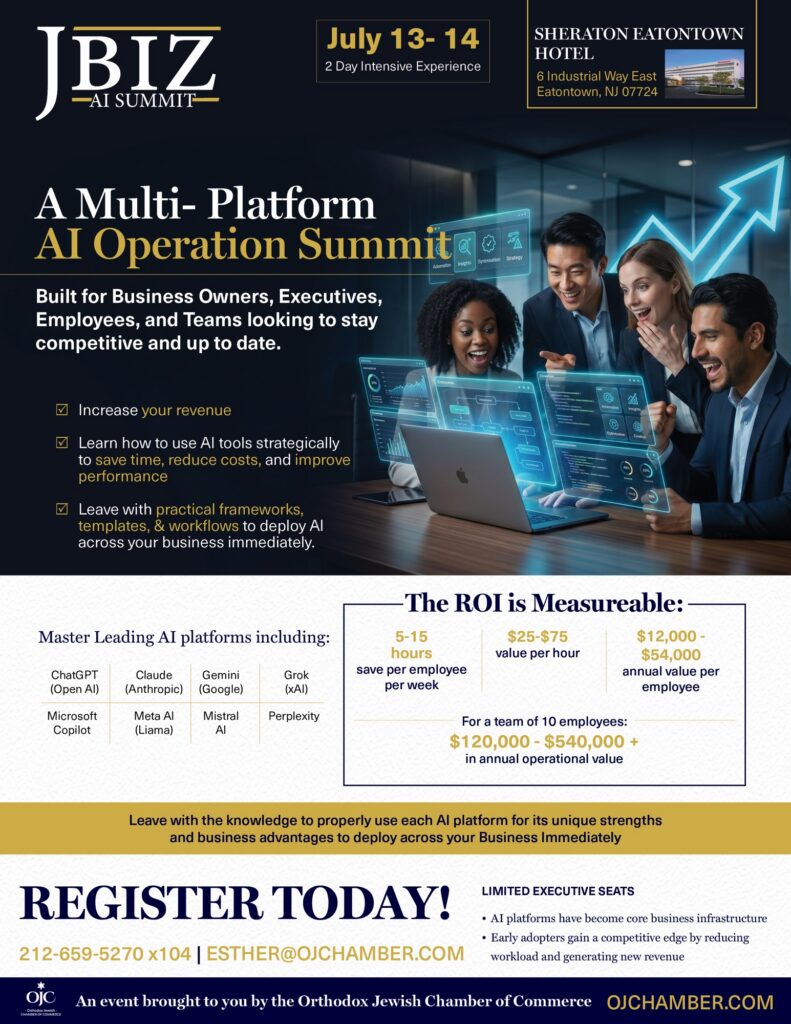
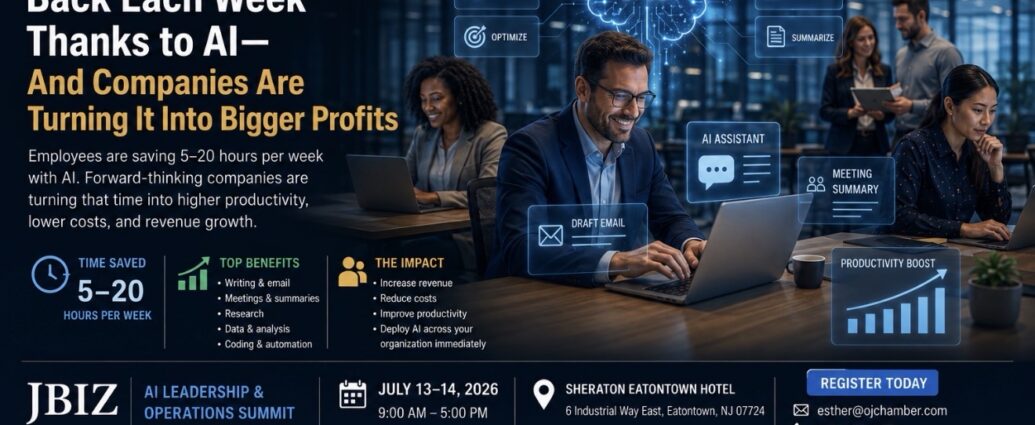
With studies showing employees saving between 5 and 20 hours per week through AI, the upcoming JBiz AI Leadership & Operations Summit will provide hands-on training across leading platforms including ChatGPT, Claude, Gemini, Grok, Microsoft Copilot, Meta AI, Mistral, and Perplexity. Attendees will learn practical frameworks, templates, and workflows to increase revenue, reduce costs, improve productivity, and deploy AI across their organizations immediately. The two-day summit will be held July 13–14, 2026, from 9:00 a.m. to 5:00 p.m. at the Sheraton Eatontown Hotel, 6 Industrial Way East, Eatontown, NJ. For registration, HR Dept inquires, or team enrollment information, click here, email esther@ojchamber.com, or call 212-659-5270 x104.
— JBizNews Desk
© JBizNews.com All Rights Reserved. Reproduction or distribution without written permission is prohibited.