By JBizNews Desk
June 2, 2026
TAIPEI — After dominating the artificial-intelligence boom from inside the world’s largest data centers, Nvidia is making its boldest move yet into personal computing.
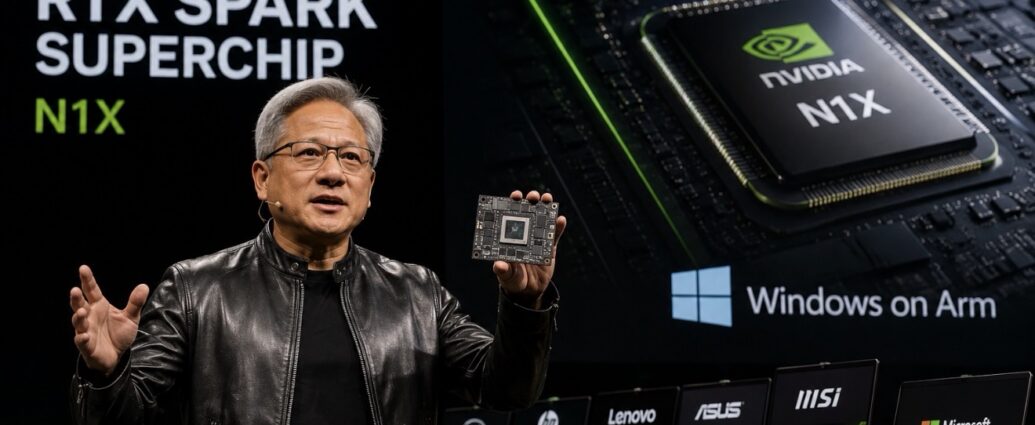
At the opening keynote of Computex 2026 in Taipei on Monday, Nvidia CEO Jensen Huang unveiled the company’s new RTX Spark Superchip, also known as the N1X, marking Nvidia’s first serious attempt to power mainstream Windows laptops and desktop systems with the same AI-focused architecture that helped transform it into one of the world’s most valuable companies.
The launch represents far more than a new processor.
It is Nvidia’s direct challenge to the companies that have controlled personal computing for decades, including Intel, AMD, Qualcomm, and even Apple, while extending Nvidia’s influence from cloud data centers into the devices consumers and businesses use every day.
Huang framed the announcement as a major platform transition rather than a routine hardware upgrade.
Speaking before thousands of developers, manufacturers, and technology executives, he argued that artificial intelligence is fundamentally changing what computers can do and that the next generation of personal devices will be defined by AI assistants capable of operating directly on the machine rather than relying entirely on cloud services.
According to Nvidia, the new processor combines a high-performance CPU architecture with an integrated RTX 5070-class graphics engine, bringing the company’s AI acceleration capabilities directly into Windows laptops.
The chip was developed in partnership with Microsoft and leverages Nvidia’s extensive CUDA software ecosystem, which remains one of the company’s most powerful competitive advantages.
For years, CUDA has served as the foundation for AI development across research labs, universities, startups, and enterprise customers.
Now Nvidia is bringing that ecosystem to consumer hardware.
The company says systems powered by the new chip will begin arriving this fall from major manufacturers including Dell, HP, Lenovo, ASUS, MSI, and Microsoft’s own Surface lineup.
The devices will run Windows on Arm, Microsoft’s increasingly important operating system architecture designed to compete with Apple’s highly successful silicon strategy.
Industry analysts view the launch as one of the most significant shifts in personal computing in years.
For decades, the laptop market has largely been dominated by processors from Intel and AMD. More recently, Apple disrupted the industry through its internally developed M-series chips.
Now Nvidia is entering the battle with a unique advantage: unmatched leadership in artificial intelligence.
The company’s goal is clear.
Rather than forcing AI applications to run through remote cloud servers, Nvidia wants users to execute increasingly sophisticated AI tasks directly on their devices.
That approach offers several benefits.
Applications can respond faster because requests do not need to travel across the internet. Sensitive information can remain on the device rather than being transmitted to external servers. Battery efficiency may improve for certain workloads, and businesses can maintain greater control over proprietary data.
Those advantages could become increasingly important as AI adoption expands.
The timing is notable.
Technology companies across the industry are racing to position themselves for what many believe will be the next major computing cycle.
Apple recently introduced new M5-powered MacBooks. Arm Holdings has unveiled its own processor initiatives. Reports indicate AMD is developing Arm-based alternatives. Meanwhile, Qualcomm continues pushing aggressively into AI-enabled PCs.
Nvidia’s entry intensifies what is becoming one of the most competitive technology battles in years.
Huang used the event to highlight Nvidia’s broader ambitions beyond personal computing.
He announced that Nvidia’s Vera CPU platform for data centers has entered full production and identified major customers including Anthropic, OpenAI, xAI, Oracle, Dell Technologies, and CoreWeave.
The company also showcased a new humanoid robotics reference platform known as Isaac GR00T, designed to accelerate development of AI-powered robots capable of operating in industrial and commercial environments.
Taken together, the announcements illustrate Nvidia’s broader strategy.
The company is no longer positioning itself simply as a chipmaker.
Instead, it is building an ecosystem that stretches from cloud infrastructure to enterprise systems, personal computers, robotics, autonomous systems, and AI software platforms.
For investors, the significance extends beyond hardware sales.
Historically, major platform shifts create waves of spending throughout the technology industry.
Businesses upgrade equipment. Consumers replace aging devices. Software developers build applications tailored to new capabilities. Service providers expand infrastructure to support emerging workloads.
If AI-powered personal computing gains widespread adoption, Nvidia could benefit not only from chip sales but from increased demand across its broader software and ecosystem offerings.
The company is effectively betting that the next generation of computing will be built around artificial intelligence at every level.
The hardware unveiled in Taipei is merely the first step.
The larger opportunity lies in the software, services, and AI applications that follow.
For now, Nvidia has taken a decisive step beyond the data center and into the devices millions of people use every day.
Whether consumers embrace AI-first computing on the scale Huang predicts remains to be seen.
But one thing is already clear: the battle for the future of personal computing has entered a new phase, and Nvidia intends to be at the center of it.
JBizNews Desk — Asia
© JBizNews.com All Rights Reserved. Reproduction or distribution without written permission is prohibited.