By JBizNews Desk
June 1, 2026
MINNEAPOLIS — General Mills (NYSE: GIS) is handing control of one of its most recognizable consumer brands in China to a local operator, announcing Monday that it has agreed to sell its Häagen-Dazs scoop-shop business in mainland China to an investor group led by rapidly expanding tea-chain operator Ningji.
The transaction, announced by General Mills through a BusinessWire release, marks a significant shift in the company’s China strategy and reflects a broader trend of multinational consumer brands increasingly relying on local operators to navigate a fiercely competitive Chinese retail market.
Under the agreement, the investor group will acquire the mainland China Häagen-Dazs retail store business and receive an exclusive license to operate Häagen-Dazs ice-cream shops and gift sales throughout mainland China. Financial terms were not disclosed. The deal is expected to close during 2026, subject to regulatory approvals.
The sale does not represent a complete withdrawal from China.
General Mills said it will retain ownership of its Häagen-Dazs retail-packaged products and foodservice operations in mainland China, meaning the brand’s products will continue to be sold through grocery stores, hotels, restaurants, and other distribution channels. The company will also continue operating Häagen-Dazs businesses in markets outside mainland China.
Still, the move represents a notable retreat from a business that once symbolized the rise of premium Western consumer brands in China.
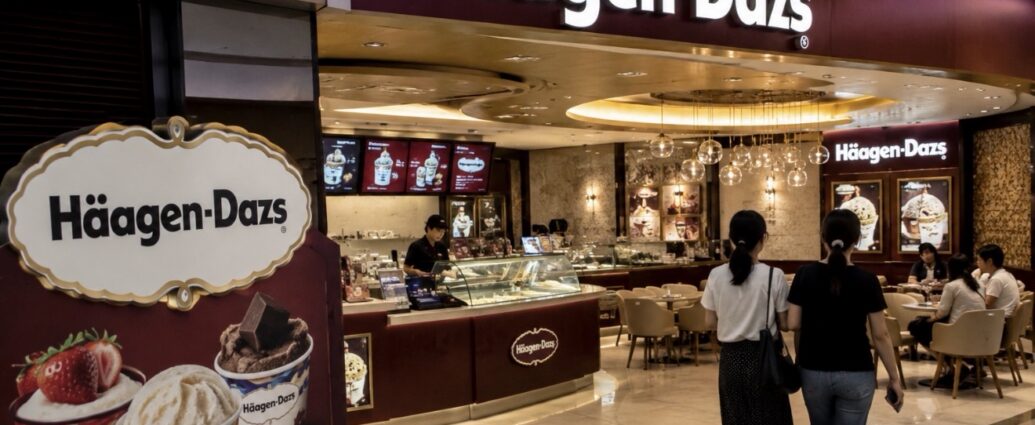
For years, Häagen-Dazs occupied a unique position in Chinese consumer culture. Its upscale stores became popular destinations for dates, celebrations, and premium gifting. At a time when foreign brands carried significant prestige among Chinese consumers, a Häagen-Dazs dessert was often viewed as an affordable luxury.
That market has changed dramatically.
China’s consumer economy has become more competitive, more localized, and increasingly driven by domestic brands that can move faster and operate more efficiently than international rivals. Consumer spending has also slowed as economic growth moderated, making premium-priced imported products harder to sell.
At the same time, local beverage and dessert chains have exploded across the country.
Ningji, one of China’s fastest-growing tea brands, operates more than 3,000 locations and has built a powerful presence among younger consumers. The company has expanded rapidly by offering premium tea products at accessible prices while maintaining a deep understanding of local tastes and shopping habits.
That local expertise is likely one of the biggest attractions for General Mills.
Running hundreds of retail stores from corporate headquarters thousands of miles away presents challenges that local operators often avoid. Real estate decisions, staffing, product innovation, marketing campaigns, and consumer trends move quickly in China, particularly in food and beverage categories.
A local operator with an existing retail network can often respond faster and more efficiently.
The transaction also aligns with General Mills’ Accelerate strategy, which focuses on directing resources toward higher-return businesses and simplifying operations.
While Häagen-Dazs remains a globally recognized premium brand, operating a network of physical retail stores requires significant labor, real estate, and management resources. Packaged-food businesses generally offer higher margins and greater scalability.
For a company whose portfolio includes brands such as Cheerios, Pillsbury, Betty Crocker, Nature Valley, Old El Paso, and Blue Buffalo, the economics are straightforward.
General Mills generated approximately $19 billion in annual revenue during fiscal 2025. Against that backdrop, a chain of ice-cream parlors represents a relatively small business that requires disproportionate operational attention.
Industry analysts say the move reflects a broader shift occurring throughout China’s consumer sector.
Rather than exiting China entirely, many multinational companies are increasingly choosing partnership models that allow them to maintain brand presence while reducing direct operational responsibilities. Local operators gain access to internationally recognized brands, while global companies preserve market exposure without managing day-to-day retail operations.
The arrangement often proves attractive for both sides.
For Chinese consumers, the transition may ultimately be invisible.
The Häagen-Dazs name remains. The stores remain. The products remain.
What may change is how the brand evolves.
With Ningji controlling operations, observers expect new menu concepts, expanded digital integration, localized product offerings, and potentially broader expansion into smaller Chinese cities where domestic operators often have stronger market knowledge.
For General Mills, the transaction simplifies its China footprint while preserving exposure to one of the world’s largest consumer markets.
For Ningji, it offers an opportunity to combine one of China’s fastest-growing beverage networks with one of the world’s most recognizable premium dessert brands.
As multinational consumer companies continue rethinking how they compete in China, the Häagen-Dazs transaction may prove less an exception than a preview of the industry’s next chapter.
Consumer & Retail — JBizNews Desk
© JBizNews.com All Rights Reserved. Reproduction or distribution without written permission is prohibited.