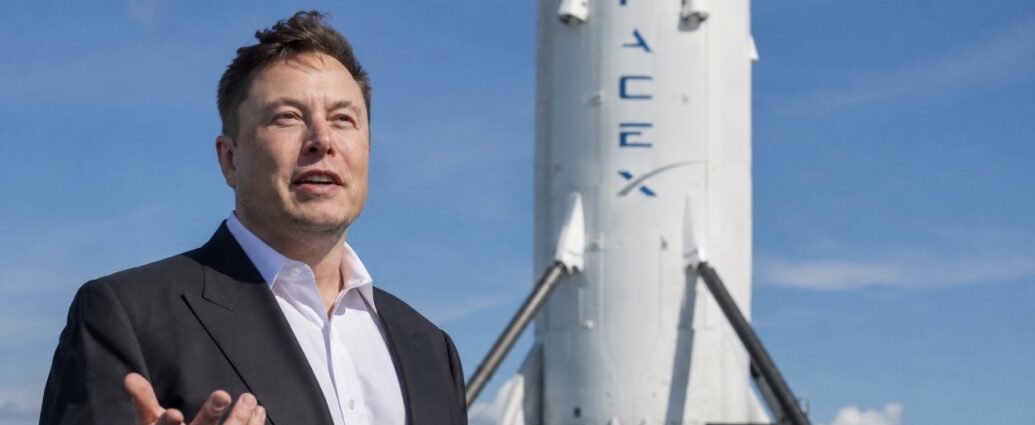
Research firm says Elon Musk’s space giant has extraordinary strengths, but investors may be paying too much for future AI and satellite growth before it is proven.
By JBizNews Desk
June 3, 2026
As SpaceX prepares for what could become one of the largest and most closely watched stock-market debuts in history, Morningstar is already warning investors that the excitement may be outrunning the fundamentals.
The investment research firm initiated coverage of SpaceX on Tuesday with a fair-value estimate of $780 billion, dramatically below the roughly $1.75 trillion valuation the company is reportedly targeting for its upcoming Nasdaq debut.
The call makes Morningstar one of the first major Wall Street voices openly questioning whether investors are getting carried away by the combination of Elon Musk, artificial intelligence, and one of the world’s most dominant aerospace companies.
“We think the company has been significantly overvalued,” Morningstar analyst Nicolas Owens wrote, arguing that investors may find better entry points after the stock begins trading publicly.
SpaceX is expected to begin its investor roadshow on June 4, with shares scheduled to start trading on June 12.
Where Morningstar Sees Value
Importantly, Morningstar is not bearish on SpaceX’s business.
Quite the opposite.
The firm credits SpaceX with building one of the strongest competitive positions in modern industrial history.
According to Morningstar, SpaceX accounted for approximately 83% of all payload mass launched into orbit worldwide during 2025, a remarkable level of dominance.
Its reusable rocket technology has dramatically lowered launch costs, helping establish barriers that competitors continue struggling to overcome.
The company’s Starlink satellite-internet business also continues to grow rapidly.
Morningstar estimates Starlink generated approximately $11.3 billion in revenue during 2025, up roughly 50% from the prior year, while producing more than $4.4 billion in operating income.
Taken together, Morningstar values SpaceX’s launch business and Starlink operations at approximately $611 billion.
The AI Question
The biggest disagreement centers on artificial intelligence.
Much of the valuation premium being attached to SpaceX today stems from investor expectations surrounding xAI, Musk’s artificial-intelligence company, and its integration with the broader SpaceX ecosystem.
Morningstar remains cautious.
The firm argues that while xAI’s Grok chatbot has gained visibility, it does not currently occupy the same leadership position as competitors such as OpenAI or Anthropic.
Owens also questioned some of the more ambitious AI-related projects being discussed around the company, including concepts involving orbital computing infrastructure and space-based data centers.
Morningstar modeled several possible outcomes.
Its most optimistic scenario values those initiatives at more than $1.3 trillion, but the firm assigns only a 7% probability to that outcome.
By contrast, Morningstar believes a much less successful scenario is considerably more likely.
Governance Concerns
The report also highlighted corporate-governance issues that some institutional investors may scrutinize.
Following the IPO, Elon Musk is expected to retain approximately 85% of voting power through a special share structure.
Morningstar also pointed to the recent integration of xAI and other Musk-controlled businesses into the broader SpaceX ecosystem, noting that transactions between related entities can sometimes create concerns among public shareholders.
While none of those issues are unusual for founder-led technology companies, they remain factors that investors often consider when assigning valuation premiums.
Why the IPO Could Still Surge
Even Morningstar acknowledges the stock could perform strongly after listing.
SpaceX is reportedly expected to sell only about 3% of its shares to the public, creating a scarcity dynamic that often supports newly public stocks.
The offering could raise between $50 billion and $80 billion, making it one of the largest public offerings ever attempted.
The deal is being led by a powerful syndicate of banks including:
- Goldman Sachs
- Morgan Stanley
- Bank of America Securities
- Citigroup
- J.P. Morgan
Analysts also expect SpaceX to become eligible for major stock indexes relatively quickly, potentially creating additional demand from index funds and institutional investors.
Musk’s Counterargument
Elon Musk, unsurprisingly, sees the future differently.
Posting on X Tuesday morning, Musk pointed to Tesla’s history as evidence that investors frequently underestimate the long-term value of his companies.
“Tesla IPO market cap was 0.1% of its current value,” Musk wrote.
The message was clear: today’s valuation may look expensive only if investors underestimate tomorrow’s opportunity.
The Bigger Picture
The debate surrounding SpaceX reflects a broader question facing today’s market.
How much should investors pay today for future AI-driven growth that has not yet fully materialized?
Few dispute that SpaceX possesses extraordinary assets: dominant launch economics, a rapidly expanding satellite network, and one of the most recognized brands in technology and aerospace.
Morningstar’s argument is not that SpaceX lacks value.
It is that investors may be assigning too much value to possibilities that remain years away from becoming reality.
That debate will soon move from analyst reports to the stock market itself.
When SpaceX begins trading on June 12, investors will decide whether the company is worth closer to Morningstar’s $780 billion estimate—or something much closer to the $1.75 trillion valuation Elon Musk is seeking.
New York — JBizNews Desk
© JBizNews.com All Rights Reserved. Reproduction or distribution without written permission is prohibited.