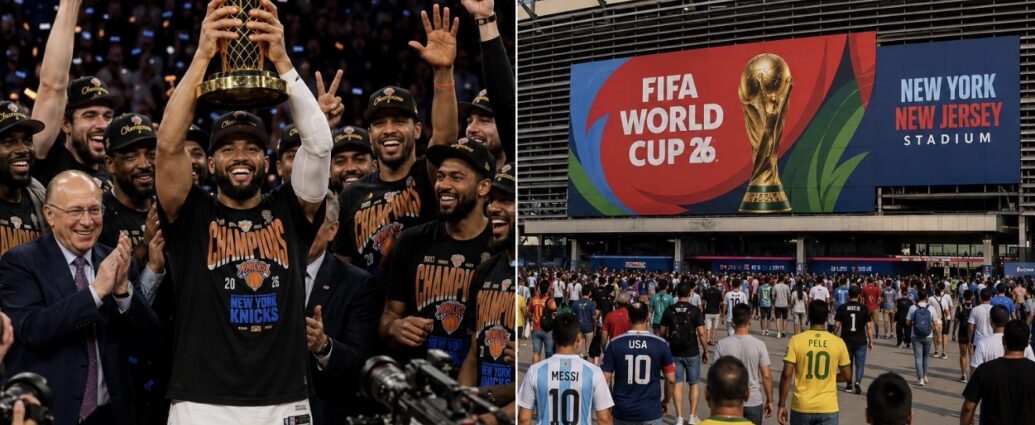
The New York Knicks won their first NBA championship in 53 years Saturday night, June 13, 2026, beating the San Antonio Spurs in five games and handing the city its biggest sports celebration in a generation. The party is barely over, and a much larger one is already underway: the 2026 FIFA World Cup kicked off the same week, with eight matches headed to the New York–New Jersey region. For the local economy, that raises a simple question with a not-so-simple answer — which one brings in more money, and to whom?
On paper, the World Cup dwarfs everything. The NYNJ Host Committee, chaired by Tammy Murphy, projects roughly $3.3 billion in economic impact for the region from the tournament’s local matches, including the final at MetLife Stadium on July 19, in an analysis built with Tourism Economics, an Oxford Economics company. The committee expects more than 1.2 million visitors and over 26,000 supported jobs across the two states.
But that’s the regional number, and it splits across a state line. New Jersey Governor Phil Murphy has estimated the tournament will deliver about $2 billion in economic impact to New Jersey specifically, supporting roughly 14,000 jobs. In other words, of the $3.3 billion regional figure, New Jersey claims well over half for itself — leaving the rest to spill into New York and the broader metro area. That matters, because every World Cup match is played in New Jersey, not New York.
The Knicks number is smaller, but it’s concentrated squarely in the five boroughs. Mayor Zohran Mamdani and the New York City Economic Development Corporation estimated the team’s playoff run generated about $202 million in economic activity from home games played, a figure they said could reach $465 million had every potential Finals home game been staged, at roughly $90 million per home date. Because the Knicks clinched on the road in Game 5, the real total lands below that ceiling.
For the team’s owner, the run paid off directly. Analysts estimate the playoffs added around $140 million in revenue for Madison Square Garden Sports Corp. (NYSE: MSGS), controlled by James Dolan, whose Knicks franchise is now valued near $9.85 billion.
Stack the headline figures side by side and the World Cup wins by a wide margin. But two things complicate that scoreboard.
The first is geography — the catch hiding inside the phrase “New York.” The Knicks money is unambiguously New York City: it happens at Madison Square Garden in the middle of Manhattan. The soccer does not. All eight regional matches, including the final, are played at MetLife Stadium in East Rutherford, New Jersey, temporarily rebranded “New York New Jersey Stadium.”
New Jersey officials have openly expressed concern that while their state hosts the matches, many visitors may spend much of their money across the Hudson River — on Broadway shows, Times Square attractions, Manhattan restaurants, and New York hotels.
So even New Jersey’s own $2 billion estimate could ultimately be affected by where visitors choose to stay, eat, shop, and spend. And the costs are real. New Jersey has already spent more than $16 million in taxpayer funds on stadium-related work, while NJ Transit has committed roughly $35 million toward transportation planning and infrastructure tied to the event.
The second catch is that all these projections come from people with a reason to make them look large. Host committees, elected officials, and economic-development agencies are promoters, not neutral scorekeepers. Economists frequently argue that major-event impact studies overstate benefits because they count spending that might have occurred elsewhere in the region anyway.
The same criticism applies to championship runs.
Many sports economists argue that the largest financial gains from a title run flow to team owners, broadcasters, sponsors, and ticket-resale platforms rather than being distributed broadly throughout a city. In many cases, spending is shifted rather than newly created.
There is also a difference in duration. The Knicks’ impact arrived in a concentrated burst over several playoff weeks. The World Cup stretches across more than a month and generates sustained global television exposure that can influence tourism, hotel demand, business travel, and regional branding long after the tournament ends.
So the honest scorecard is this: the World Cup is the far larger economic event by projection — roughly $3.3 billion regionally, with about $2 billion expected to land in New Jersey — while the Knicks championship run is the cleaner and more direct New York City economic story, with spending concentrated in Manhattan and the five boroughs.
The World Cup’s billions may ultimately prove larger, but exactly how much of that money ends up in New York versus New Jersey remains one of the tournament’s biggest unanswered questions.
Two championships. Two global events. Two very different economic stories.
And in both cases, the cheering may be easier to measure than the money.
JBizNews Desk — New York
© JBizNews.com All Rights Reserved. Reproduction or distribution without written permission is prohibited.