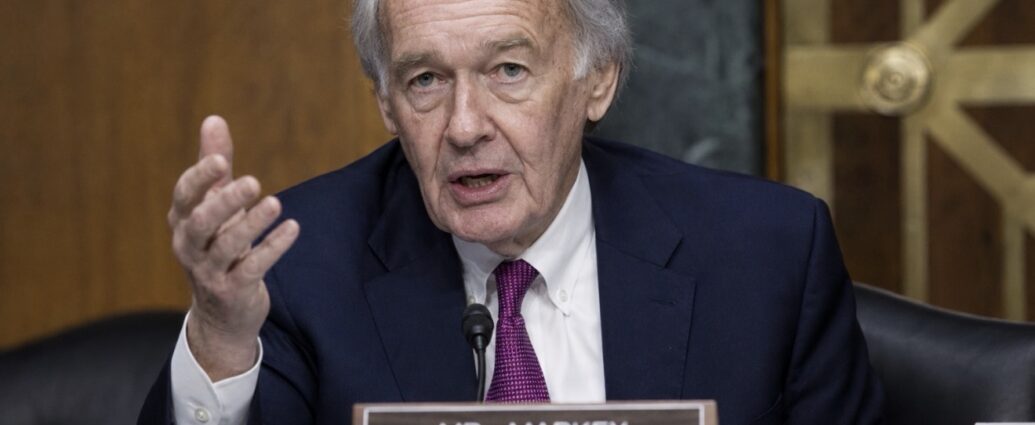
WASHINGTON — A leading Senate Democrat says the Trump administration’s changes to federal contracting are making it harder for small businesses to compete for government work.
On June 12, Sen. Ed Markey (D-Mass.), the ranking Democrat on the Senate Small Business and Entrepreneurship Committee, released a report titled “Trump’s Contracting Catastrophe: Turning Main Street into Pain Street.” The report argues that federal contracting policies implemented since early 2025 have significantly reduced opportunities for small businesses.
The administration disputes that characterization, arguing that its reforms are intended to reduce waste, improve accountability, and make federal procurement more efficient.
According to Markey’s report, federal agencies have reduced spending with small-business contractors by more than $47 billion since January 2025, representing a 19% decline compared with the previous 16-month period. The report also claims that more than 6,500 small businesses have stopped working with the federal government during the past 15 months.
Markey argues that the changes are disproportionately affecting the very businesses federal contracting programs were designed to support.
The report found declines across multiple categories of small-business participation, including small disadvantaged businesses, women-owned firms, HUBZone companies, veteran-owned businesses, and service-disabled veteran-owned businesses.
“The federal government should be a partner for Main Street, not a piggy bank for the wealthy and well-connected,” Markey said in releasing the report.
The committee attributes the decline to several administration actions, including changes to contracting goals, delays in certification programs that allow firms to qualify for set-aside contracts, contract cancellations, and increased scrutiny of small-business programs.
The Small Business Administration has also tightened oversight of economically disadvantaged business programs, a move administration officials describe as necessary to prevent abuse and ensure compliance with eligibility requirements.
The impact, according to the report, is being felt in communities across the country.
In Massachusetts, Markey’s home state, small-business contracting reportedly declined by 31% since the start of 2025. For many small firms, federal contracts provide a stable source of revenue, support hiring, and serve as a valuable credential when competing for private-sector work.
The White House sees the situation differently.
In an executive order issued on April 30, the administration argued that federal procurement had become burdened by excessive costs, administrative inefficiencies, and weak performance incentives. The order directed agencies to expand the use of fixed-price contracts and strengthen accountability measures.
Another executive order issued in March restricted certain diversity-related contracting practices, reshaping programs that many Democrats say are critical to expanding opportunities for underrepresented businesses.
Republicans on the Senate committee, led by Chair Joni Ernst (R-Iowa), have largely supported the administration’s efforts, describing them as part of a broader push to reduce waste, fraud, and inefficiency in government spending.
The data itself remains the subject of debate.
According to the Government Accountability Office, overall federal contracting increased in fiscal year 2025, rising to approximately $793 billion from $755 billion the previous year.
GAO data show small-business contracting declining by approximately $3.7 billion, to $172.6 billion, a much smaller decrease than the one cited in Markey’s report.
The discrepancy appears to stem largely from differences in measurement periods. Markey’s committee focused on the most recent 15 months, while GAO figures cover the broader federal fiscal year.
Adding to the uncertainty, the SBA has not yet released its official 2025 Small Business Procurement Scorecard. The most recent scorecard, covering fiscal year 2024, showed a record $183.5 billion in federal contracts awarded to small businesses.
Despite disagreements over the numbers, both sides acknowledge that many small businesses face growing economic pressures from inflation, higher operating costs, and broader market uncertainty.
Supporters of small-business contracting programs warn that if fewer small firms participate in federal procurement, agencies may become increasingly dependent on a smaller number of large contractors.
That possibility has become a central concern in the debate.
For now, the dispute remains unresolved, with both sides awaiting the SBA’s official 2025 data. Until then, thousands of small businesses that rely on government contracts will continue operating in a procurement environment that is undergoing significant change.
Washington — JBizNews Desk
© JBizNews.com. All Rights Reserved. Reproduction or distribution without written permission is prohibited.