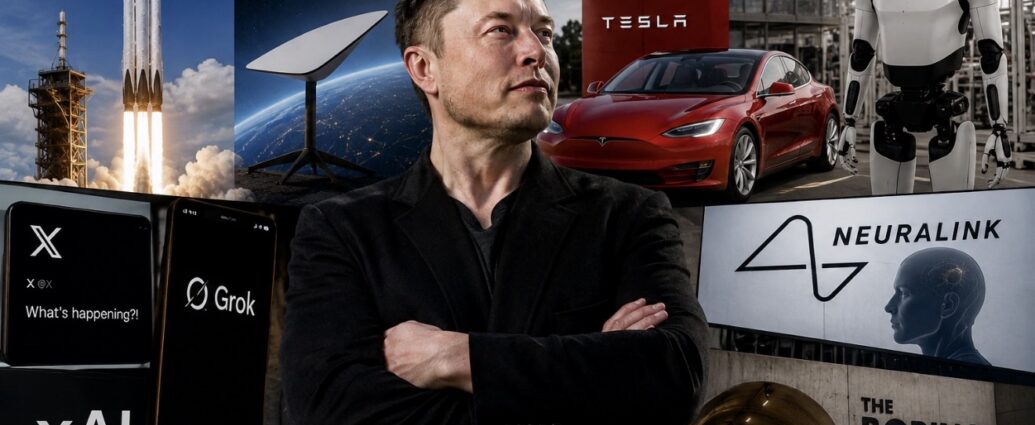
NEW YORK — Elon Musk became the world’s first trillionaire on Friday, when his rocket company SpaceX completed the largest stock-market debut in history, listing on the Nasdaq at $135 a share and raising $75 billion at a value of about $1.77 trillion. The milestone crowned a man who now controls a tangle of companies spanning rockets, electric cars, artificial intelligence, social media, brain implants and underground tunnels. Here is a guide to the Musk empire — how the pieces fit together, and how high his fortune could still climb.
At the center sits SpaceX, founded in 2002 and now far more than a rocket maker. It launches more rockets than most countries, runs the Starlink satellite-internet network — which reached 10.3 million subscribers early this year, double a year earlier — and is building toward sending people to Mars. The company that just went public is also bigger and stranger than the old SpaceX: over the past year Musk folded two of his other businesses into it. SpaceX has even asked regulators for permission to launch a “space cloud” of up to a million satellites to run AI computing in orbit, roughly a hundred times the size of Starlink today.
That makes the newly public SpaceX a three-in-one conglomerate. Musk’s AI company xAI, maker of the Grok chatbot, was absorbed into SpaceX in February. xAI had itself swallowed X, the social-media platform formerly known as Twitter, in March 2025. So a single company now owns rockets, satellites, a leading AI lab and one of the world’s largest social networks. Musk holds roughly 40% of it — a stake worth several hundred billion dollars on its own.
Then there is Tesla, the electric-car maker Musk has led for nearly two decades and long the source of much of his wealth. Worth around $1.2 trillion, Tesla is racing beyond cars into humanoid robots — its Optimus machine — and self-driving software, which it is shifting from a one-time purchase to a monthly subscription. Musk owns roughly 10% of the company, plus a set of stock options restored by Delaware’s highest court in December. Looming over all of it is a new pay package, approved by shareholders in November, that could hand him up to nearly $1 trillion in additional Tesla shares if the company hits a series of aggressive targets.
Further out on the frontier is Neuralink, Musk’s brain-implant company. Founded in 2016, it builds a coin-sized device, the N1, that lets paralyzed patients control computers with their thoughts, and it is testing a separate implant called Blindsight meant to restore vision. In its most recent funding round, Neuralink was valued at about $9 billion — a rounding error next to SpaceX and Tesla, but with outsized potential. The company plans to move from a handful of test patients to high-volume production this year, using a surgical robot to automate the implant procedure. If brain-computer interfaces become mainstream medicine, that $9 billion figure could multiply many times over, turning a science-fiction bet into a major business.
The empire’s odds and ends are still substantial. The Boring Company digs traffic tunnels and is worth billions on its own. Musk made his first fortune at PayPal in the early 2000s, and last year he served as a senior adviser to the President before stepping away. Several of his companies feed one another: Tesla has invested $2 billion in xAI and sold it hundreds of millions of dollars of battery packs, blurring the lines between his businesses.
Where could it all lead? Musk has already become the first person to pass $500 billion, $600 billion, $700 billion and $800 billion in net worth, all since late 2025, and now the first to cross a trillion. Almost none of that is cash. As he put it earlier this year, his fortune is “almost entirely due to my ownership stakes in Tesla and SpaceX.” That is exactly why it can keep climbing. If Tesla hits the milestones in its giant pay package, if SpaceX keeps rising from its $1.77 trillion debut, and if xAI and Neuralink grow into their promise, analysts and prediction markets see a path toward $2 trillion and beyond. The same concentration is also his biggest risk: a stumble at Tesla or a sell-off in SpaceX could erase hundreds of billions just as fast.
For now, Musk sits atop a collection of companies unlike anything one person has controlled before — touching how people drive, talk, connect to the internet, and perhaps one day think. The trillion-dollar question is whether so many world-changing bets, all tied to one man, can keep paying off at once.
JBizNews Desk
© JBizNews.com All Rights Reserved. Reproduction or distribution without written permission is prohibited.