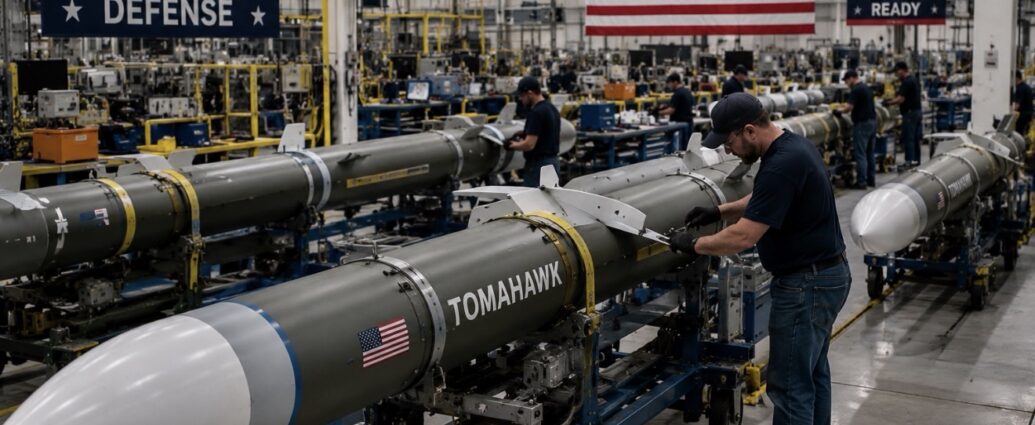
President Donald Trump has invoked the Defense Production Act to push American weapons makers to produce more munitions faster, according to a presidential memorandum dated June 11 and made public Tuesday in the Federal Register.
The order points to “systemic constraints in the munitions industrial base” and hands Defense Secretary Pete Hegseth the authority to strike voluntary agreements with manufacturers to fix them.
The law Trump reached for is a Cold War relic.
Passed in 1950 during the Korean War, the Defense Production Act lets a president steer private industry toward national-defense needs — a powerful tool that signals how seriously Washington is taking the strain on its arsenal.
That strain traces directly to the Iran war.
The roughly 15-week conflict, on top of years of arming Ukraine and other partners, has burned through stocks of missiles and precision weapons far faster than factories can refill them.
An April analysis from the Center for Strategic and International Studies found the U.S. may have used up more than half its inventory of four critical munitions, including Tomahawk cruise missiles, during the Iran campaign.
The memo lays out the bottleneck in plain terms: limited production capacity, fragile supply chains, long-lead parts that take many months to build, and the chokepoints that come with them.
Some of the hardest pieces to make quickly are solid rocket motors, igniters, and guidance systems — the specialized internals that go into nearly every modern missile, and exactly the parts no manufacturer can spin up overnight.
For the defense industry, the order is an invitation to do more business with the government.
The biggest contractors — Lockheed Martin and RTX, the parent of Raytheon — already work closely with the Pentagon, and the new authority is meant to deepen that cooperation.
A Pentagon official, industrial-base policy chief Michael Cadenazzi, told reporters Tuesday that the act lets the government sit down with companies and work through supply-chain problems together without running afoul of antitrust law.
The timing lined up with fresh movement in the industry.
Also on Tuesday, Lockheed Martin and GM Defense announced an agreement to work together on strengthening defense supply chains and manufacturing.
Not everyone inside the government agrees there is an emergency to fix.
Hegseth has spent weeks downplaying worries about depleted stockpiles, telling lawmakers the concern has been “foolishly and unhelpfully overstated” and insisting the military has what it needs.
Yet in earlier testimony he also acknowledged it could take months, even years, to replace some of what has been fired.
The business stakes reach well beyond the marquee contractors.
Replenishing missile stocks means orders flowing down to the smaller companies that make rocket motors, electronics, machined metal parts, and chemicals — many of them mid-sized manufacturers spread across states that depend on defense work for jobs.
A sustained push to rebuild inventories is the kind of demand that fills plants and adds shifts, and it tends to last for years rather than months.
Investors noticed.
Shares tied to defense manufacturing and the exchange-traded funds that track them tend to move on signals like this, because a government commitment to rebuild stockpiles points to steady, multi-year revenue for the companies that make weapons and their components.
The order does not name dollar figures or guarantee contracts, but it tells the industry the orders are coming.
There is a strategic worry sitting underneath all of it.
Defense planners have warned that inventories drained in the Middle East leave less in reserve for any future conflict involving China, where a clash would demand exactly the long-range missiles the U.S. has been spending down.
For now, the practical effect is a green light.
Trump has told his defense secretary to lean on industry, and industry has been handed a reason to invest in new capacity.
Whether that turns depleted shelves back into full ones — and how quickly — will depend on the same fragile supply chains the order was written to fix.
Washington — JBizNews Desk
JBizNews Desk / © JBizNews.com All Rights Reserved. Reproduction or distribution without written permission is prohibited.