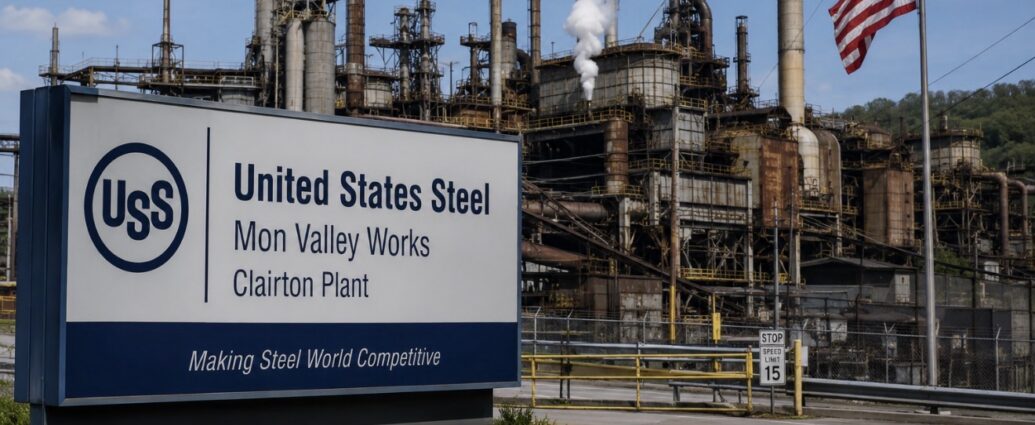
U.S. Steel said in an updated economic impact analysis released June 8 that its Japanese parent, Nippon Steel, will spend between $2 billion and $2.5 billion to overhaul its Mon Valley Works complex in southwestern Pennsylvania over the next three years — more than double the amount the company first committed to when the two firms combined.
The centerpiece is a new, state-of-the-art hot strip mill that would replace an 87-year-old facility and, the company says, secure thousands of steel jobs for decades to come.
The plan calls for building the new mill at the Edgar Thomson plant in Braddock, Pennsylvania, while upgrading other parts of the Mon Valley Works.
The new mill would take the place of an aging hot strip mill at the nearby Irvin plant, which is set to be decommissioned.
U.S. Steel says the modern facility is designed to waste less material, use less energy, and turn out higher-quality steel, including the grades that supply American automakers and other manufacturers.
A hot strip mill is where steel slabs are reheated and rolled into the flat sheets used to make cars, appliances, and building materials — a core step in turning raw steel into finished products.
Modernizing it lets the plant make a wider range of higher-value steel.
The figure marks a sharp increase from the original pledge.
When Nippon Steel was negotiating its purchase of U.S. Steel in August 2024, it promised to spend at least $1 billion on a hot strip mill in the region.
The company is now weighing two larger blueprints — a $2 billion version and a $2.5 billion version — either of which would roughly double that early commitment.
The economic stakes for the region are considerable.
According to the analysis, the project could pump as much as $1.7 billion into Pennsylvania’s economy and support up to 6,381 jobs.
For the Mon Valley, a stretch of old steel towns east of Pittsburgh that has lost industrial work for generations, the spending lands as a rare promise of stable, good-paying employment.
The United Steelworkers union, which represents roughly 75% of U.S. Steel’s North American workforce, saw strong support for the merger among local members in Pennsylvania, in large part because of the investment commitments attached to it.
David Burritt, president and chief executive of U.S. Steel, framed the investment as proof that American steelmaking still has a future.
He said the project protects thousands of jobs and will supply U.S. manufacturers for generations, calling it an example of what investing in America looks like.
He also pointed to the region’s history, noting that the Mon Valley is where the American steel industry was first forged.
That history runs deep.
The Edgar Thomson plant has operated for more than 150 years and is the last integrated steel producer in Pennsylvania still running blast furnaces and basic oxygen furnaces.
It was opened in 1875 by Andrew Carnegie as part of Carnegie Steel, making this modernization a notable chapter for one of the country’s oldest continuously operating mills.
The new spending flows from one of the most closely watched corporate deals in recent years.
Nippon Steel completed its roughly $14.9 billion takeover of U.S. Steel in 2025 after a long and politically charged review.
As part of the agreement, Nippon Steel pledged to invest about $11 billion across U.S. facilities through 2028, keep U.S. Steel’s headquarters in Pittsburgh, and give the U.S. government unusual power to weigh in on major decisions.
The Mon Valley project is one piece of that broader commitment, which spans plants in several states and is meant to protect and create roughly 100,000 jobs.
For U.S. Steel, now the American arm of the world’s fourth-largest steelmaker, the bet is that pouring money into older mills can keep domestic production competitive against cheaper foreign steel and rivals at home.
For the towns around the Mon Valley Works, the more immediate question is simpler: whether the construction, and the jobs that come with it, arrives on schedule.
Pittsburgh — JBizNews Desk
JBizNews Desk / © JBizNews.com All Rights Reserved. Reproduction or distribution without written permission is prohibited.