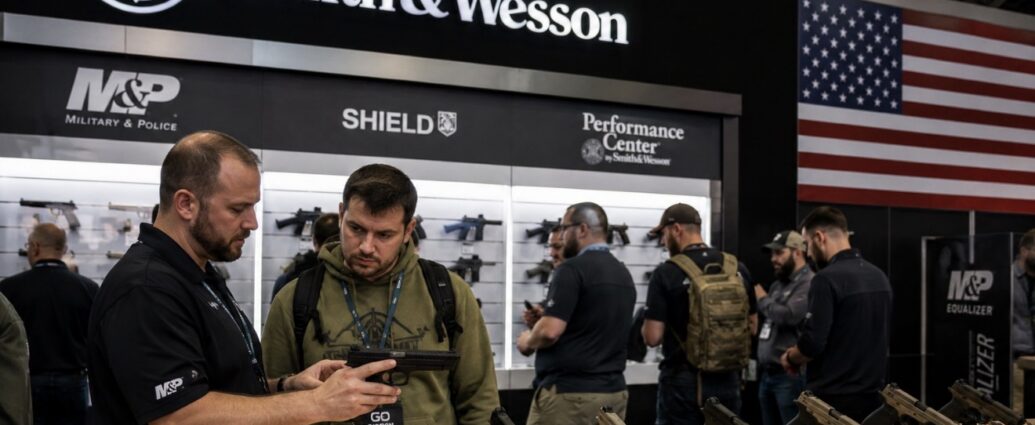
Smith & Wesson Brands reported a sharp jump in sales and profit on Wednesday, and behind the numbers sits a demand story the Maryville, Tennessee gunmaker rarely spells out: a country where fear — much of it driven by a record stretch of antisemitic violence — is sending first-time buyers to gun counters. The company posted results for its fiscal fourth quarter and full year ended April 30, with handguns accounting for the overwhelming majority of shipment growth.
The clearest signal is the gap between the company and the wider market. Handgun shipments into the sporting-goods channel rose 23.2% even as the national background-check measure rose just 1.1%, and handguns made up more than 80% of units shipped. People are not simply buying more guns — particular buyers are, for particular reasons.
One of those reasons runs straight through the American Jewish community.
In its annual audit released May 6, 2026, the Anti-Defamation League called 2025 one of the most violent and deadly years for Jews in the United States, counting 6,274 antisemitic incidents of assault, harassment, and vandalism — an average of 17 incidents per day. The year before, in 2024, the group recorded 9,354 incidents, a record high. “Numbers that would have shocked us five years ago are now our floor,” ADL Chief Executive Jonathan Greenblatt said.
The violence has been concrete and recent.
On May 21, 2025, two Israeli Embassy staffers were shot and killed outside the Capital Jewish Museum in Washington. Days later, on June 1, 2025, a man threw Molotov cocktails at a Run for Their Lives gathering supporting Israeli hostages in Boulder, Colorado, an attack that later claimed the life of an 82-year-old woman. Additional incidents followed, including a truck driven into a synagogue in West Bloomfield, Michigan, in March 2026, and an arson attack at Mississippi’s oldest synagogue in January 2026.
The response has been measurable.
Surveys released in October 2025 by the ADL and the Jewish Federations of North America found that 9% of American Jews had purchased a firearm because of security concerns, while 13% had installed new security systems. For a community historically associated with relatively low rates of gun ownership, the shift is significant.
Organizations have emerged to meet that demand.
Lox & Loaded, a Jewish firearms-training organization founded in March 2025, has expanded to 21 states, 40 chapters, and more than 1,000 members. In April 2026, the group announced a partnership with the National Rifle Association to provide expanded training opportunities and range access. Other organizations, including Magen Am and the Community Security Service, have expanded security training programs for synagogues and Jewish institutions. Collectively, Jewish organizations now spend an estimated $765 million annually on security measures.
The financial results reflect the demand.
Fourth-quarter net sales reached $178.4 million, up 26.7% from a year earlier, while earnings came in at 36 cents per share. Full-year sales totaled $523.8 million, an increase of 10.4%. The board declared a quarterly dividend of 13 cents per share, payable on July 15.
Chief Financial Officer Deana McPherson pointed directly to handguns as the primary driver of performance.
“Our outperformance was mostly driven by handgun shipments, which represented over 80% of our units shipped,” she said.
New products generated 37.5% of fourth-quarter revenue, and management said it expects overall firearm demand to remain relatively stable. President and CEO Mark Smith has credited recent product launches and disciplined pricing for helping drive growth.
The same firearms purchased by some consumers for protection continue to place Smith & Wesson at the center of the national debate over gun violence.
Survivors of the 2022 Highland Park Fourth of July parade shooting have sued the company, alleging it improperly marketed a rifle to vulnerable young men. The case remains active. Earlier this week, the U.S. Supreme Court declined to hear a challenge by gun manufacturers to a New York law allowing the state and private plaintiffs to sue firearm companies over criminal misuse of their products. Smith & Wesson was among the challengers.
The firearms industry argues that such lawsuits conflict with the Protection of Lawful Commerce in Arms Act, a federal law enacted in 2005 that shields manufacturers from many claims arising from criminal misuse of firearms. Gun-control advocates counter that companies should face accountability when marketing or business practices contribute to violence.
For investors, the earnings report highlights a company benefiting from strong demand and favorable product trends. For the broader public, it underscores a more complicated reality: a firearm manufacturer posting some of its strongest results in years while a growing number of Americans — including many Jews who once avoided gun ownership — decide that personal protection has become a necessity.
JBizNews Desk
Wall Street
© JBizNews.com All Rights Reserved. Reproduction or distribution without written permission is prohibited.