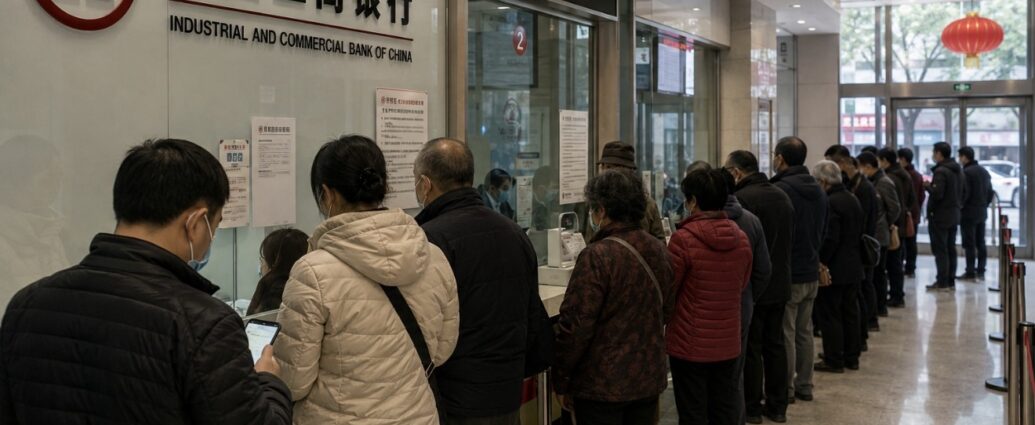
A growing mountain of soured household loans is becoming one of the biggest threats to China’s economy, and the country’s own banks are showing the strain. Industrial & Commercial Bank of China (ICBC) — the world’s largest bank by assets — reported that its bad-loan ratio on personal consumer loans climbed to 2.51% by the middle of last year, while its credit card delinquency rate hit 3.75%. That consumer bad-loan ratio stood at just 1.34% two years earlier.
Those are the figures at China’s strongest lender. At weaker regional banks, the picture is far uglier. Bohai Bank’s consumer bad-loan ratio jumped to 12.37% in 2024 from 4.44% a year earlier, and Harbin Bank’s rose to 5.51%. When more than one in eight consumer loans goes bad, a bank is in real trouble.
The rot is spreading fast enough that Beijing’s regulator has stepped in. The National Financial Regulatory Administration extended a program through the end of 2026 that lets banks bundle their bad personal loans and sell them to asset managers — a pressure valve to get the debt off bank books. Sales of these distressed personal loans more than doubled in the first half of 2025 from a year earlier. By the end of 2024, banks had packaged some 1.18 trillion yuan — roughly $165 billion — of troubled retail loans into securities, most of it tied to credit cards and unsecured consumer borrowing.
Here is the alarming part: this debt is being dumped at fire-sale prices. In early 2025, bad personal loans were selling for only about four cents on the yuan, meaning banks were recovering pennies on what they were owed. With no personal bankruptcy law in China and courts buckling under millions of retail debt cases, lenders would rather take a deep loss than chase borrowers who cannot pay.
How did the world’s second-largest economy get here? It starts with the property crash, which wiped out household wealth as apartments lost value. Then came deflation: China has been stuck in falling prices for roughly ten straight quarters, which makes every debt harder to repay because borrowers pay back loans with money that buys more than it used to. Layer on wage cuts across finance, manufacturing, and government jobs, plus worry over tariffs and incomes, and you get households that are tapped out and scared.
Scared people stop spending. A central bank survey found that 61.4% of Chinese households now want to boost their savings — nearly 20 percentage points higher than before the pandemic. Hoarding cash is rational for any one family, but for the economy it is poison: weak spending feeds more deflation, which sours more debt, which makes everyone more cautious still.
It is worth keeping perspective. By global standards, Chinese household debt is not extreme — about 60% of economic output, below the roughly 70% in the United States and far below South Korea — and economists worry less about the total than about how fast the bad loans are climbing. As ING economist Lynn Song put it, “Income growth-driven consumption would be strongly preferable” to a recovery propped up by more borrowing — but raising incomes is the harder path, and Beijing has leaned on lending instead.
The consumer mess sits inside a far bigger problem. Estimates suggest China’s banking system is carrying trillions of dollars in hidden bad debt, masked by policies that allow struggling borrowers to defer payments rather than default — keeping official bad-loan rates relatively stable while avoiding a broader banking panic. The tradeoff is that capital remains tied up in struggling borrowers and unproductive sectors rather than flowing to healthier parts of the economy. As Victor Shih, a China finance expert at the University of California San Diego, observed, “There’s no financial crisis, but there’s no free lunch in economics. The price is just growth, inefficiency and low productivity.”
For Americans, this is not a far-off story. A weak Chinese consumer pushes Beijing to lean harder on exports, flooding global markets with cheap goods and squeezing manufacturers elsewhere. And a China that cannot get its own people to spend buys less from everyone else. The pile of bad consumer debt is President Xi Jinping’s problem first — but in a connected world, a stalled Chinese consumer eventually shows up in everyone’s economy.
JBizNews Desk
Hong Kong
© JBizNews.com All Rights Reserved. Reproduction or distribution without written permission is prohibited.