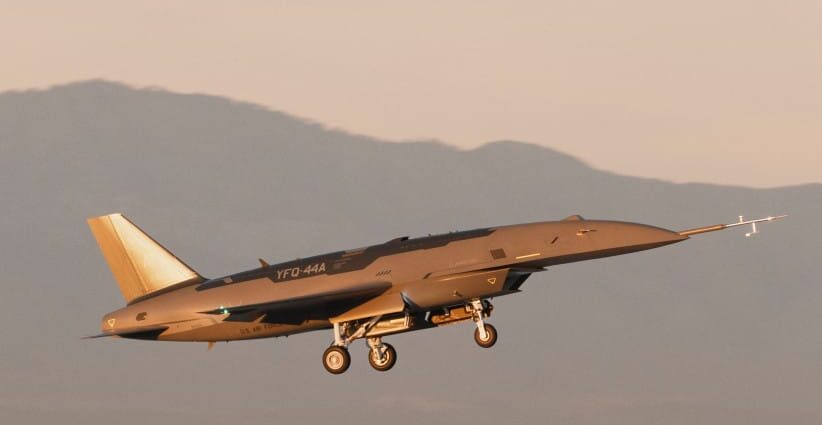
The US Air Force on Wednesday awarded production contracts to General Atomics and Anduril Industries to build its first fleet of semi-autonomous Collaborative Combat Aircraft (CCA), moving a program that began just over two years ago from prototype to full-scale manufacturing.
The department awarded production contracts to both companies — General Atomics for the FQ-42 and Anduril for the FQ-44, the Air Force said, without disclosing the cost or size of the order.
The contracts were awarded months ahead of schedule, a sign that both aircraft meet mission requirements and are ready for manufacturing.
“By moving fast from competitive selection into full-scale manufacturing, we position ourselves to field highly credible and combat-ready semi-autonomous systems to stay ahead of the pacing challenge,” said Secretary of the Air Force Troy Meink. “These contracts reaffirm our confidence in the strategic path forward for the program to procure over 150 combat capable CCA by the end of the decade.”
In a press release, Anduril said that the contract “establishes a structure for the Air Force to buy additional lots of production FQ-44 aircraft across the next several years, providing a clear path for the Air Force to rapidly and affordably expand fighter capacity.”
According to the company, the timeline from prototype award in April 2024 to production contract represents the fastest path from prototype to production for a fighter aircraft in more than 50 years.”
Alongside the hardware contracts, the Air Force simultaneously moved forward on the software side of the program, awarding mission autonomy production contracts to a pool of six vendors: Anduril, General Atomics, Lockheed MartinLMT.N, Northrop GrummanNOC.N, RTX’s RTX.N Collins Aerospace, and Shield AI.
In a notable departure from traditional Pentagon procurement, the Air Force is pursuing a strategy it calls “software sold separately,” deliberately decoupling the purchase of the CCA’s mission autonomy software from its airframe.
CCA is key component
The CCA program is a key component of the USAF’s future force design, intended to distribute combat power, reduce risk to human pilots, and expand the reach of crewed aircraft that are intended to serve as force multipliers and expand the lethality of manned aircraft, such as the F-35 and Boeing’s F-47 fighter jet for the Next Generation Air Dominance (NGAD) platform that will replace the F-22 raptor.
The Air Force ultimately intends to field about 1,000 combat-capable CCA, using continuous competition among vendors to drive down costs while scaling fighter capacity. According to Anduril, the production line is currently capable of delivering up to 150 aircraft per year.
The CCA program emphasizes human-machine teaming, allowing pilots to command multiple autonomous aircraft that can scout ahead, engage targets, and absorb enemy fire. CCAs offer a cost-effective means of expanding airpower, allowing militaries to deploy large numbers of capable aircraft without the logistical and human constraints of traditional fleets.
Their AI-driven autonomy enables rapid decision-making and mission adaptability, particularly in scenarios where communication may be degraded or denied. Moreover, by placing unmanned systems in high-risk roles, commanders can reduce the exposure of human pilots to hostile fire, thereby enhancing survivability and operational resilience.
The YFQ‑44A and related platforms will eventually support missions ranging from electronic warfare and surveillance to strike operations, depending on the needs of the battlespace.