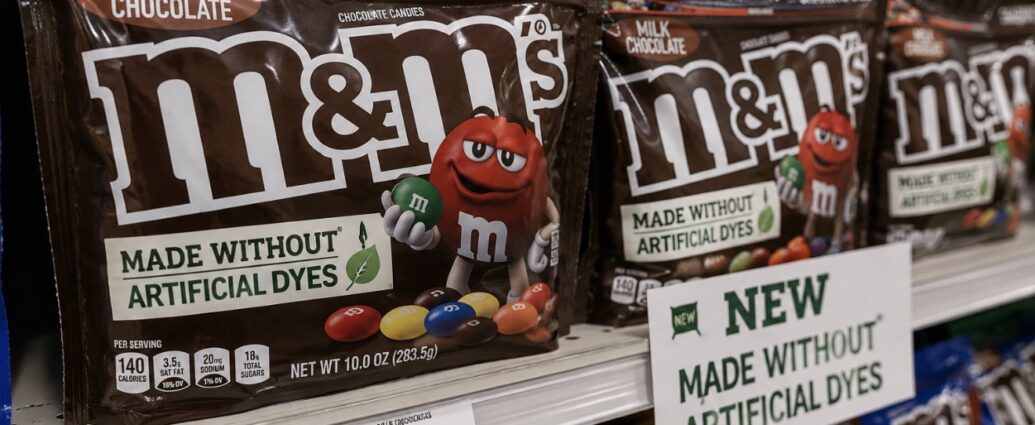
Mars Wrigley North America is moving forward with plans to sell dye-free versions of some of its most recognizable candy brands, marking a significant shift for a company that previously resisted removing artificial colors from its products.
The initiative, first announced in July 2025 and now rolling out during 2026, will introduce versions of M&M’s Chocolate, Skittles Original, Starburst Original, and Extra Spearmint Gum made without synthetic petroleum-based food dyes. The move aligns with growing pressure from regulators, lawmakers, and consumer advocates associated with the Make America Healthy Again (MAHA) movement championed by Health and Human Services Secretary Robert F. Kennedy Jr.
The reformulated products will be sold alongside existing versions rather than immediately replacing them nationwide.
According to Anton Vincent, President of Mars Wrigley North America, the company’s approach is intended to be both “consumer-focused and science-led.”
The announcement represents a notable reversal from Mars’s earlier position.
In 2016, the company pledged to remove artificial colors from its global food portfolio within several years. That commitment was later scaled back after Mars concluded many consumers did not view synthetic dyes as a major concern.
At the time, the company said its research showed that many customers around the world did not consider artificial colors to be ingredients they actively sought to avoid.
Since then, however, the political and regulatory environment has changed dramatically.
The Food and Drug Administration (FDA) banned Red No. 3 from foods in early 2025, requiring manufacturers to remove the additive by 2027. Federal regulators have also encouraged food manufacturers to reduce reliance on other synthetic dyes, including Red 40, while approving additional natural coloring alternatives derived from fruits, vegetables, and other natural sources.
Several states have enacted laws limiting or banning artificial food dyes in school meals, further accelerating industry reformulation efforts.
The issue has also drawn legal scrutiny.
Texas Attorney General Ken Paxton launched an investigation into Mars, seeking company records and questioning why some products sold in Europe already use alternative formulations while U.S. versions continue to contain artificial dyes. Paxton directly linked the inquiry to broader MAHA health initiatives and called on manufacturers to move more aggressively toward reformulation.
For food companies, replacing synthetic dyes is not a simple or inexpensive process.
Natural color alternatives often provide less vibrant colors, can be less stable over time, and frequently have shorter shelf lives than synthetic additives. Supply chains for natural color ingredients are also more limited, creating additional cost pressures as demand increases across the industry.
The National Confectioners Association has warned that large-scale transitions away from synthetic dyes could significantly increase manufacturing costs and strain supplies of natural coloring ingredients.
Despite those challenges, much of the industry is already moving in the same direction.
Kraft Heinz, General Mills, PepsiCo, ConAgra, The Hershey Company, Nestlé USA, McCormick, and J.M. Smucker have all announced plans to reduce or eliminate artificial food dyes, with most targeting completion between 2027 and 2028.
That leaves Mars no longer as an outlier but as part of a broader transformation sweeping through the American food industry.
For consumers, the rollout comes with an important distinction: the traditional versions of these products are not disappearing immediately. Instead, Mars is initially introducing dye-free alternatives and allowing shoppers to choose between the two.
The scientific debate surrounding food dyes also remains unresolved. The FDA continues to maintain that approved food-color additives are safe for most consumers when used as directed. However, some researchers and health advocates point to studies suggesting certain artificial dyes may contribute to hyperactivity and behavioral issues in a subset of children.
As a result, the shift is being driven not only by science, but also by changing consumer preferences, political pressure, and evolving market expectations.
For Mars, a privately held company generating tens of billions of dollars in annual revenue, the calculation appears increasingly straightforward: the cost of reformulation may now be lower than the reputational risk of resisting a trend that is rapidly gaining momentum among regulators, lawmakers, and consumers.
Whether the dye-free versions ultimately replace the originals remains to be seen. But one thing is clear: the candy aisle is becoming the latest battleground in America’s growing debate over food ingredients and public health.
JBizNews Desk
© JBizNews.com All Rights Reserved. Reproduction or distribution without written permission is prohibited.